Moses and Jesus in the Providence of Restoration
Moses and Jesus in the Providence of Restoration
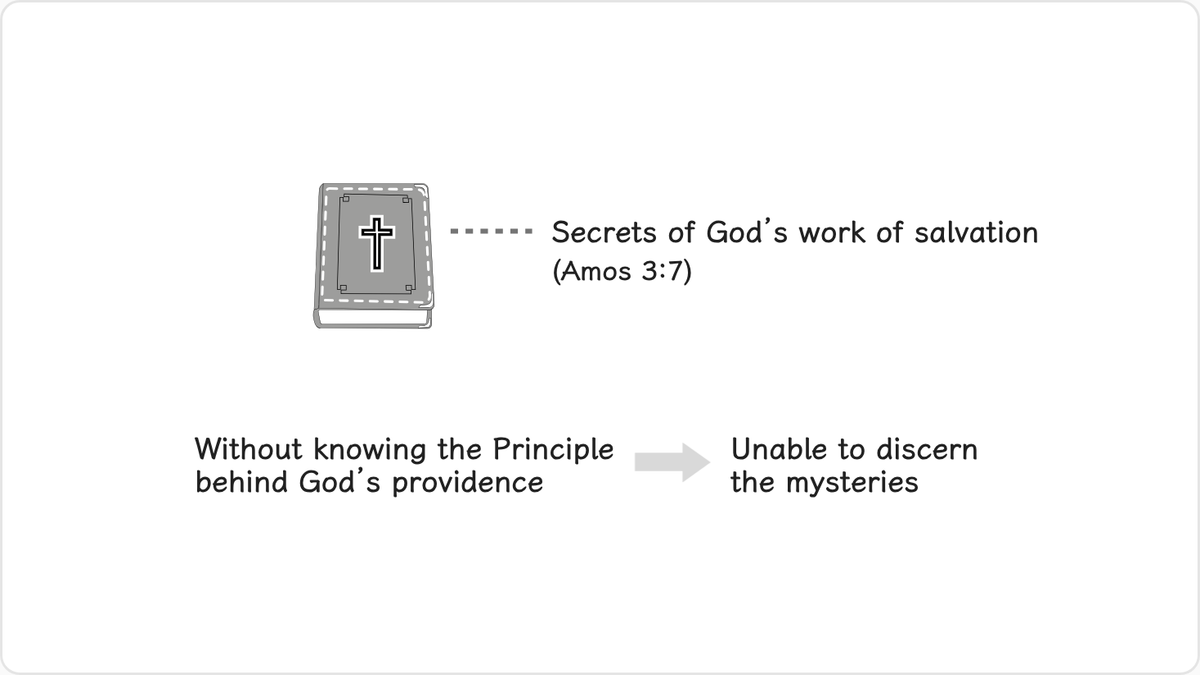
- The Bible contains many secrets concerning God’s work of salvation. It is written, “Surely the Lord God does nothing, without revealing his secret to his servants the prophets” (Amos 3:7).
- However, without knowing the principle behind God’s providence, people have been unable to discern the mysteries concealed in the Bible.
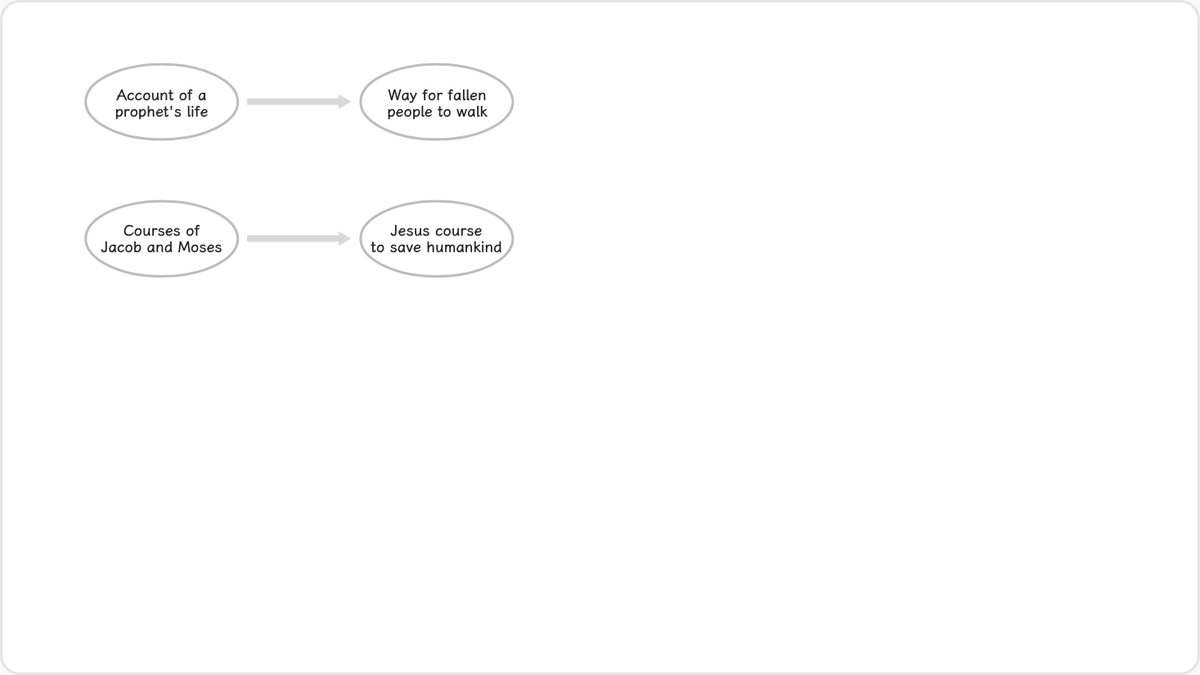
- The biblical account of a prophet’s life is not merely a record of history. Rather, through the life course of a prophet, the Bible discloses the way for fallen people to walk.
- In particular, we shall examine how God set up the providential courses of Jacob and Moses as models for Jesus’ course to save humankind.
The Model Courses for Bringing Satan to Submission
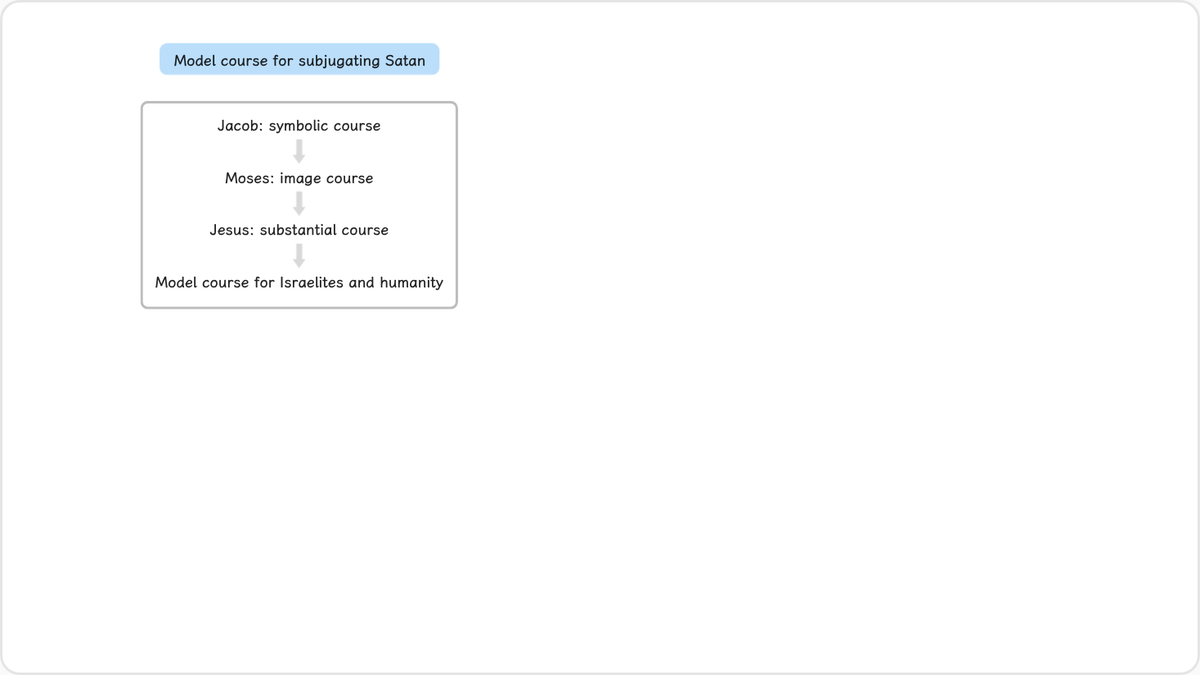
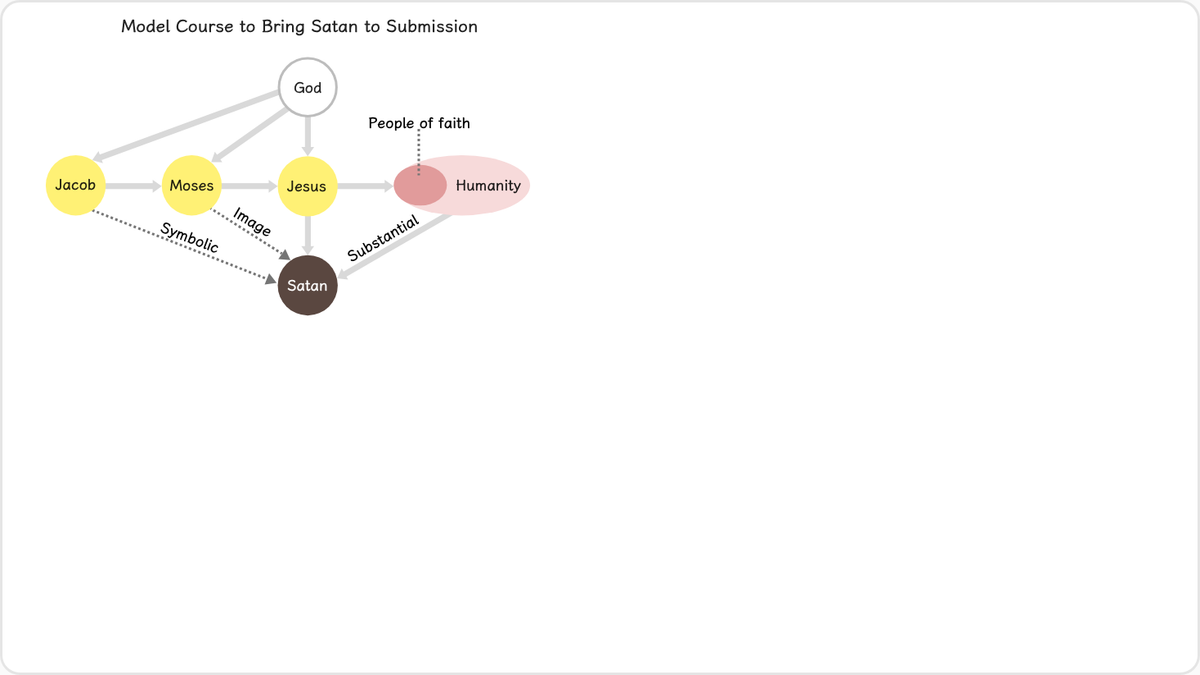
- Jacob’s entire course became the model course for Moses and Jesus.
- Moses walked a course for the subjugation of Satan that was the image of the course Jesus would walk.
- Jesus came to bring Satan to submission in substantial terms.
- Still earlier, God had Jacob walk a course that was a symbolic representation of Jesus’ course.
- Moreover, Jacob’s course is the model for the course which the Israelites and all of humanity must walk to bring Satan to submission and attain the goal of the providence of restoration.
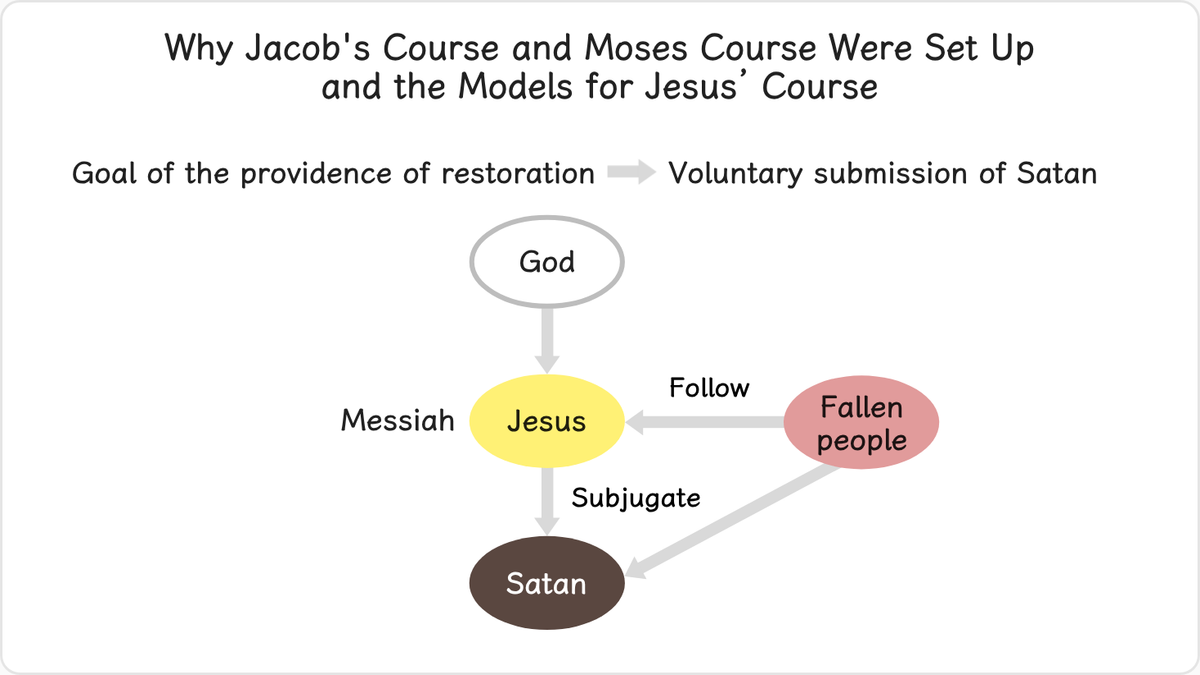
- The goal of the providence of restoration is attained when human beings bring Satan to voluntary submission and become his master.
- They must do this by fulfilling their given portion of responsibility.
- Jesus, as the Messiah and the true human ancestor, pioneered the course to bring Satan to complete submission and has since guided people of faith to follow his example.
- Satan, who does not meekly surrender even before God, would by no means readily surrender to Jesus, much less to ordinary believers.
- Therefore, God, who takes responsibility for human beings, whom He created, called upon Jacob and worked through him to show us, in symbolic form, the course for bringing Satan to submission.
- Moses was able to subjugate Satan by following the pattern of the model course which was revealed symbolically in Jacob’s course.
- Similarly, by building on the pattern of Moses’ course, Jesus came to substantially bring Satan to submission.
The Providence of Restoration under the Leadership of Moses
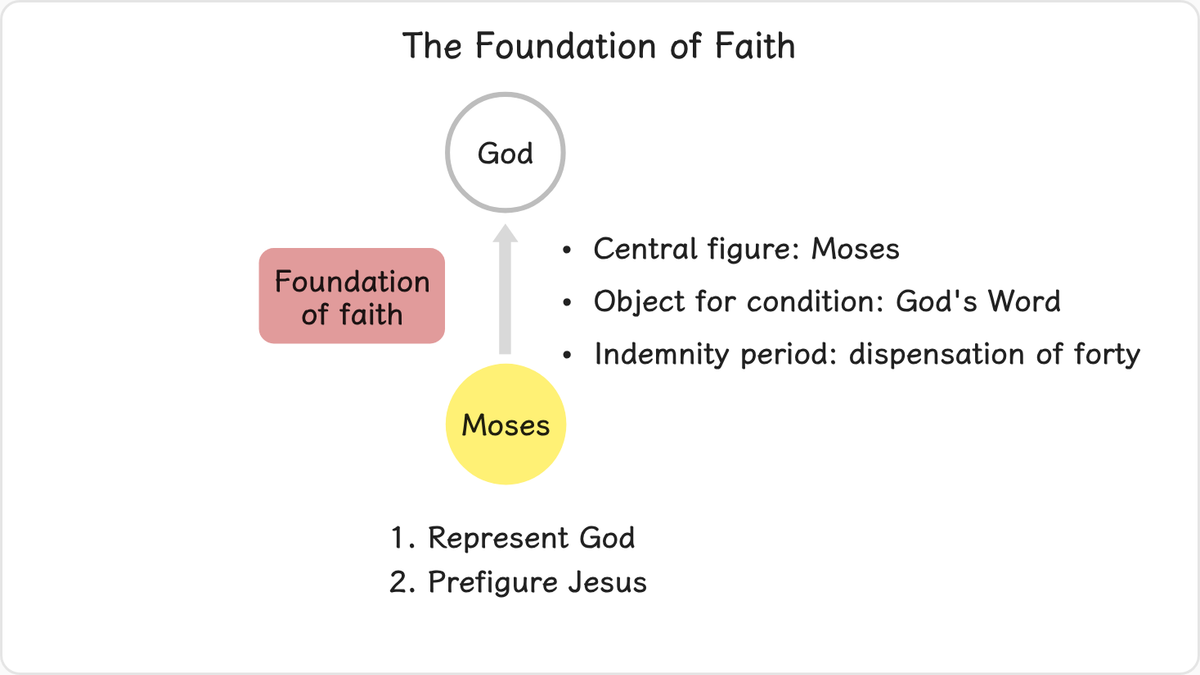
- Moses was the central figure to restore the foundation of faith.
- A foundation of faith had to be laid anew to begin the course to return to the promised land of Canaan upon the conclusion of the four hundred years of slavery.
- Moses was different from all the previous central figures who were called to lay the foundation of faith.
- First, Moses was put in the position representing God, acting in His stead.
- Second, God set up Moses to prefigure Jesus.
- Unlike Abel, Noah and Abraham, Moses did not need to make a symbolic offering.
- Rather, he could restore the foundation of faith merely by obedience to God’s Word while fulfilling a dispensation of forty for the separation of Satan.
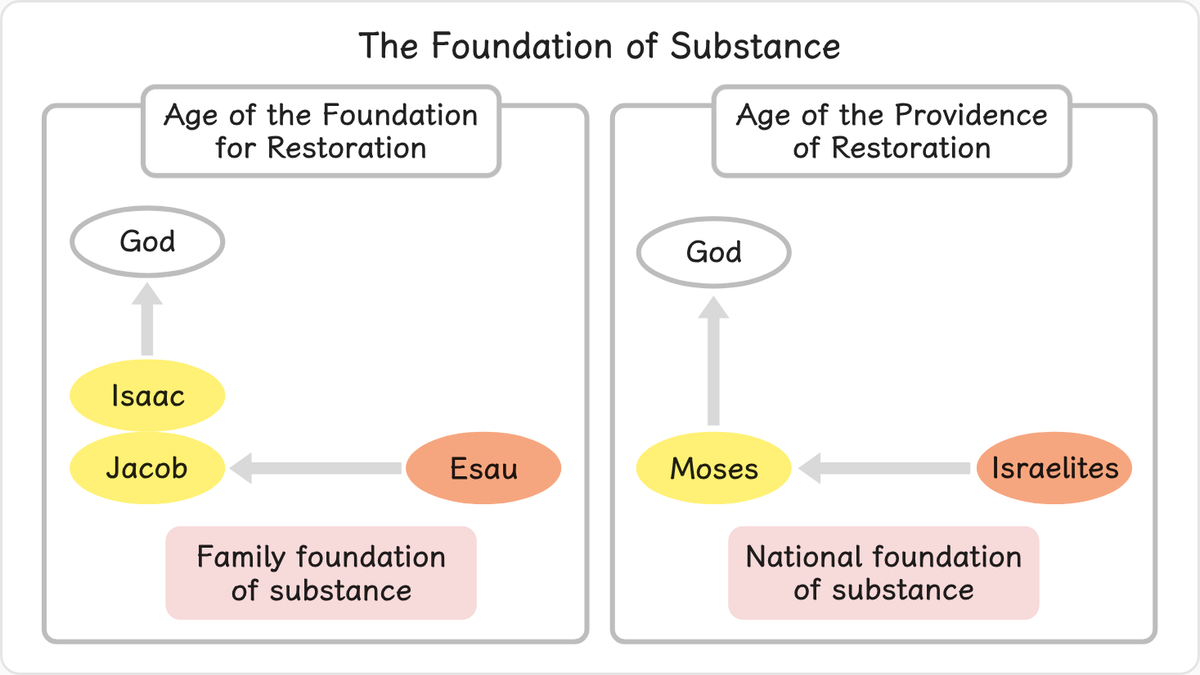
- In the Age of the Providence to Lay the Foundation for Restoration, God worked to lay the family foundation of substance.
- Upon entering the Age of the Providence of Restoration, God worked to lay the national foundation of substance.
- Once Moses had secured the position of Abel, the Israelites, standing in the position of Cain, were supposed to fulfill the national indemnity condition to remove the fallen nature through their obedience to Moses.
- By doing so, they would establish the national foundation of substance.
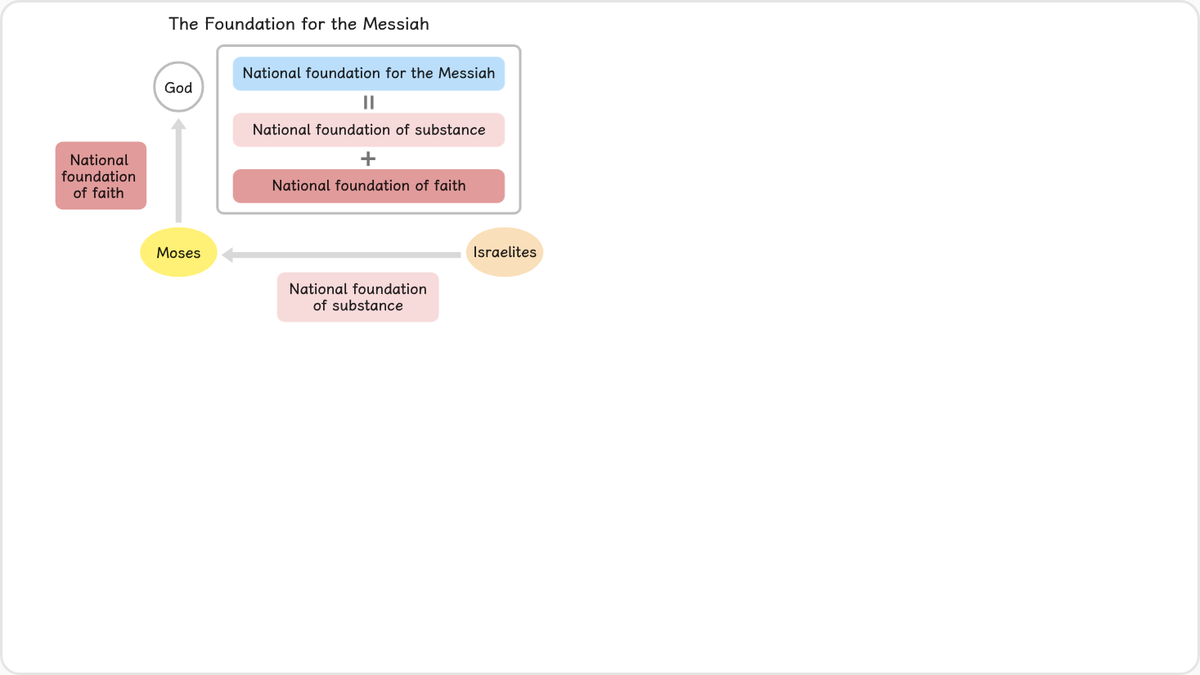
- Moses was to restore through indemnity the national foundation of faith,
- and the Israelites under Moses’ leadership were to restore through indemnity the national foundation of substance.
- This would have constituted the national foundation for the Messiah.
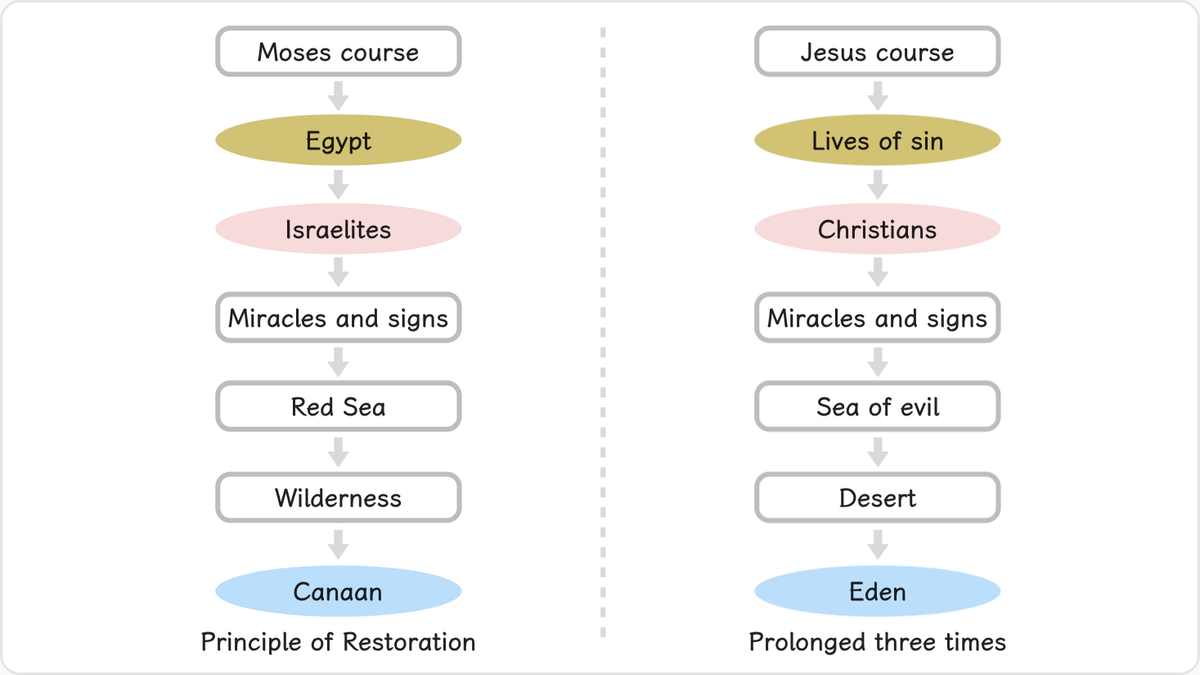
- Moses brought the Israelites out of Egypt, the satanic world,
- with miracles and signs, led them across the Red Sea,
- and had them wander through the wilderness before entering the promised land of Canaan.
- This foreshadowed the course on which Jesus would one day lead Christians, the Second Israel.
- With miracles and signs, Jesus would bring Christians out of lives of sin and lead them safely across the troubled sea of evil.
- He would take them through a desert devoid of life-giving water before guiding them into the Garden of Eden of God’s promise.
- Both courses were prolonged three times because of the Israelites’ faithlessness.
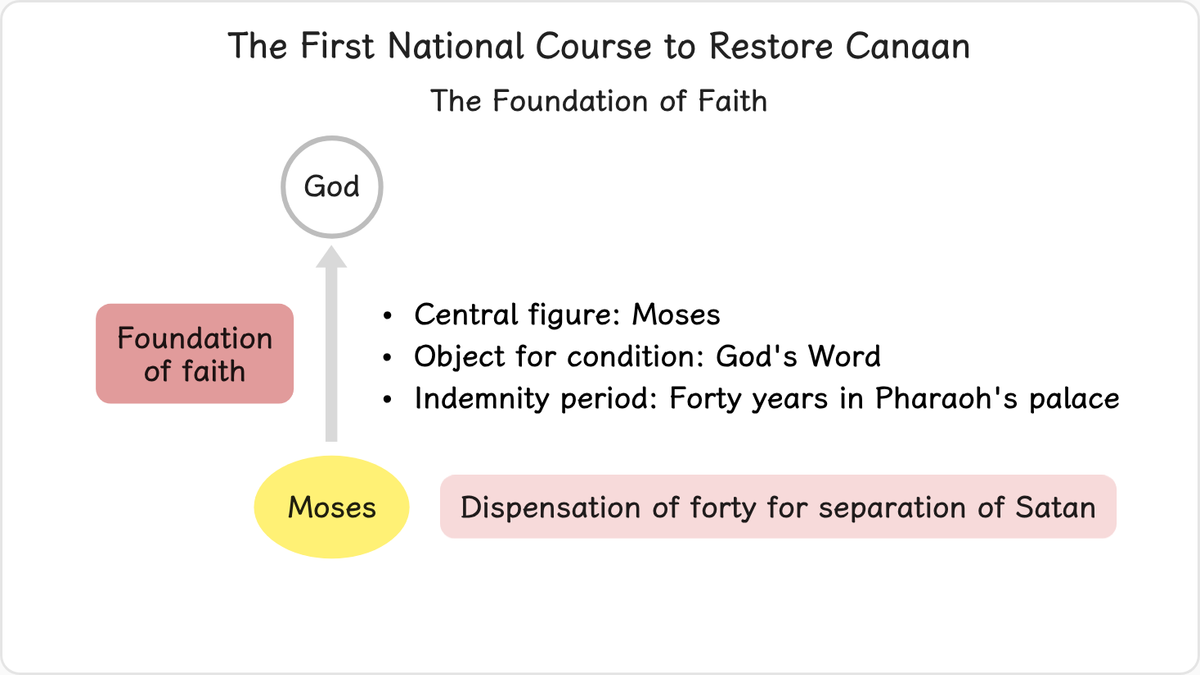
- In order for Moses to become the central figure to restore the foundation of faith and be qualified to lead the Israelites out of Egypt,
- he as an individual had to inherit the 400-year national indemnity period and complete a dispensation of 40 for the separation of Satan.
- To achieve these purposes, Moses was brought into the Pharaoh’s palace, the center of the satanic world, and he spent forty years there.
- During the forty years of his life in the Pharaoh’s palace, Moses fulfilled the dispensation of forty for the separation of Satan and thereby restored the foundation of faith.
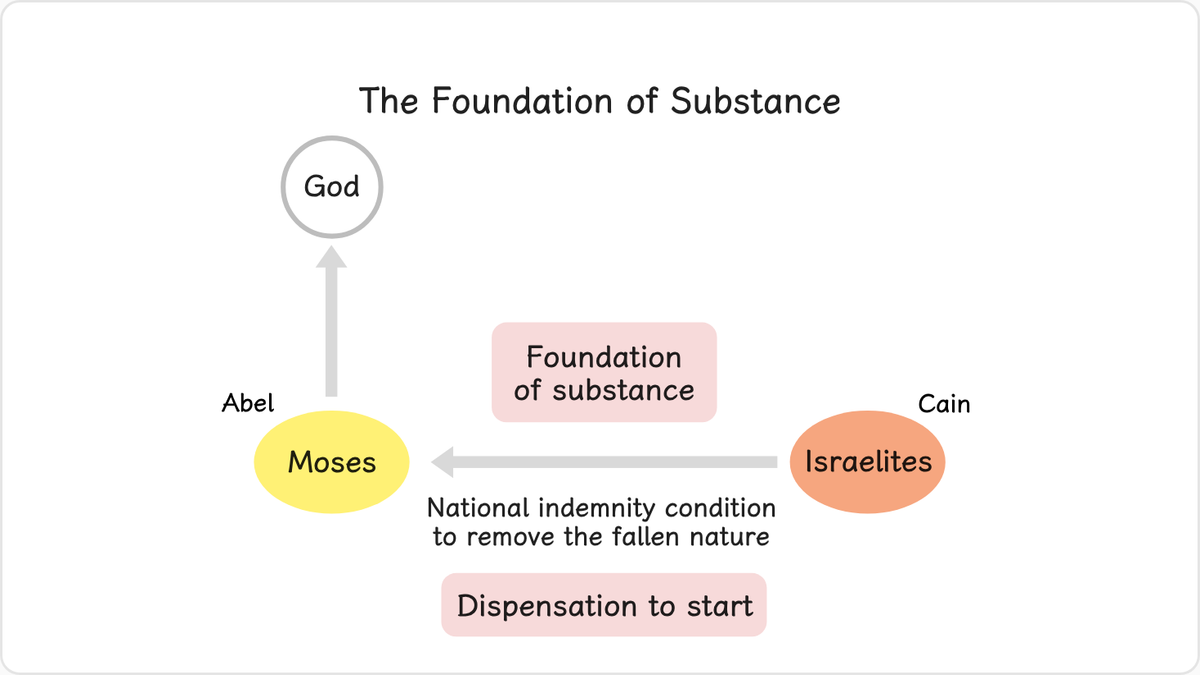
- The Israelites, who were in the position of Cain, were supposed to follow and obey Moses in faith, who had secured the position of Abel.
- By inheriting God’s Will from Moses and multiplying goodness, they would fulfill the national indemnity condition to remove the fallen nature and lay the national foundation of substance.
- The Israelites were to lay the foundation of substance by following Moses from the time they left Egypt until they entered the blessed land of Canaan.
- God commenced the dispensation to start the course with Moses’ act of killing an Egyptian.
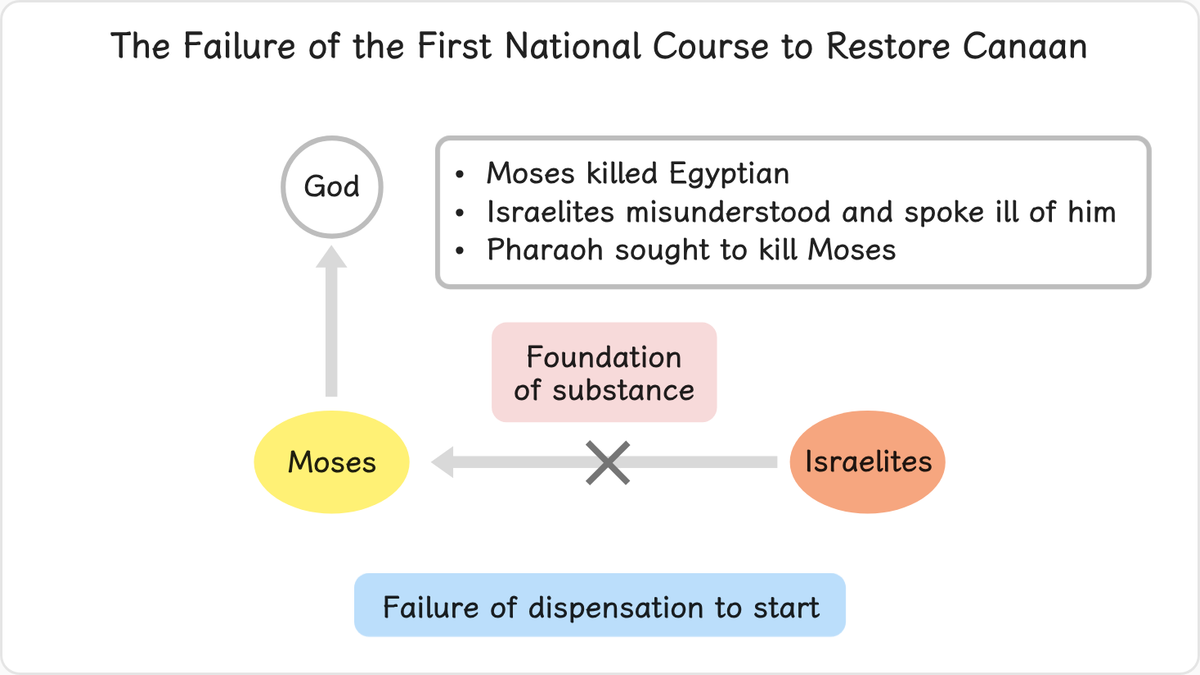
- Seeing one of his brethren being mistreated by an Egyptian taskmaster, Moses was incited by his burning love for his people; he struck and killed the man.
- When the Israelites saw Moses strike and kill the Egyptian, they misunderstood him and spoke ill of him.
- When Pharaoh heard of it, he sought to kill Moses. Reluctantly forsaking the Israelites, Moses fled into the wilderness of Midian.
- The foundation of substance was shattered, and the first national course to restore Canaan failed.
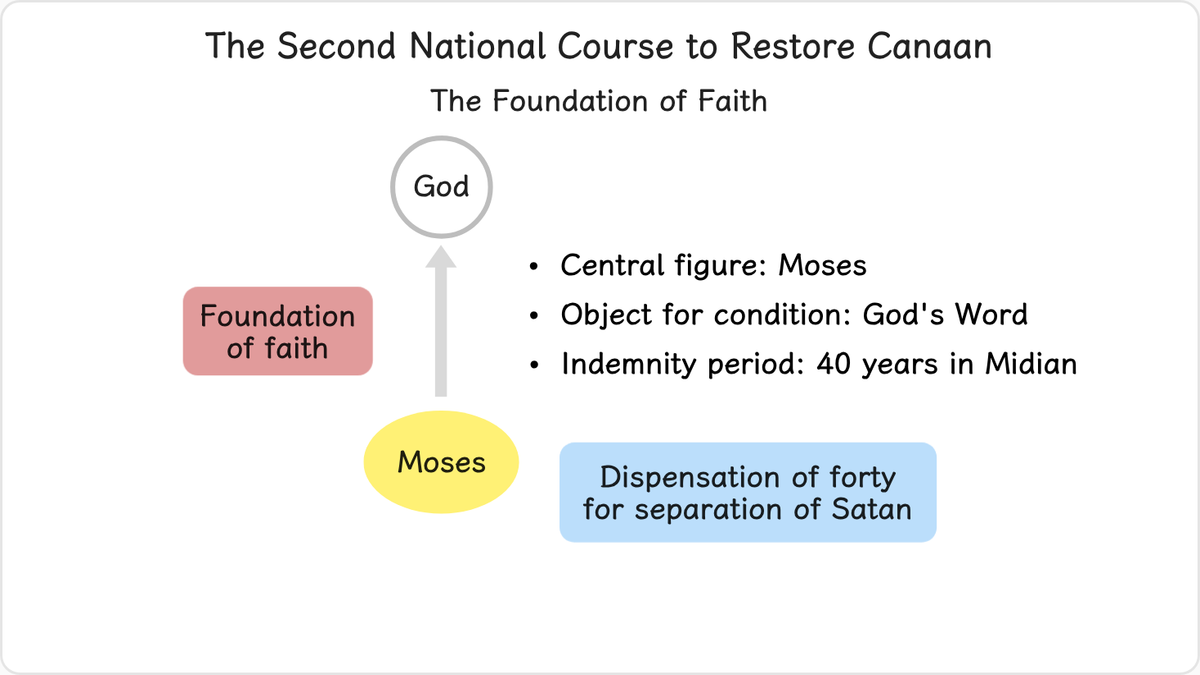
- When the first national course to restore Canaan ended in failure, Satan claimed the forty years of Moses’ life in Pharaoh’s palace.
- Hence, for Moses to begin the second national course to restore Canaan, he had to lay anew the foundation of faith by completing another period of forty years to restore through indemnity his lost forty years in the palace.
- Moses went through a second dispensation of forty for the separation of Satan during the forty years he spent in the wilderness of Midian.
- There he restored the foundation of faith needed to embark upon the second national course to restore Canaan.
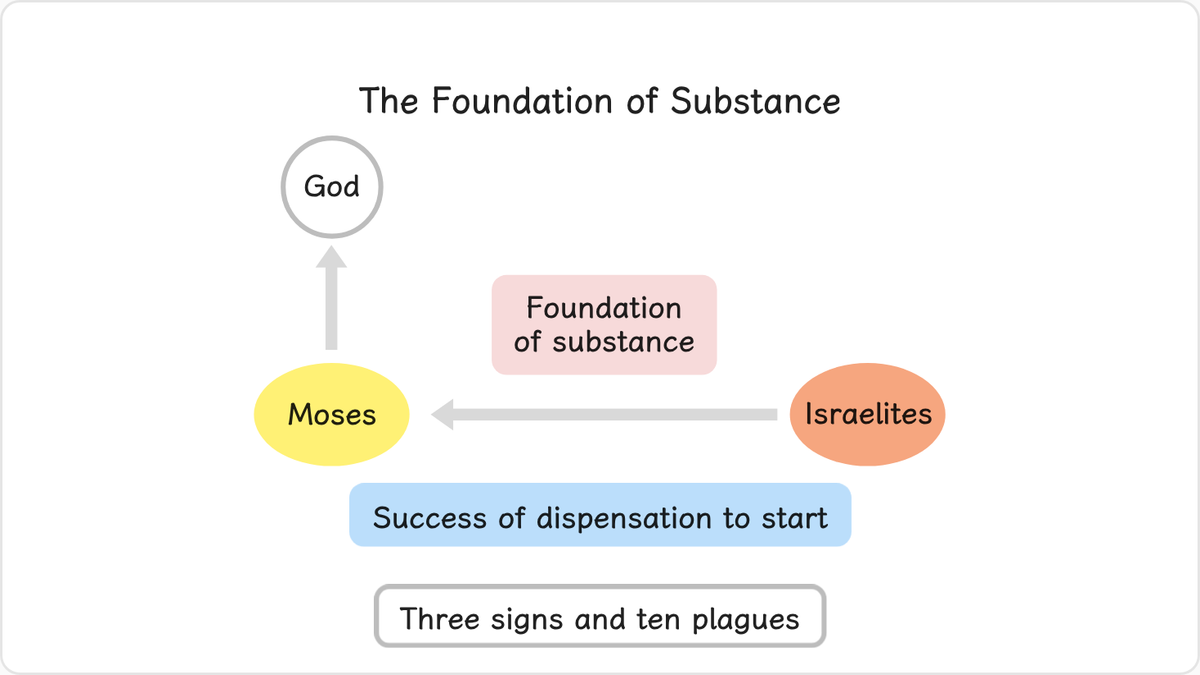
- To work the dispensation to start the second national course to restore Canaan, God granted Moses three signs and ten plagues with which to prevail over the Egyptians.
- The Israelites believed and followed Moses. Hence, the Israelites could embark upon the second national course to restore Canaan.
- The Israelites had to remain faithful and obedient to Moses for the duration of their journey.
- Until they had traversed the wilderness with unwavering faith in Moses and entered the land of Canaan, the national foundation of substance would not be established.
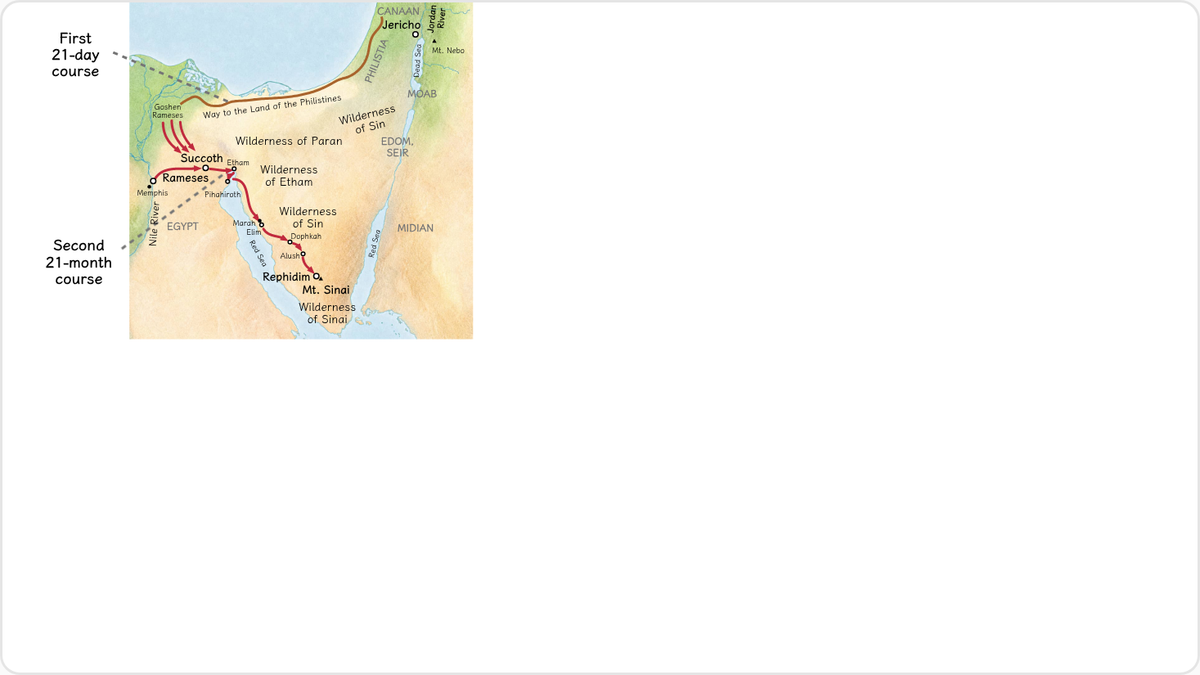
- In the first course, if the Israelites had followed Moses, they would have been led along the direct route by way of the land of the Philistines and would have entered Canaan in twenty-one days.
- This was a period corresponding to Jacob’s 21-year course in Haran.
- However, in the second course, God did not lead the people along the direct route.
- He was worried that when they encountered the warlike Philistines, they might again turn faithless and return to Egypt.
- Hence, God led them across the Red Sea and through the wilderness in a long detour. God planned to bring them into Canaan after twenty-one months.
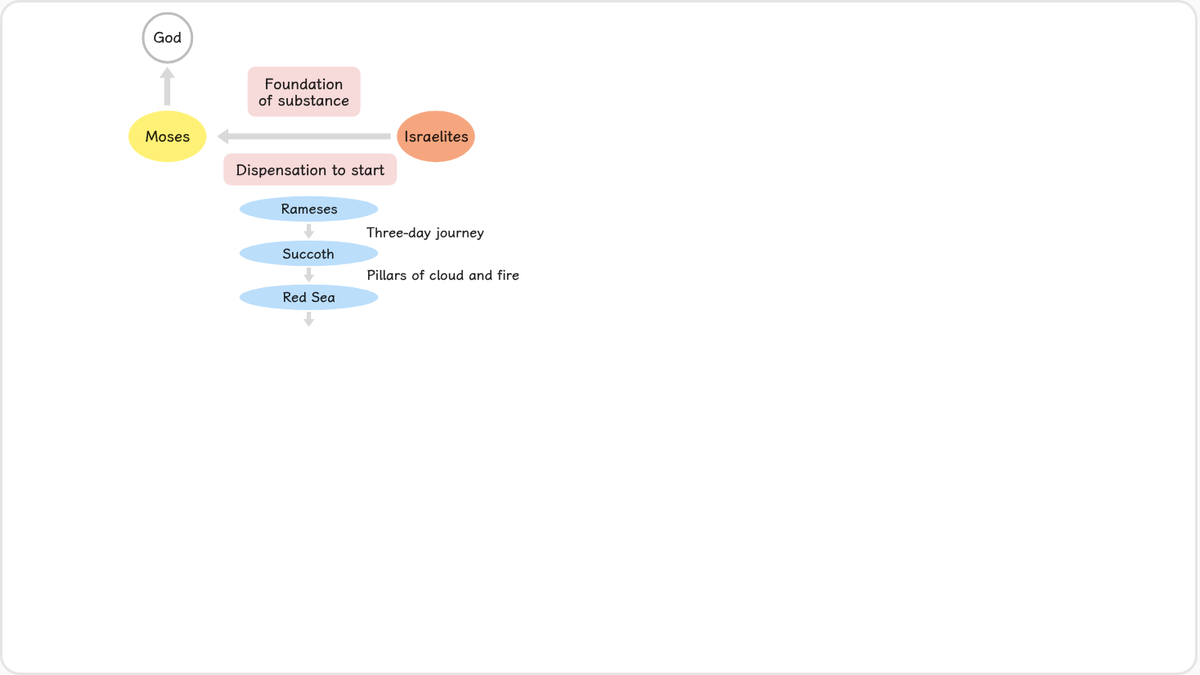
- In order to start the national course, Moses asked for a leave of three days with the intention of deceiving the Pharaoh and liberating his people from bondage.
- The Israelites departed from Rameses and upheld God’s Will throughout the 3-day journey to their first campsite at Succoth.
- At the shore of the Red Sea, upon God’s command, Moses stretched out his staff and parted the waters; then he led the Israelites across on dry ground.
- The Egyptians chasing them in chariots were drowned when the waters closed up and engulfed them.
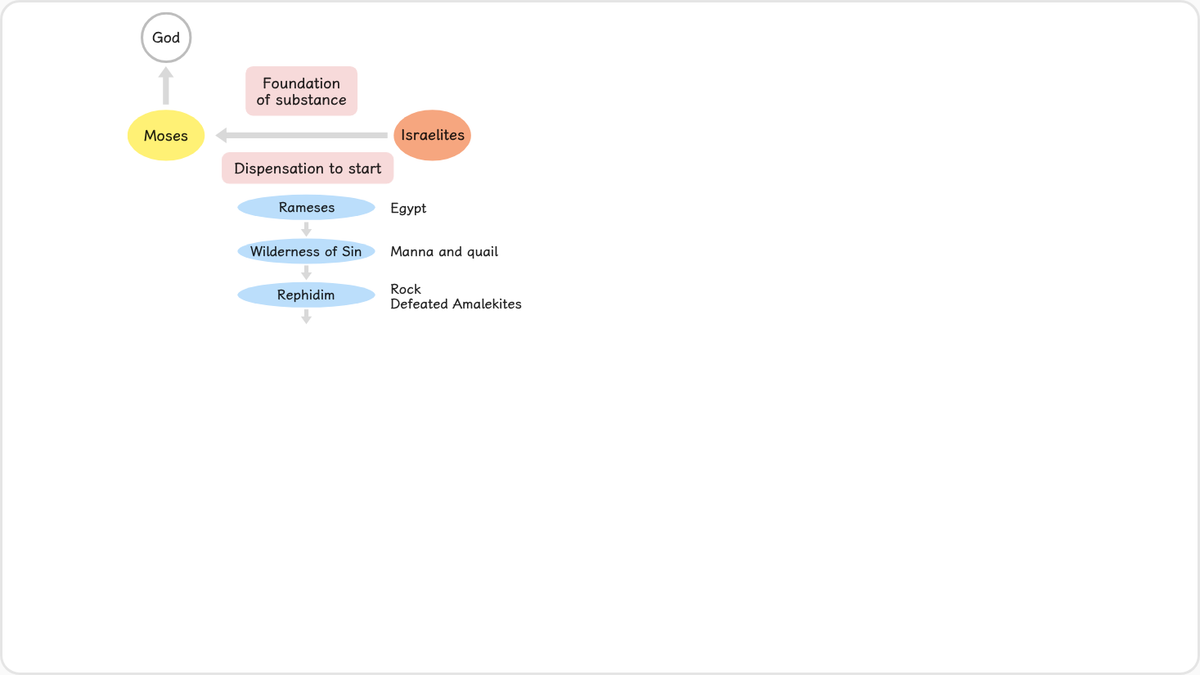
- The Israelites arrived at the wilderness of Sin. From then, God fed them with manna and quail.
- When the Israelites camped at Rephidim, there was no water for the people to drink.
- God commanded Moses to strike the rock at Horeb that water might spring forth from it.
- Moses did so and gave the people water which saved their lives (Exod. 17:6).
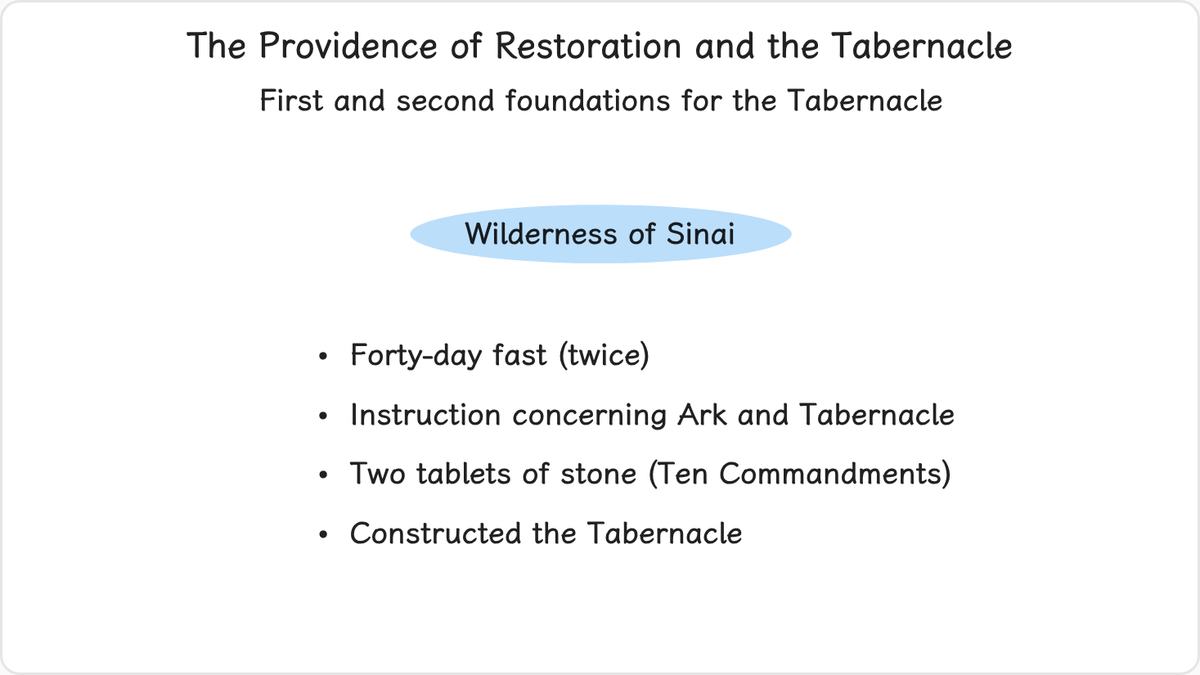
- The Israelites arrived in the wilderness of Sinai. Moses then took seventy elders and climbed Mt. Sinai to meet God.
- During his 40-day fast, Moses received God’s instructions concerning the Ark of the Covenant and the Tabernacle.
- When the forty-day fast was over, Moses received two tablets of stone, inscribed by the finger of God with the Ten Commandments.
- However, when Moses came down from Mt. Sinai and went before the Israelites, he found them worshipping a golden calf.
- His anger burned hot when he saw this. He threw down the tablets of stone and broke them at the foot of the mountain (first failure).
- Then, after Moses fasted for 40 days a second time, God dictated the Ten Commandments to Moses, and Moses wrote them on the tablets.
- Moses took these tablets and went before the Israelites again.
- This time they honored Moses. In obedience to his directions, they built the Ark of the Covenant and constructed the Tabernacle.
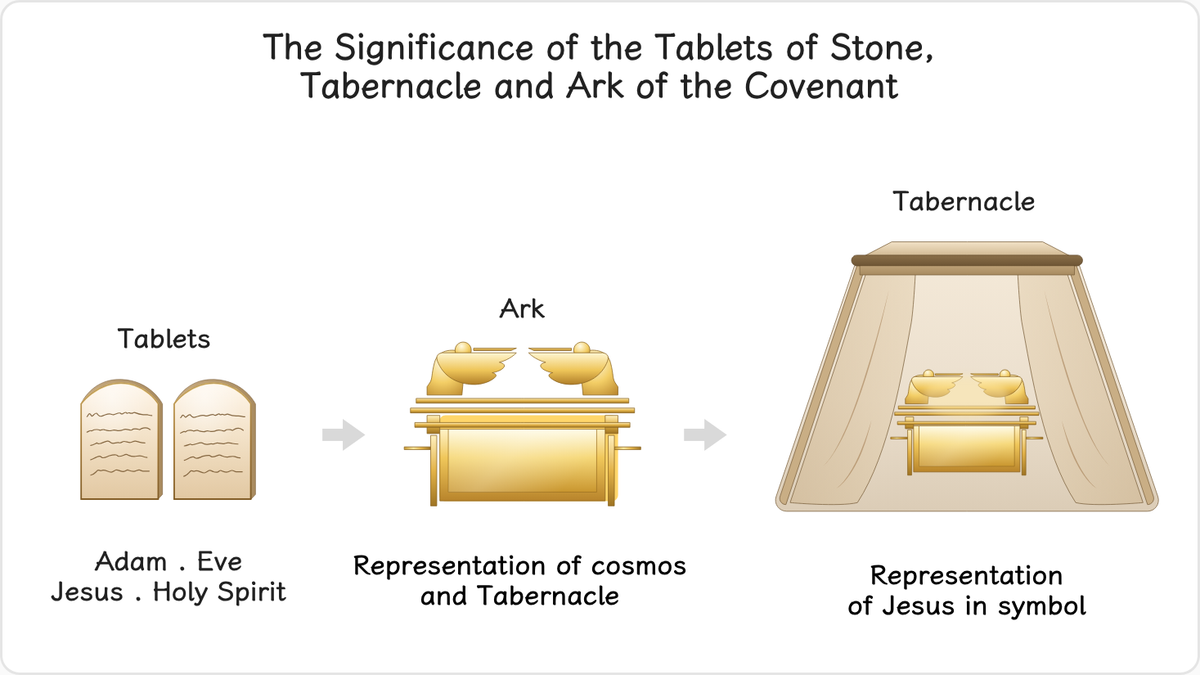
- The two tablets, inscribed with the Word, symbolized restored Adam and Eve, and also symbolized Jesus and his would-be Bride (Holy Spirit).
- The Tabernacle was a representation of Jesus in symbol.
- The Ark of the Covenant represented the cosmos and, at the same time, was a smaller representation of the Tabernacle.
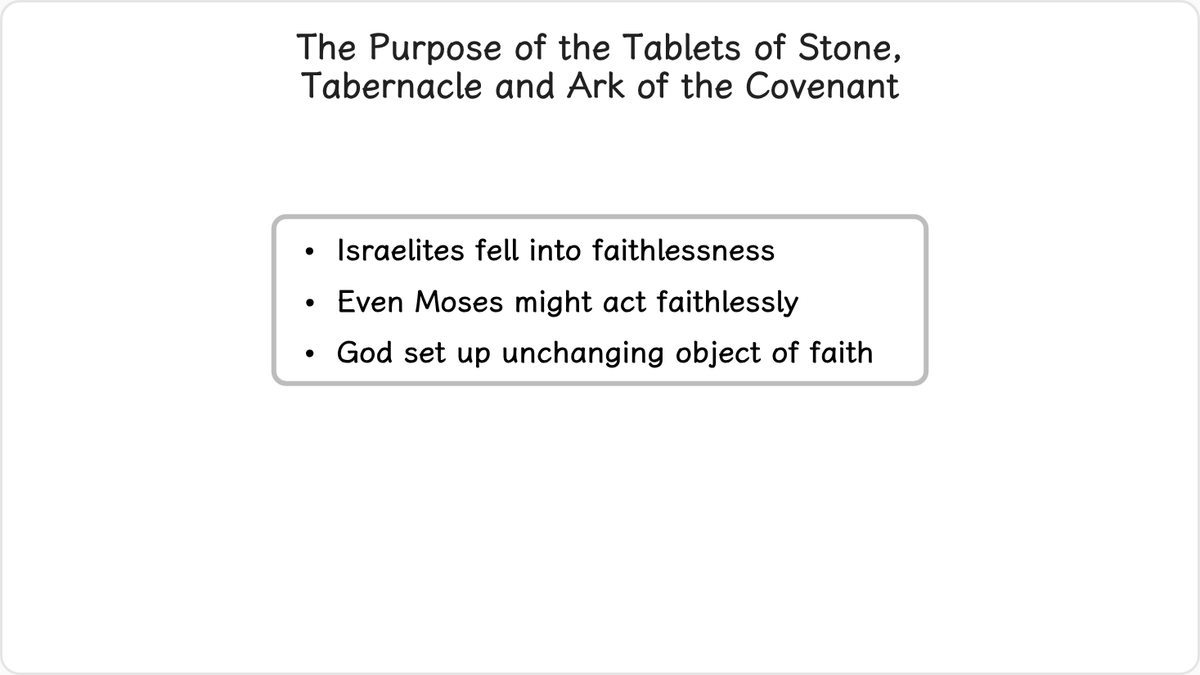
- For what purpose did God give the tablets of stone, the Tabernacle, and the Ark of the Covenant?
- The Israelites repeatedly fell into faithlessness during their journey. In the end, there was danger that even Moses might act faithlessly.
- To cope with this situation, God set up an object of faith, one which would remain unchanged even though the people might change.
- Because of the faithlessness of the Israelites, the second foundation for the Tabernacle was again defiled by Satan.
- However, the Israelites were allowed to attempt yet another dispensation of forty for the separation of Satan and restore through indemnity the foundation for the Tabernacle in their third attempt.
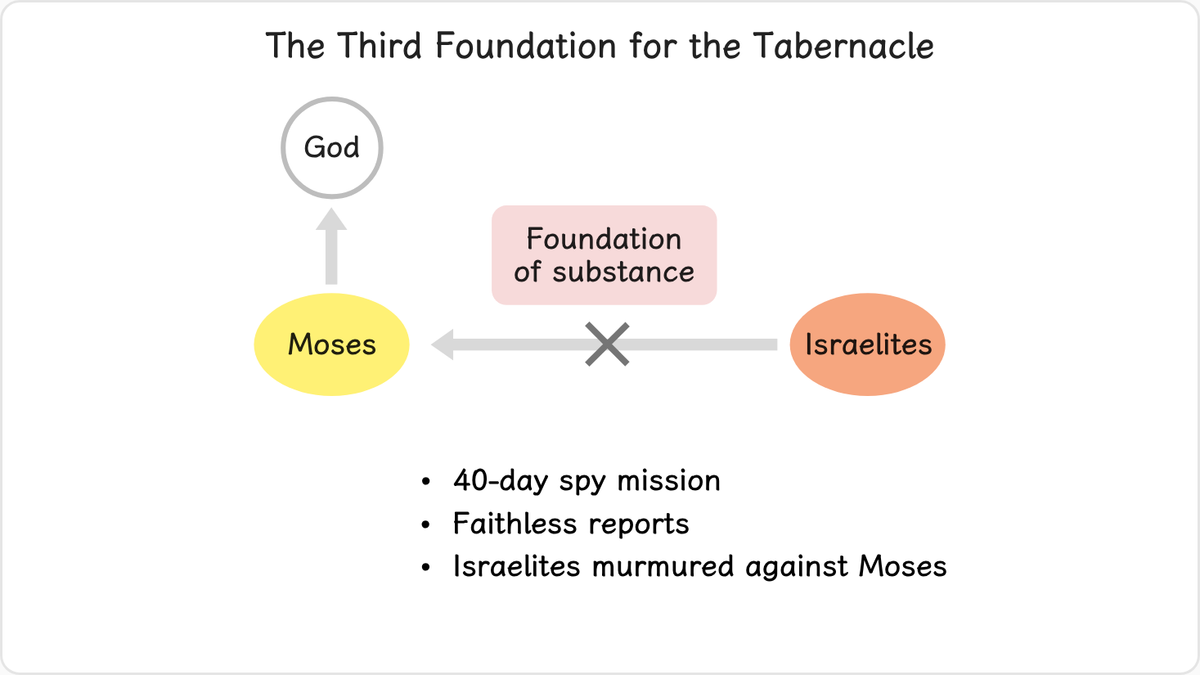
- The forty-day mission to spy out the land of Canaan was given as the condition to achieve this.
- When the spies returned, all the spies except Joshua and Caleb presented faithless reports.
- Upon hearing this report, the Israelites again murmured against Moses.
- As a result of their lack of faith, the third foundation for the Tabernacle ended in failure.
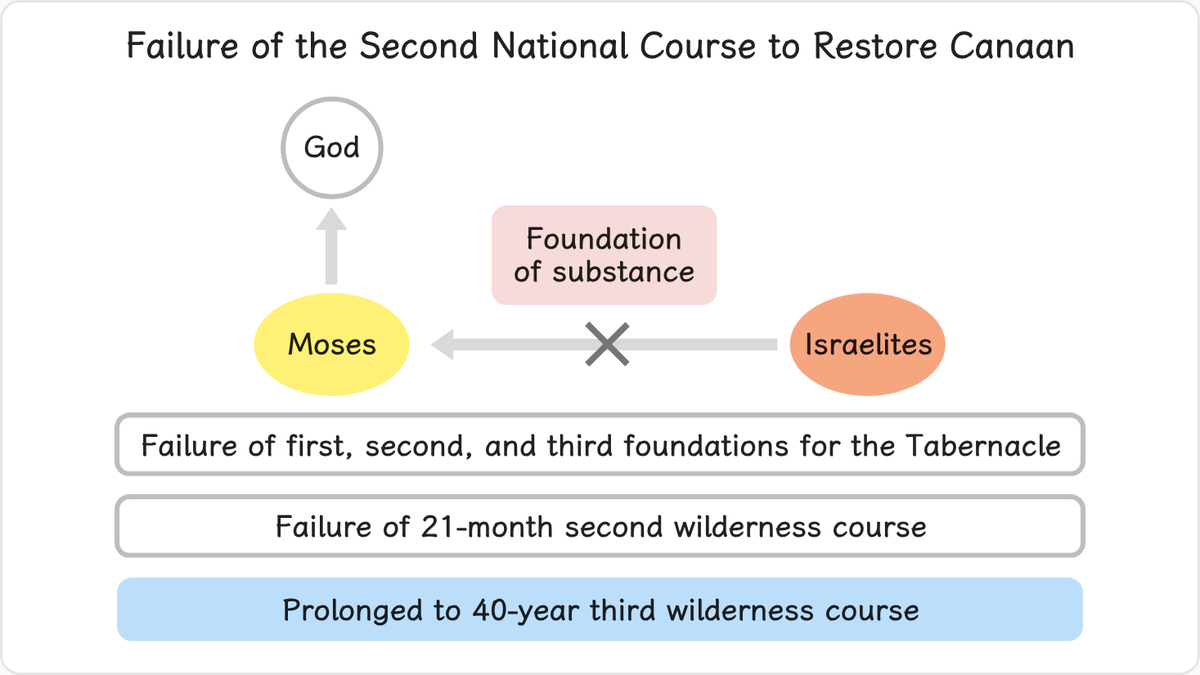
- The foundation for the Tabernacle was invaded by Satan three times.
- Therefore, the national indemnity condition to remove the fallen nature was not fulfilled, and the foundation of substance for the second national course to restore Canaan was not laid.
- Consequently, the entire second national course to restore Canaan ended in failure. God’s providence was prolonged to a third national course.
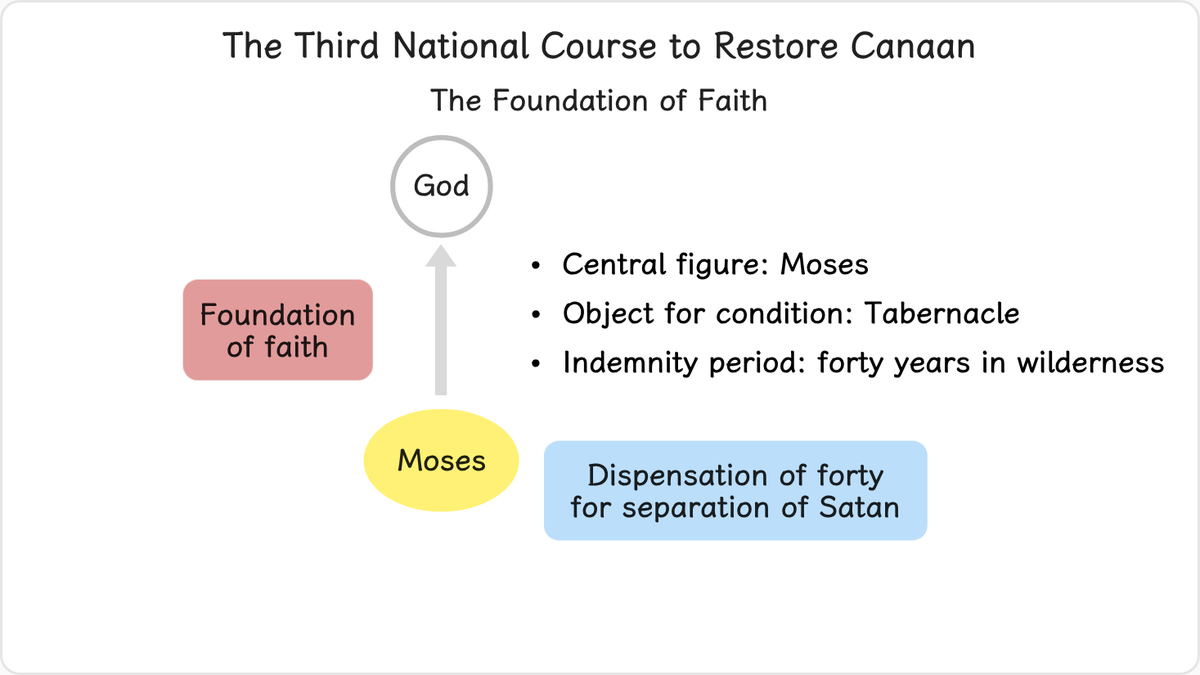
- The second national course to restore Canaan ended in failure.
- The forty years Moses had spent in the wilderness of Midian to restore the foundation of faith were invaded by Satan.
- As a result of the failure of the mission to spy out the land, the people had to wander in the wilderness for forty years, one year for each day of the forty-day spy mission, until they returned to Kadesh-barnea.
- For Moses, this 40-year wandering in the wilderness was to separate Satan, who had invaded the previous foundation of faith,
- and to restore through indemnity the foundation of faith for the third course.
- Due to the Israelites’ faithlessness, the foundation for the Tabernacle was invaded by Satan three times.
- Therefore, the foundation of substance for the second national course to restore Canaan was not laid.
- Consequently, the entire second national course to restore Canaan ended in failure.
- God’s providence was prolonged to a third national course.
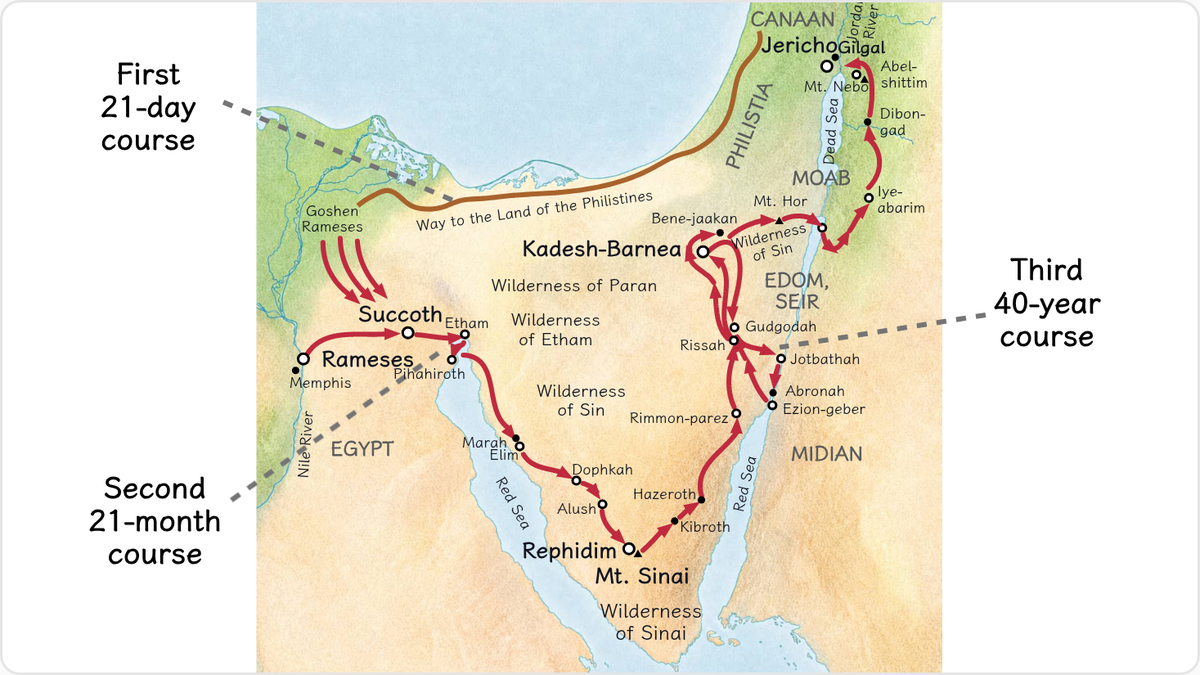
- During the 40 years, Moses completed the foundation of faith for the third national course to restore Canaan.
- Accordingly, he also secured the position of Abel for the foundation of substance.
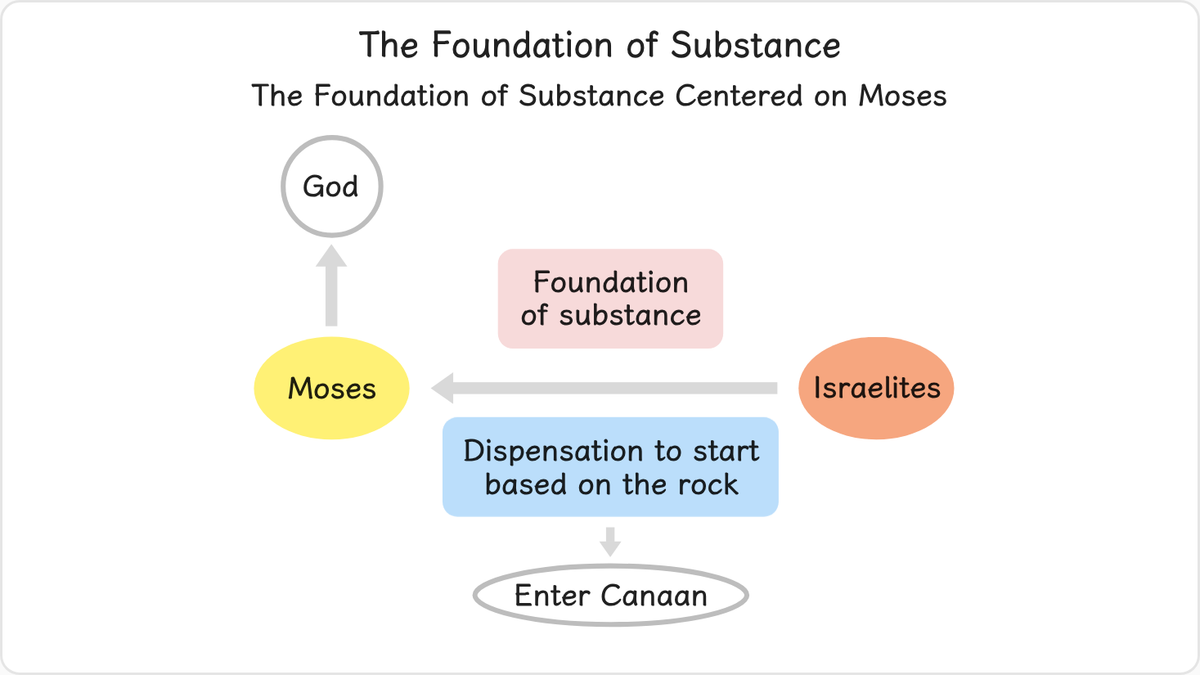
- For the Israelites, the goal for the forty years of wandering in the wilderness was to accomplish the dispensation to start the third course.
- The third national course to restore Canaan was to begin upon completing a dispensation to start based on the rock.
- Henceforth, had the Israelites honored the Tabernacle with faith and devotion and followed Moses into Canaan, they would have established the foundation of substance in the third national course.
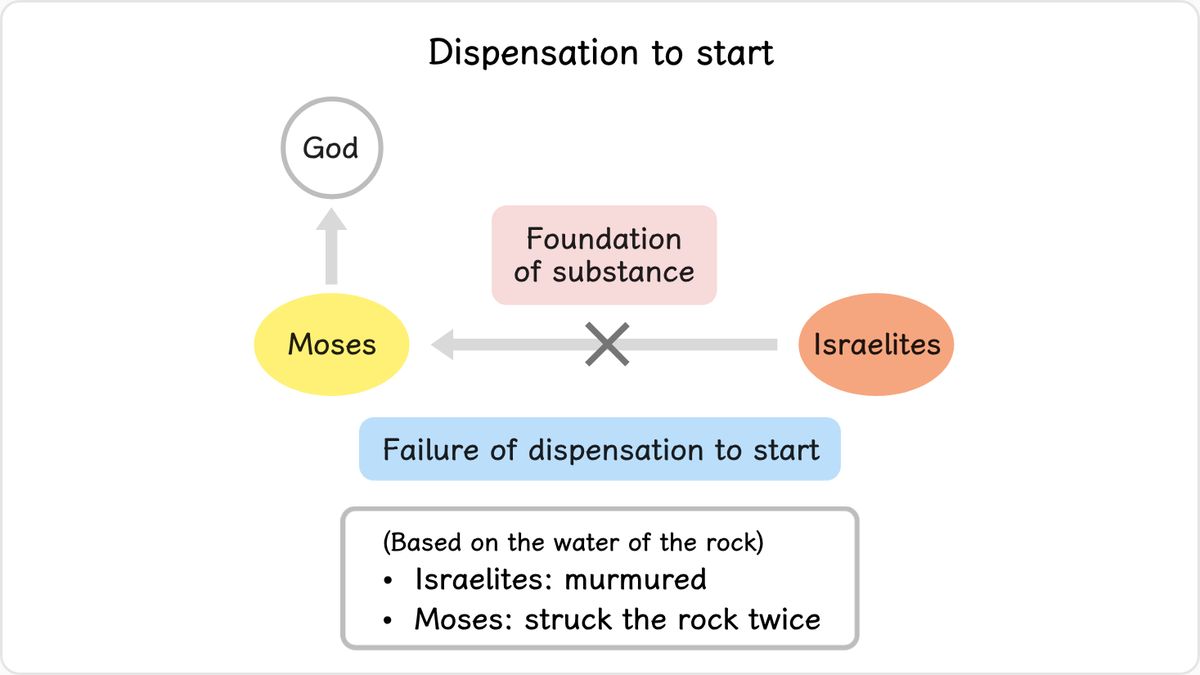
- In order to conduct the dispensation to start based on the rock, God instructed Moses to strike the rock with his staff that it might yield water and give drink to the people.
- However, when Moses heard the people murmuring against him and complaining that they had no water to drink, he raged in uncontrolled anger and struck the rock twice.
- By striking the rock twice, Moses undermined the dispensation to start based on the rock.
- As a consequence, he was not permitted to enter the promised land.
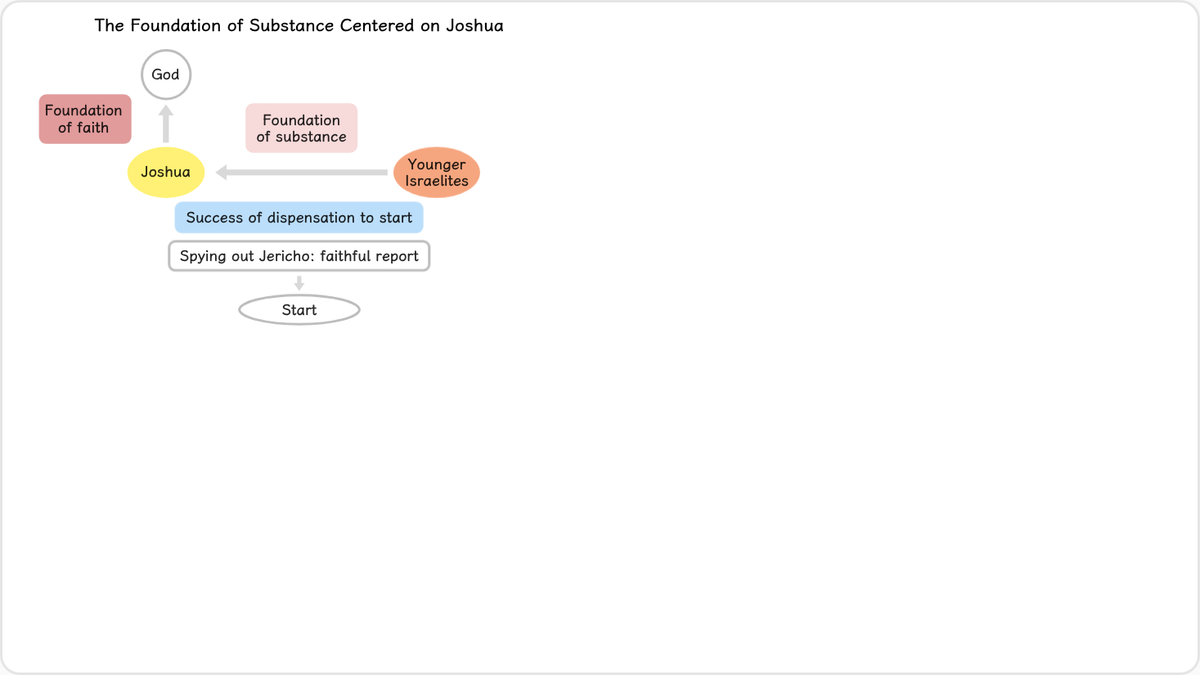
- God elevated Joshua to Moses’ place and had the internal Israelites obey him and stand with him upon the foundation for the Tabernacle.
- Joshua sent two men to spy out the fortified city of Jericho.
- When they returned, the two spies made a faithful report: “... all the inhabitants of the land are fainthearted because of us” (Josh. 2:24).
- The younger generation of Israelites raised in the wilderness all believed the spies’ words, and this faith enabled them to start the third course.
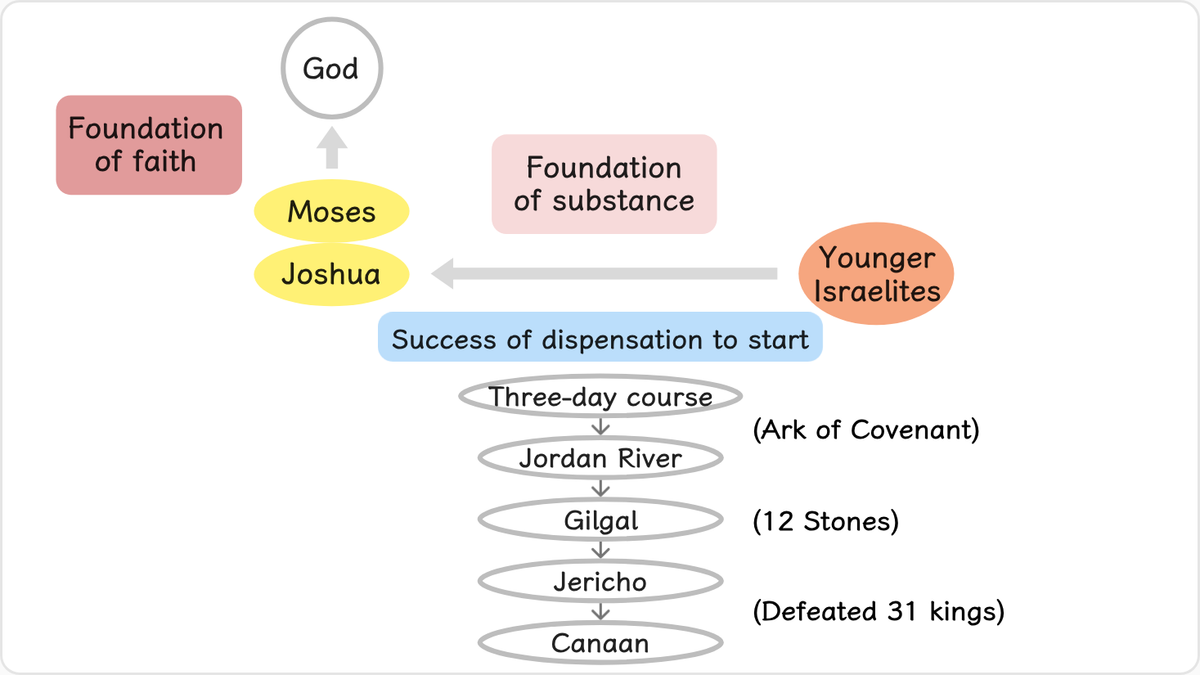
- After the Israelites under Joshua’s leadership completed the 3-day course, the Ark of the Covenant led them to the Jordan River.
- The tablets lying at the center of the Ark, and the pillars of cloud and fire both symbolized Jesus and his would-be Bride.
- When the Ark of the Covenant entered the Jordan River, its waters parted, opening the way for the people following the Ark to walk on the riverbed.
- After coming up out of the Jordan, they encamped at Gilgal and observed the feast of Passover.
- Afterward, they set out for the city of Jericho.
- After marching around the city for seven days, they raised a great shout and the city walls tumbled down.
- Joshua then launched attacks on the enemy with insurmountable force. He defeated thirty-one kings altogether.
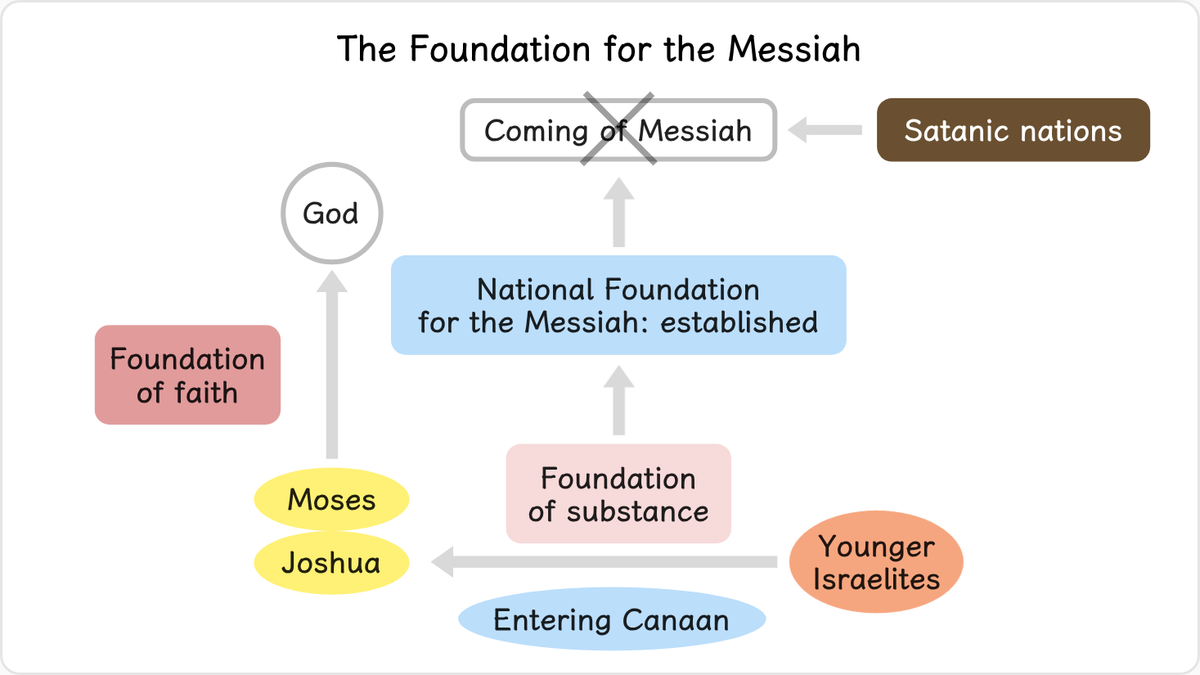
- Based on Joshua’s victory, the Israelites laid the foundation of substance in the third national course and established the foundation for the Messiah.
- However, fallen people had already founded powerful nations such as Egypt, led by satanic rulers who opposed God’s providence of restoration.
- Therefore, even though the national foundation for the Messiah was established under Joshua’s leadership, it would be necessary to build a sovereign kingdom from which the Messiah could confront the satanic nations of the world.
- However, once the younger generation of Israelites entered Canaan, they also became faithless.
- Hence, God’s providence was prolonged again, and would suffer repeated setbacks until the time of Jesus.
The Providence of Restoration under the Leadership of Jesus
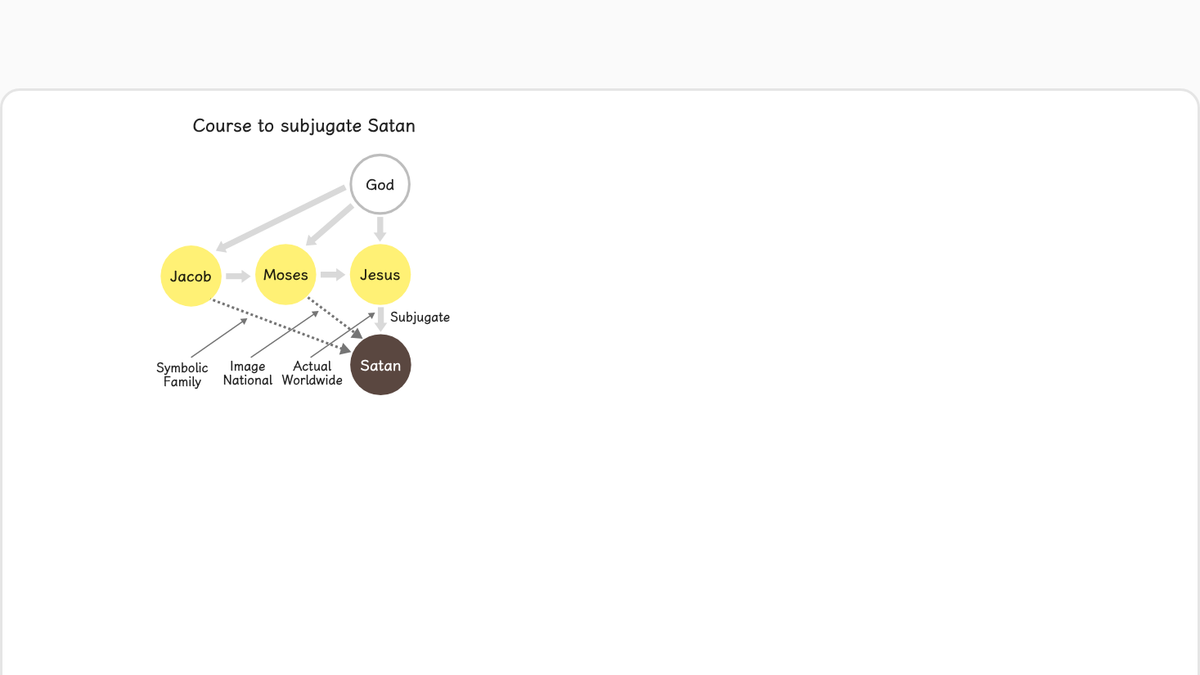
- In the beginning, Adam should have governed the angels, but due to his fall, human beings came under Satan’s dominion.
- Jesus came as the second Adam to personally bring Satan to submission and establish the Kingdom of Heaven.
- Jacob walked the symbolic course to bring Satan to submission,
- while Moses walked the image course.
- Their courses pioneered the way for Jesus to walk the actual course.
- In walking the worldwide course to restore Canaan, Jesus followed the model demonstrated in the national course to restore Canaan when Moses was working to subjugate Satan.
- When God told Moses, “I will raise up for them a prophet like you ... and I will put my words in his mouth” (Deut. 18:18), the prophet referred to Jesus.
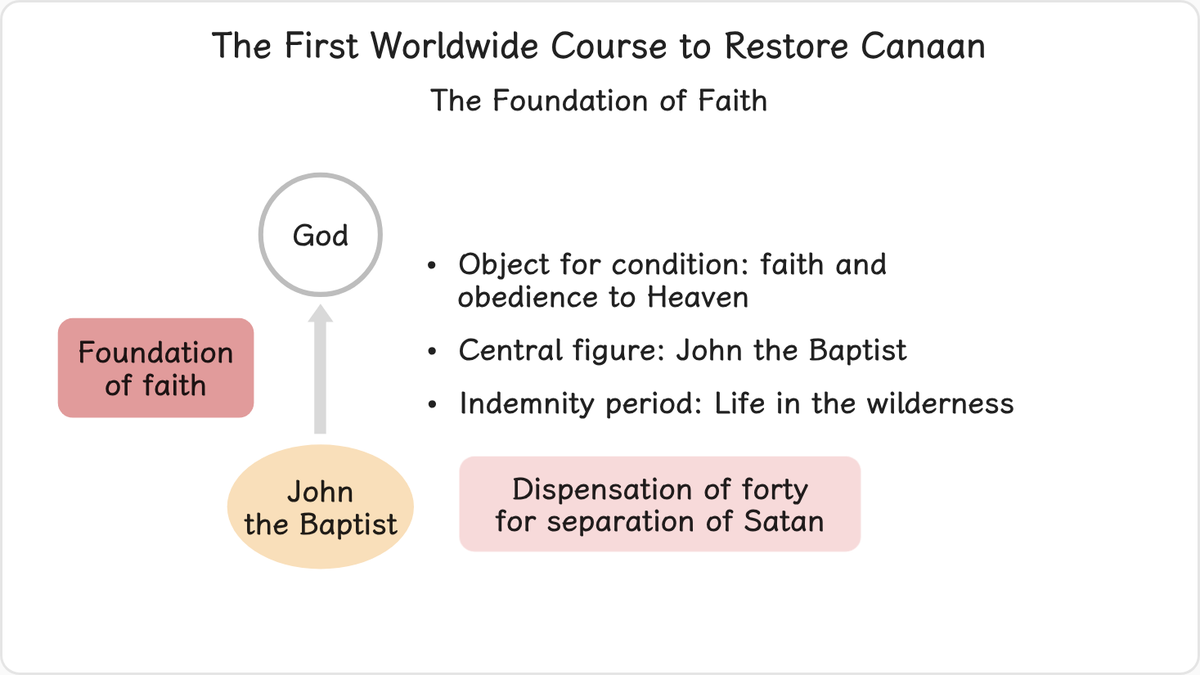
- In the first worldwide course to restore Canaan, the central figure entrusted with the mission to restore the foundation of faith was John the Baptist.
- Moses had learned to love his brethren and the traditions of his fathers while living in the Pharaoh’s palace.
- Likewise, John the Baptist learned the way of faith and obedience to Heaven and made preparations for the Messiah while living in the wilderness.
- In this way, John the Baptist successfully established the dispensation of forty for the separation of Satan,
- and was able to lay the foundation of faith for the first worldwide course to restore Canaan.
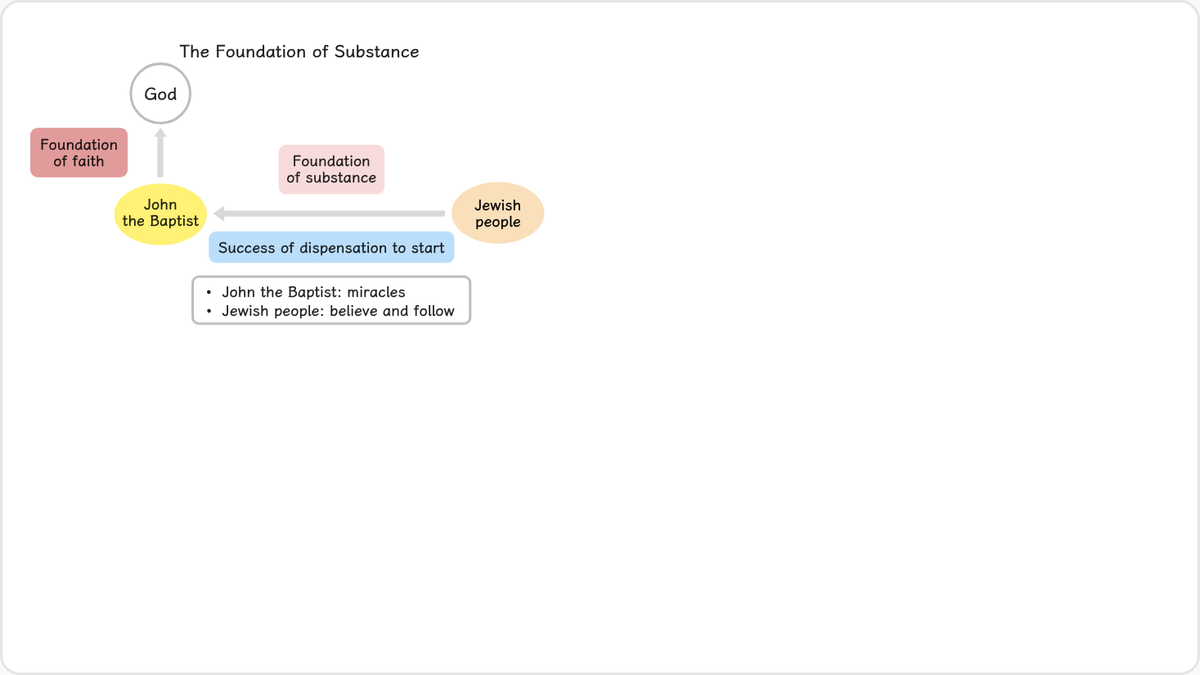
- Since John the Baptist restored through indemnity the foundation of faith, he secured the position of Abel for the fulfillment of the indemnity condition to remove the fallen nature on the world level.
- God conducted the dispensation to start by encouraging the Jewish people to believe in John through the miracles surrounding his life.
- Since the Jewish people believed and followed John the Baptist, they could start the worldwide course to restore Canaan.
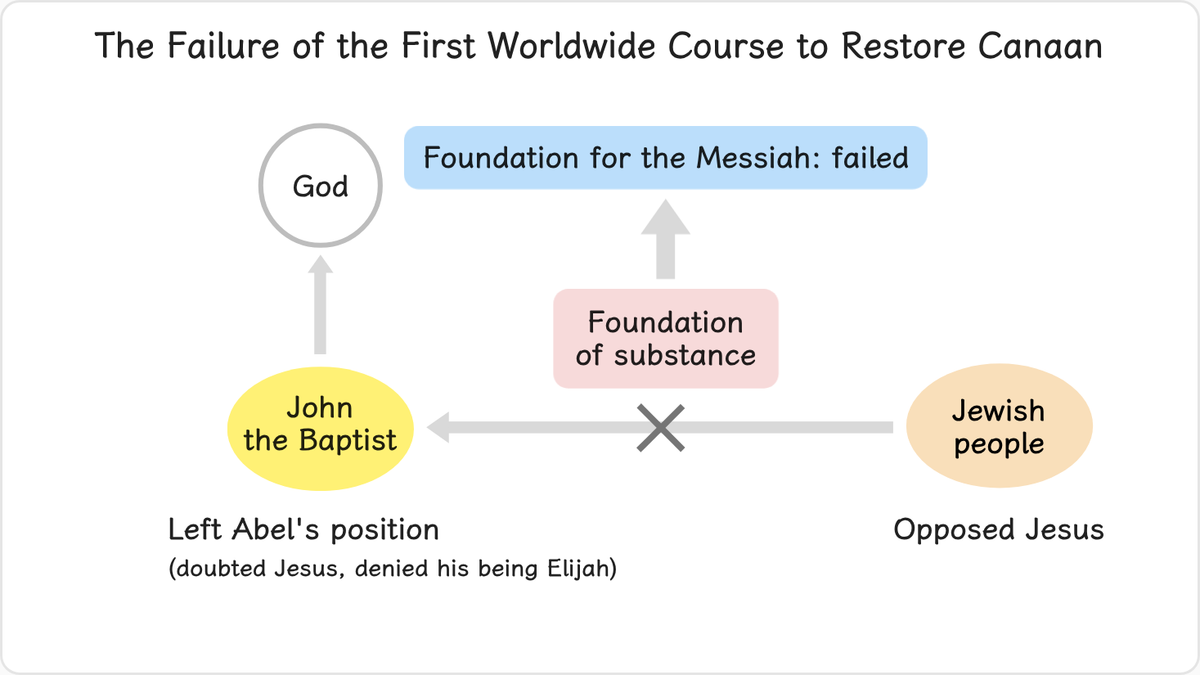
- John the Baptist harbored doubts toward Jesus, even though he had testified to him. He denied that he was Elijah even though he in fact came to fulfill Elijah’s mission.
- This not only blocked the Jewish people’s path to Jesus, it even led them to oppose him.
- In effect, John left the position of Abel, and failed to complete the foundation of substance or the foundation for the Messiah.
- Consequently, the first worldwide course to restore Canaan was aborted. As was the case in Moses’ days, it was prolonged to a second and then a third course.
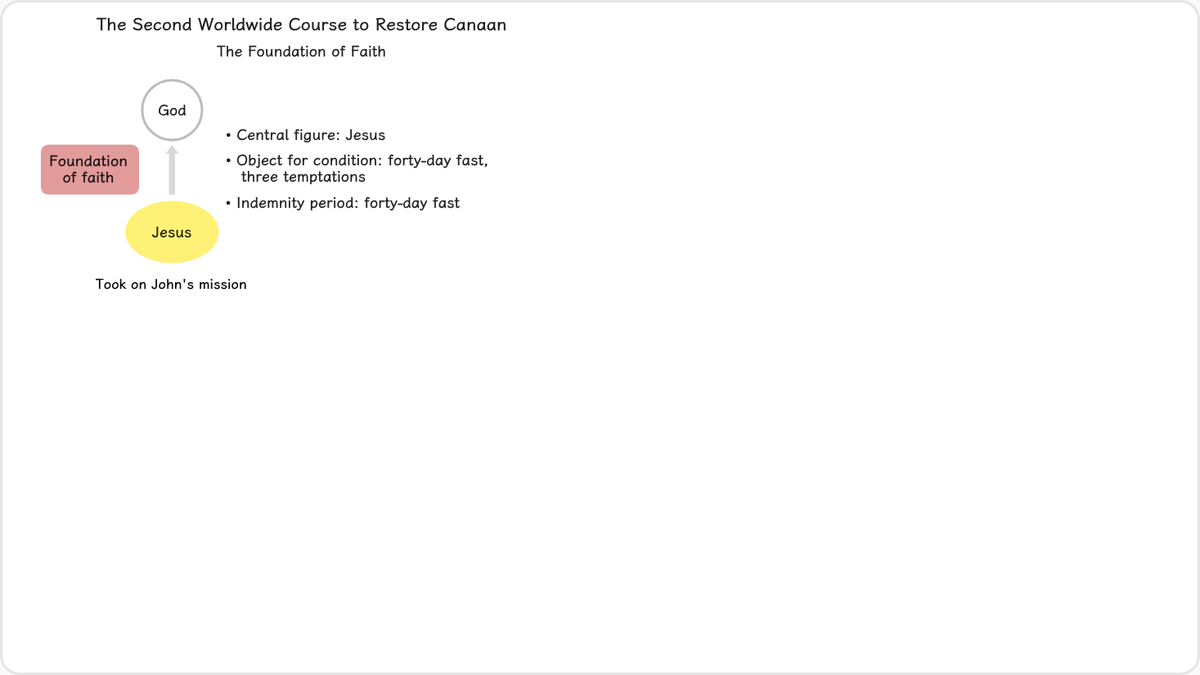
- The foundation of faith which John had laid for the first course was invaded by Satan.
- Jesus himself now had to take on John’s mission and restore through indemnity the foundation of faith in order to restore Canaan.
- When Jesus fasted for 40 days in the wilderness, it was to separate Satan for the very purpose of restoring the foundation of faith.
- Because he was in such a situation, Jesus enjoined Peter not to reveal to the Jewish people that he was the Messiah.
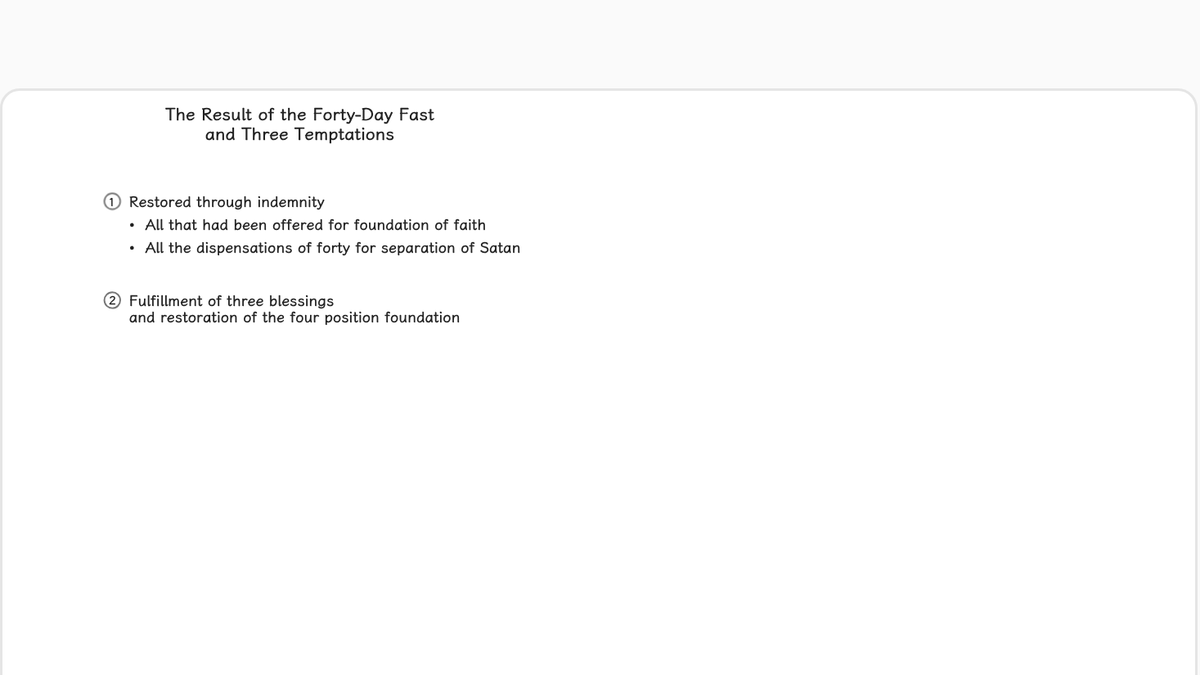
- First, in the position of John the Baptist, Jesus restored through indemnity the foundation of faith for the second worldwide course to restore Canaan.
- In so doing, Jesus restored all that had been offered to God over the course of the providence for the purpose of laying the foundation of faith.
- Furthermore, Jesus restored through indemnity, all at once, all the dispensations of 40 for the separation of Satan conducted during the 4000 years since Adam.
- Second, by rising from John the Baptist’s position to the position of the Messiah, Jesus paved the way for the fulfillment of God’s three great blessings and the restoration of the four position foundation.
- Jesus was the fulfillment of the three manifestations of grace (tablets, Ark, and Tabernacle) and the Ten Commandments.
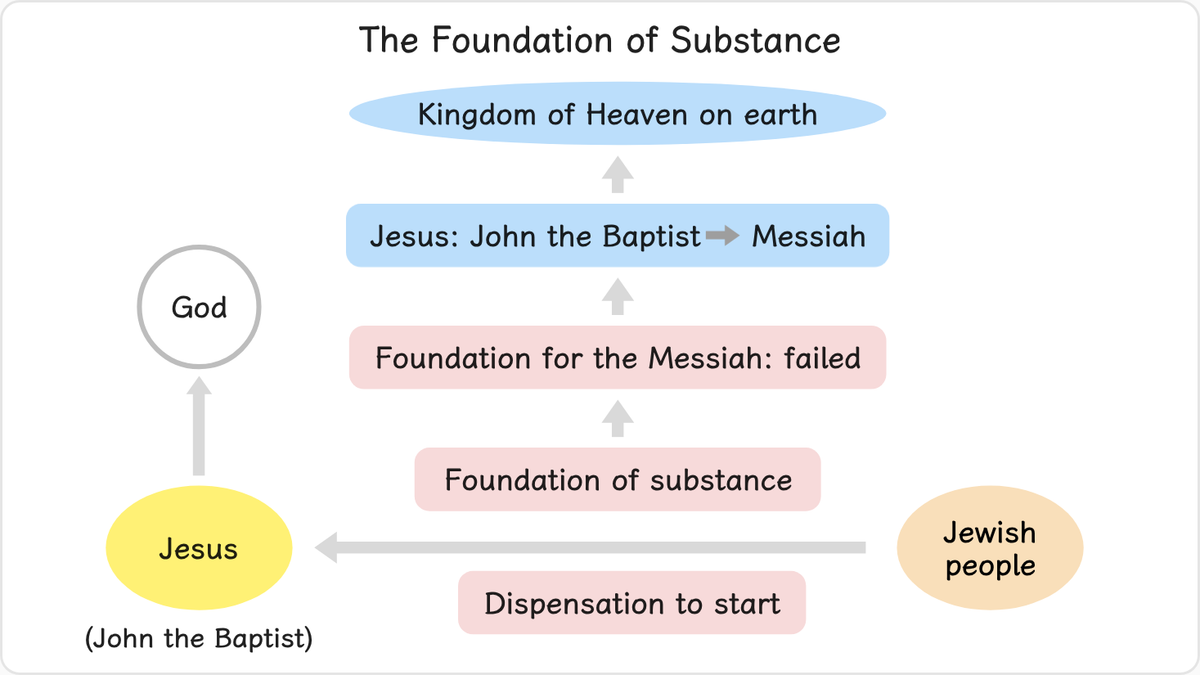
- Therefore, God conducted the dispensation to start the second worldwide course to restore Canaan based on Jesus’ own words and miraculous deeds.
- Standing upon the foundation for the Messiah, Jesus would have risen from the position of John the Baptist to the position of the Messiah.
- Then, by engrafting all people with himself, humankind would have been reborn, cleansed of the original sin, and would have become one with God in heart.
- They would have restored their original, God-given nature and built the Kingdom of Heaven on earth in Jesus’ day.
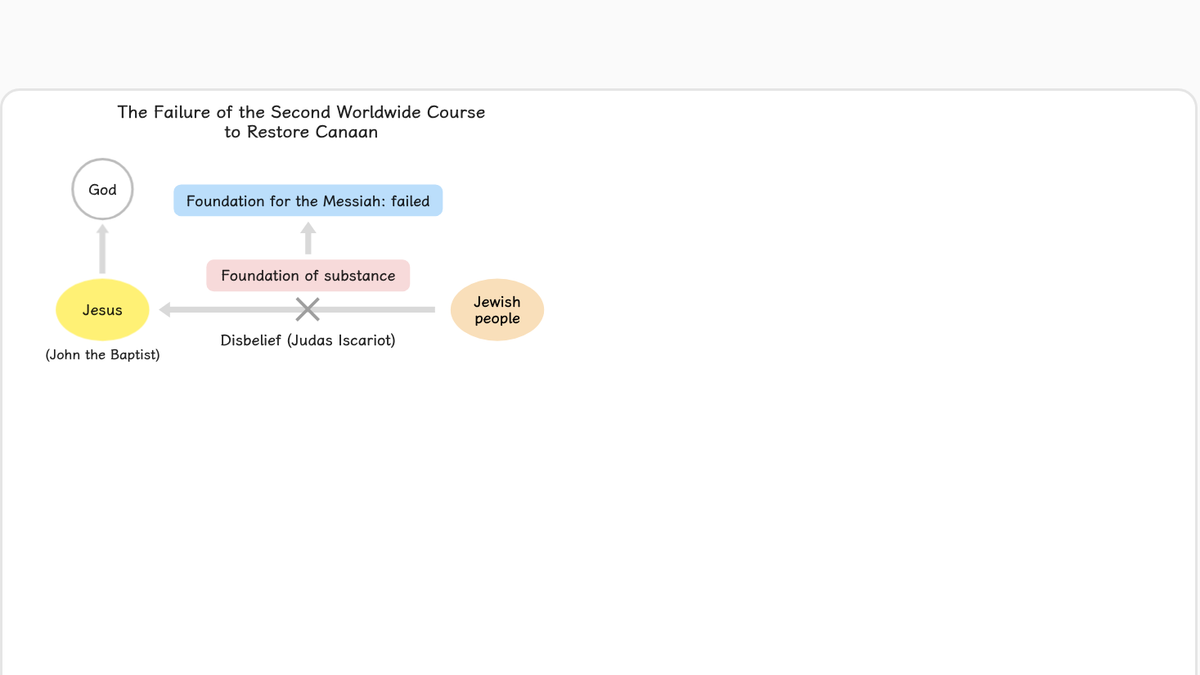
- Satan confronted Jesus through Judas Iscariot, the disciple who betrayed him.
- Due to the faithlessness of the Jewish leaders and Judas, Jesus could lay neither the foundation of substance nor the foundation for the Messiah for the second worldwide course to restore Canaan.
- The second worldwide course thus ended in tragic failure.
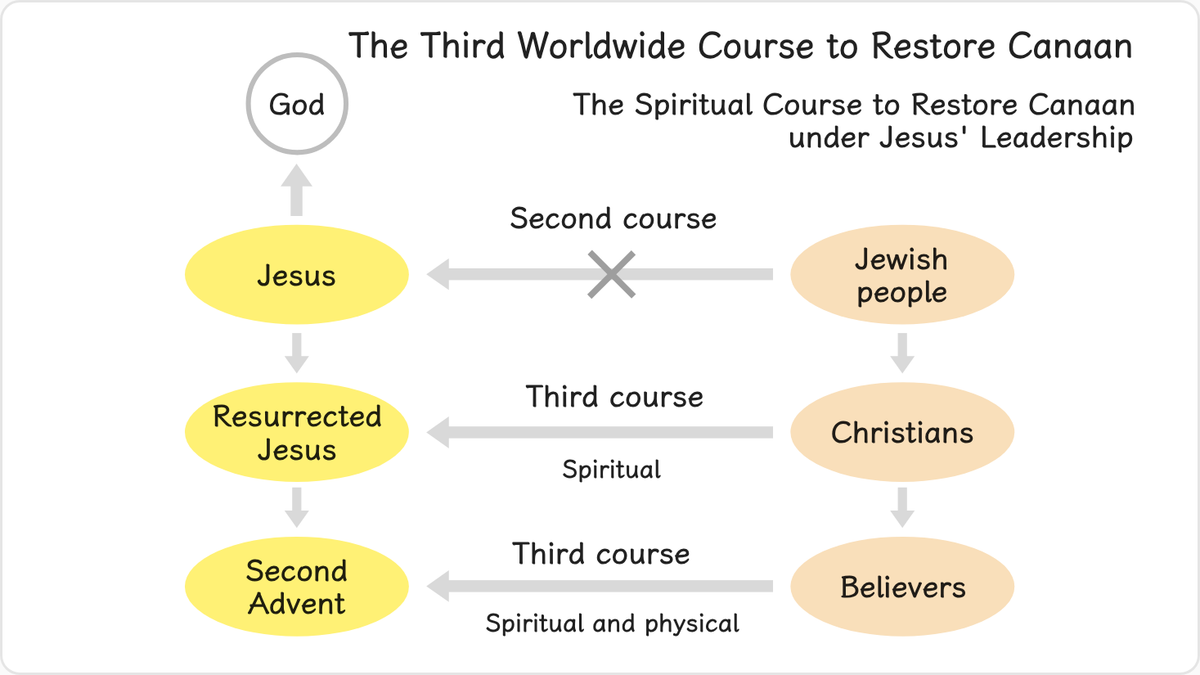
- Jesus, who was the focus of faith for the Jewish people, had to walk the path of death and be crucified,
- and the Jewish people lost the one who should have been the spiritual and physical focus of their faith.
- They no longer had a basis upon which to begin the third worldwide course to restore Canaan as a substantial course.
- Rather, Christians, as the Second Israel, were to begin this course as a spiritual course by exalting the resurrected Jesus as their focus of faith.
- Christ at the Second Advent will succeed the mission of Jesus. He will complete, both spiritually and physically, the third worldwide course to restore Canaan.
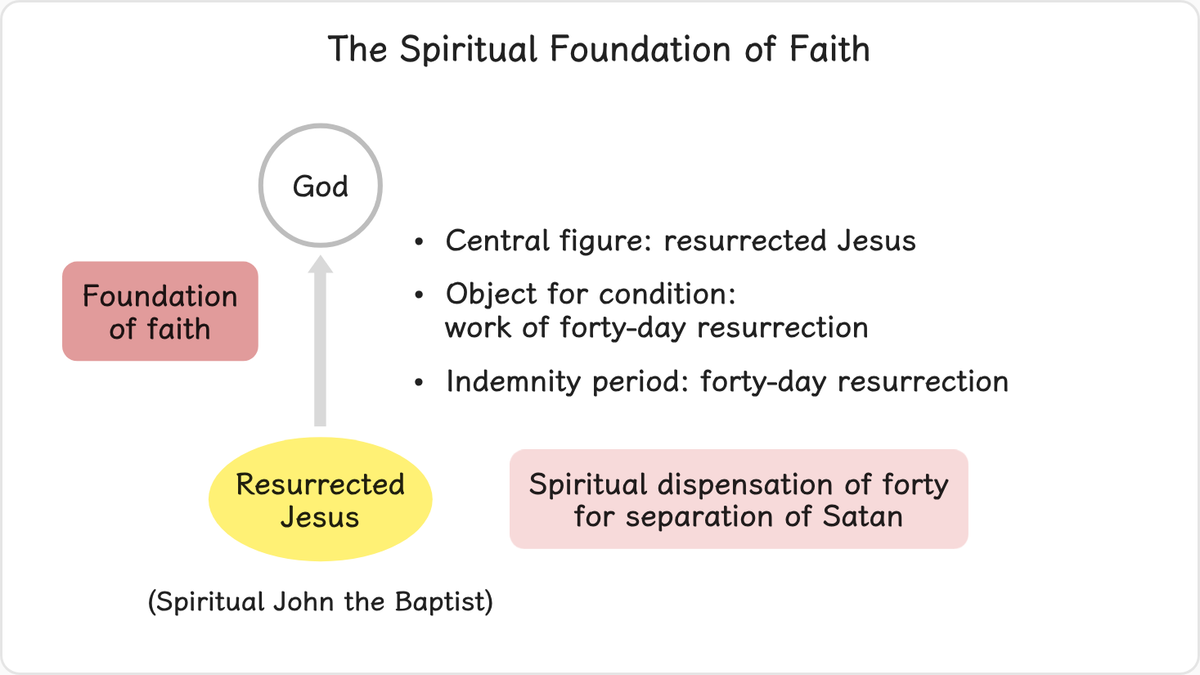
- After Jesus gave up his body on the cross, he resumed John the Baptist’s mission spiritually.
- During the forty-day period from his resurrection to his ascension, Jesus fulfilled the spiritual dispensation of forty for the separation of Satan.
- By doing so, Jesus restored the foundation of faith for the spiritual course in the third worldwide course to restore Canaan.
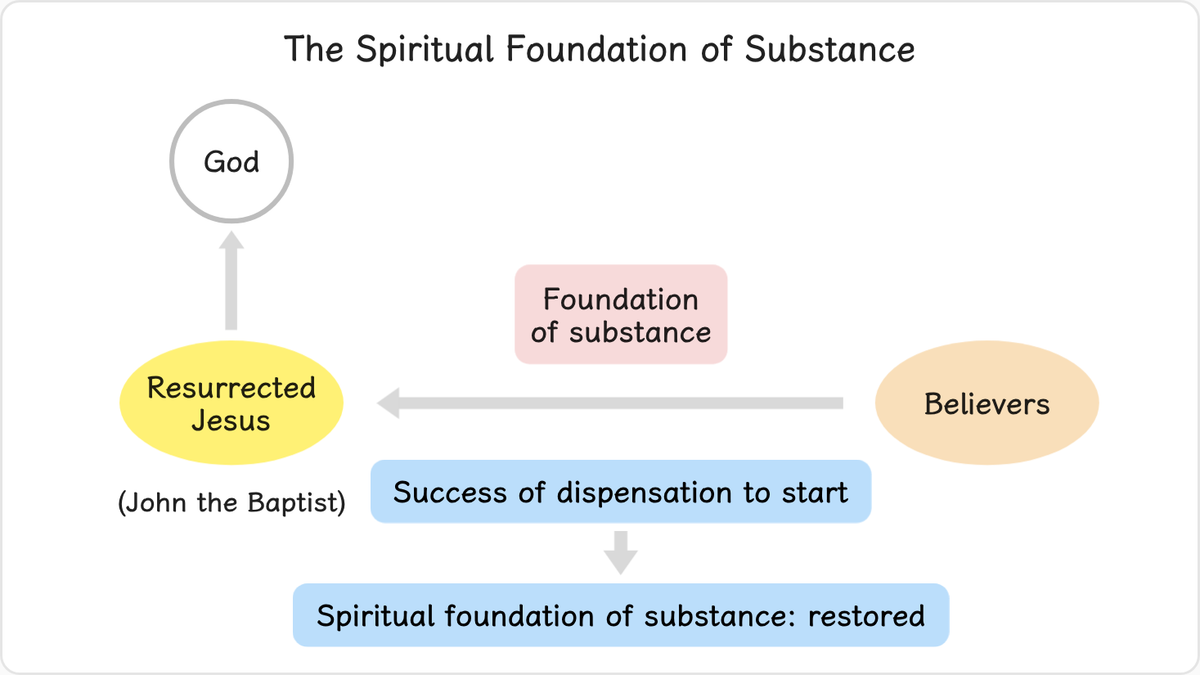
- Through his resurrection appearances, Jesus fulfilled the dispensation of forty for the separation of Satan while standing in the position of John the Baptist in spirit.
- He thereby laid the foundation of faith for the spiritual course in the position of the spiritual True Parent. At the same time, from the position of a child, he secured the position of Abel for fulfilling the indemnity condition to remove the fallen nature.
- The resurrected Jesus was himself the spiritual fulfillment of the tablets of stone, the Ark of the Covenant and the Tabernacle.
- He gathered his scattered disciples from all over Galilee and worked the dispensation to start by giving them the power to perform signs and miracles.
- The faithful believers stood in the position of Cain.
- By believing in Jesus and following him devotedly, they fulfilled the indemnity condition to remove the fallen nature and restored the spiritual foundation of substance.
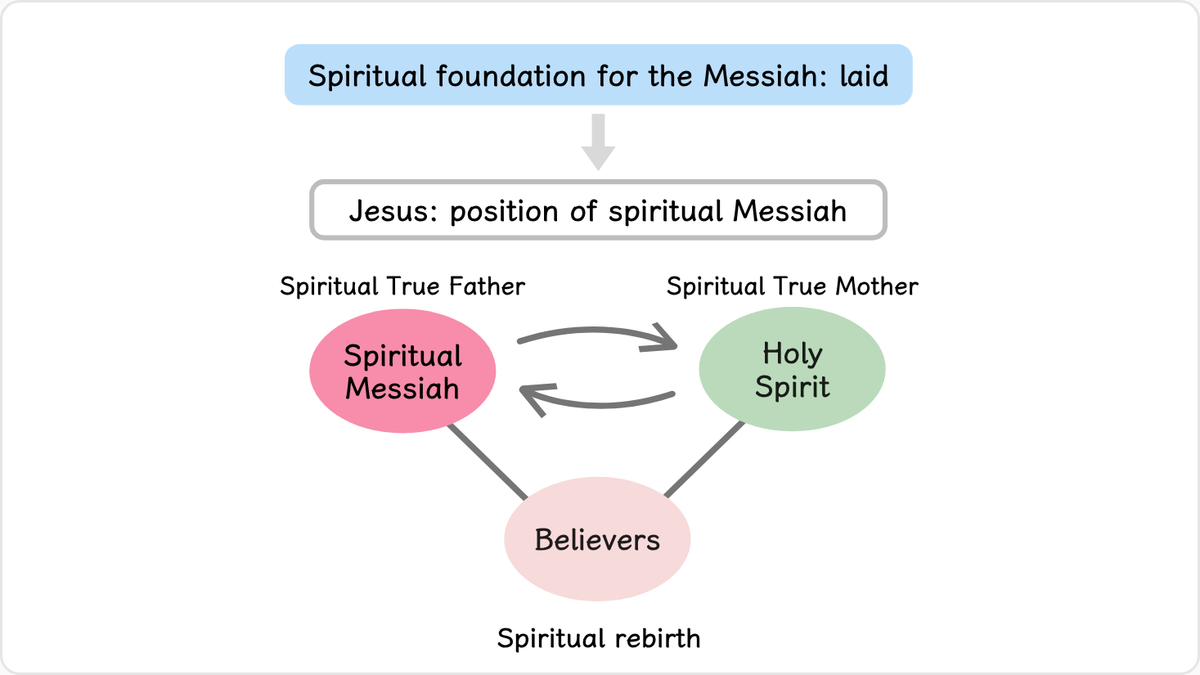
- The disciples laid the spiritual foundation of substance and the spiritual foundation for the Messiah.
- Upon this foundation, Jesus ascended from the position of the spiritual mission-bearer for John the Baptist to the position of the spiritual Messiah and sent the Holy Spirit.
- Thereupon, Jesus and the Holy Spirit became the spiritual True Parents and began the work of giving rebirth.
- Ever since the descent of the Holy Spirit at the Pentecost (Acts 2:1-4), the resurrected Jesus as the spiritual True Father and the Holy Spirit as the spiritual True Mother have worked in oneness,
- to grant spiritual rebirth by spiritually engrafting believers with themselves. This is the work of spiritual salvation.
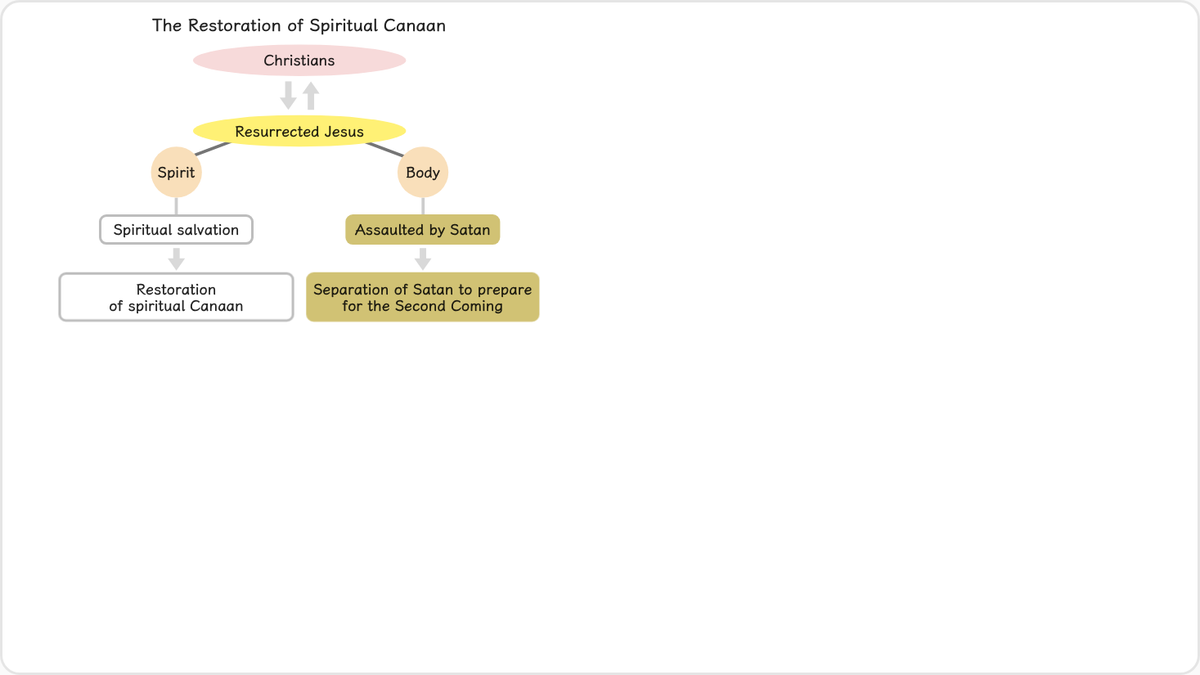
- By believing in and serving the resurrected Jesus, who stands upon the spiritual foundation for the Messiah,
- Christians can accomplish the restoration of spiritual Canaan and enter its realm of grace.
- On the other hand, the physical bodies of Christians stand in the same position as Jesus’ body,
- which was assaulted by Satan through the crucifixion.
- Hence, Christians are still stained with the original sin, and thus they still must walk the course for the separation of Satan to prepare for the Second Coming of Christ.
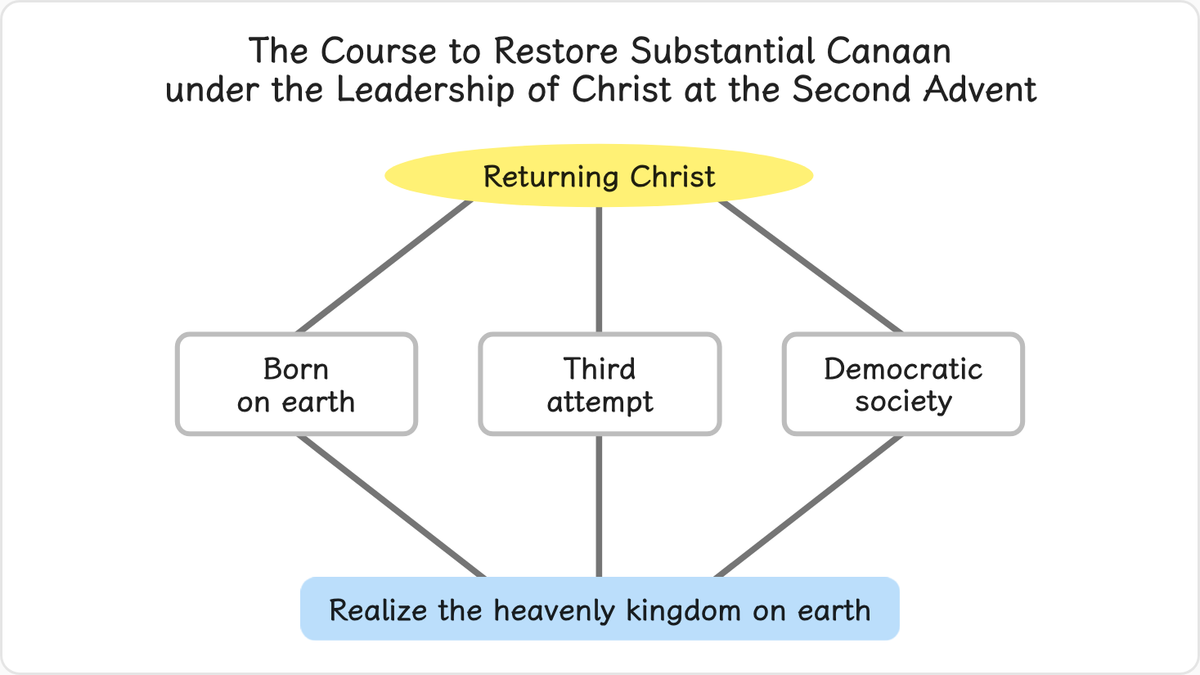
- While Jesus has been restoring Canaan as a worldwide spiritual realm, Christ at the Second Advent is to complete this third worldwide course as a substantial course and build the actual Kingdom of Heaven on earth.
- For this reason, he must be born on earth in the flesh.
- He will not die without fulfilling the providence of restoration.
- This is because God’s providence, which began with Adam, was prolonged through Jesus, and will bear its fruit without fail at the Second Advent.
- Moreover, God’s spiritual providence of restoration during the two thousand years since Jesus’ day has prepared a democratic social and legal environment which will protect Christ at the Second Advent.
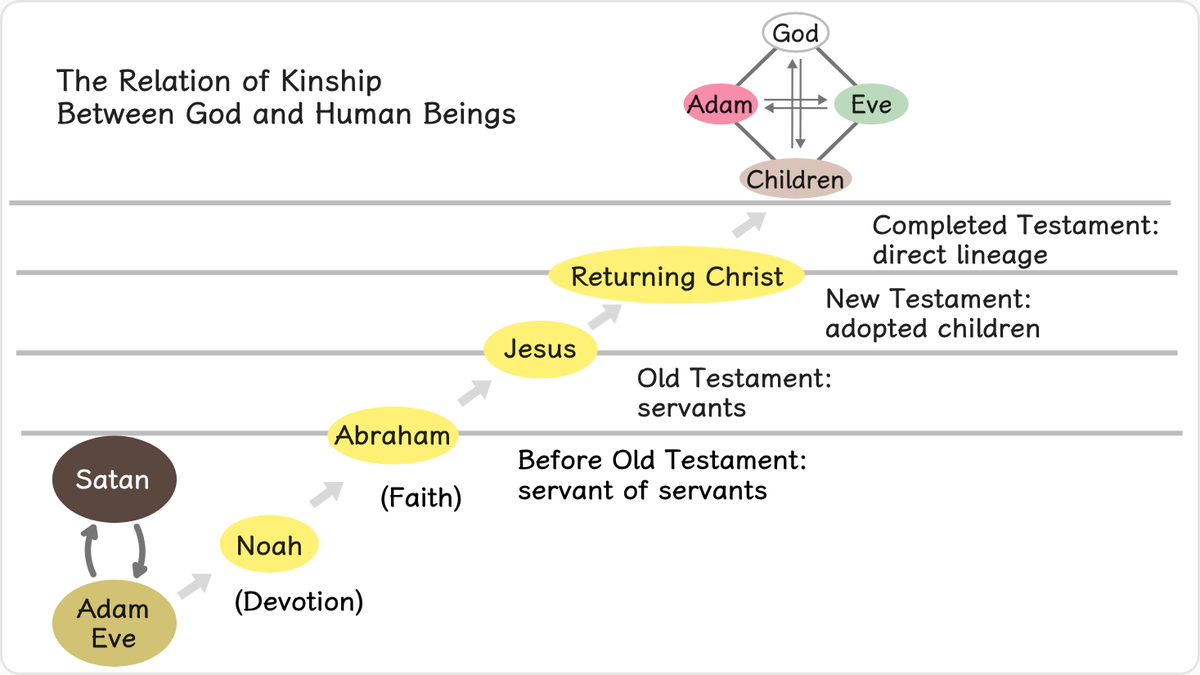
- The ultimate purpose of God’s providence of restoration is to transform fallen people, who have no connection to God’s lineage, into children born of God’s direct lineage.
- At Noah’s time, because Noah had demonstrated utmost devotion, his family could stand in an indirect relationship with God, as a servant of servants.
- Abraham's family and their descendants, God’s chosen people, were elevated to the position of God’s servants.
- In the days of Jesus, the disciples were elevated from the position of servants to the position of adopted children.
- The Christ will return and restore all humanity to be God’s children of direct lineage.
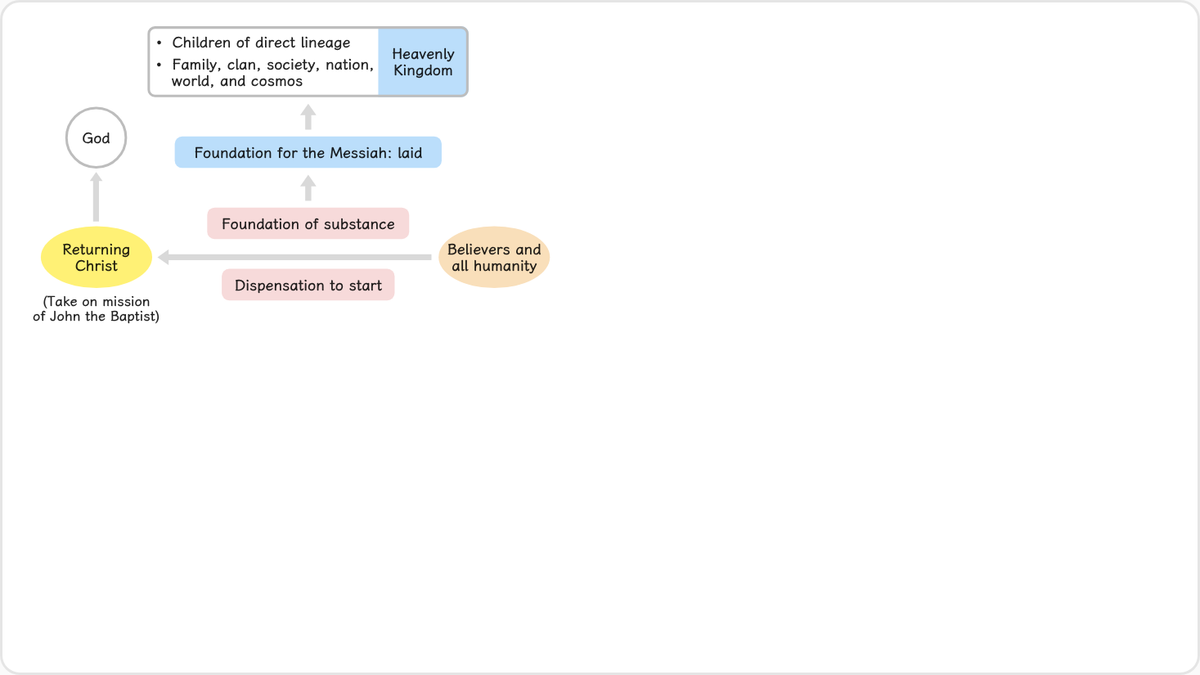
- The returning Christ will conduct the dispensation to start based on the Word and then complete the foundation for the Messiah both spiritually and physically.
- Upon that foundation, he will engraft all humanity with himself, cleansing them of the original sin and restoring them to be God’s children, born of His lineage.
- Christ at the Second Advent will begin by laying, both spiritually and physically, the family foundation for the Messiah.
- He will then expand its scope to the clan, society, nation, world and cosmos.
- When this foundation is secure, he will finally be able to build the Kingdom of Heaven.