Predestination
Predestination
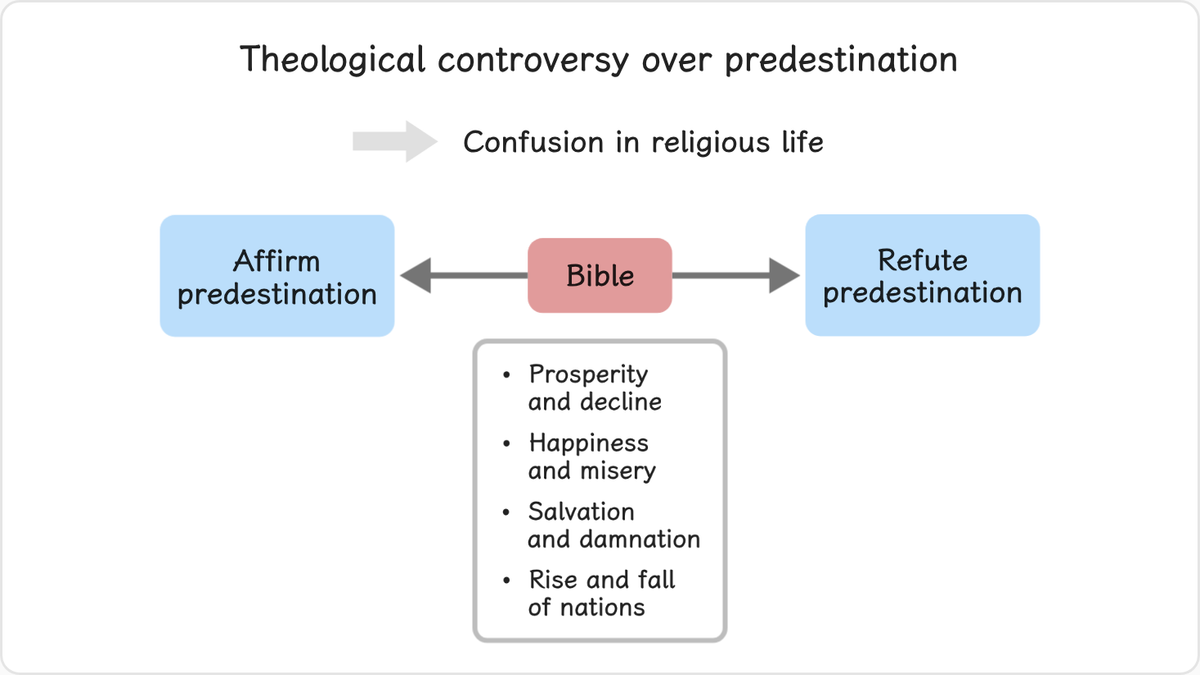
- Theological controversy over predestination has caused great confusion in the religious lives of many people.
- In the Bible, we find many passages which are often interpreted to mean that everything in an individual’s life –
- prosperity and decline,
- happiness and misery,
- salvation and damnation,
- as well as the rise and fall of nations – comes to pass exactly as predestined by God.
- Yet we can also find sufficient evidence in the Bible to refute the doctrine of absolute predestination.
- There are ample grounds in the Bible to justify either of these two contrasting doctrines.
The Predestination of God’s Will
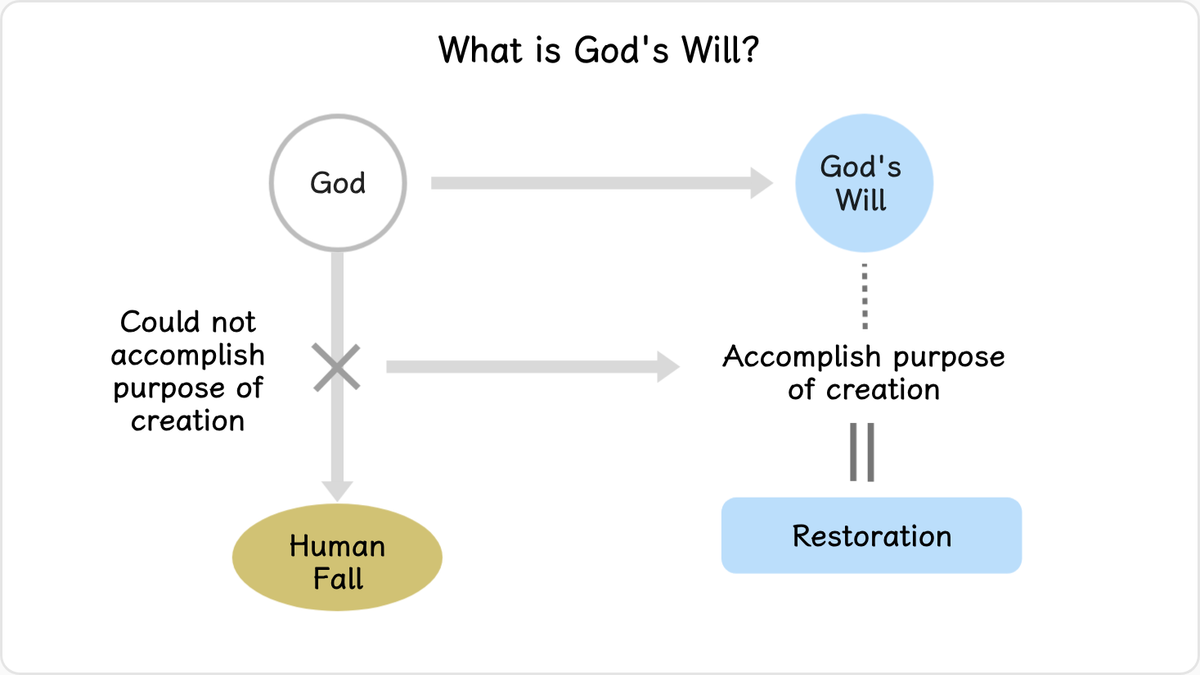
- Before discussing the predestination of God’s Will, let us first examine what is being willed.
- God could not accomplish His purpose of creation due to the human Fall.
- Accordingly, God’s Will in carrying out His providence for fallen humanity is still to accomplish the purpose of creation.
- In this sense, God’s Will is that restoration be accomplished.
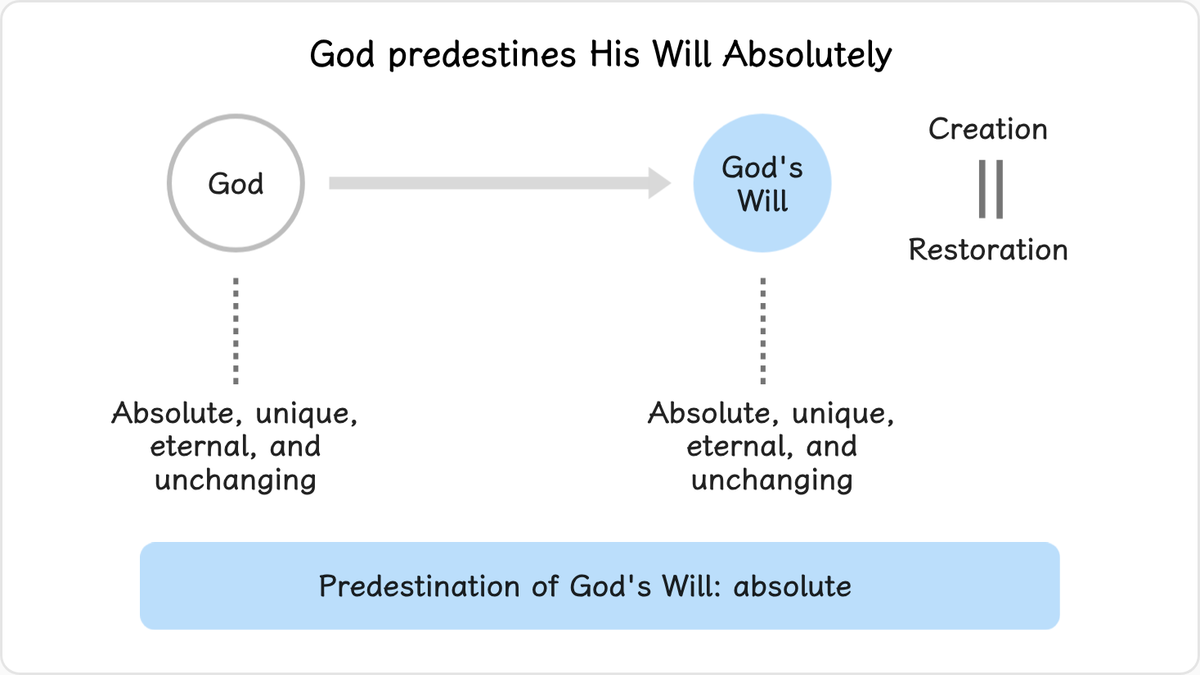
- God is the absolute Being, unique, eternal and unchanging.
- Therefore, the purpose of His creation must also be absolute, unique, eternal and unchanging.
- Likewise, His Will for the providence of restoration, the goal of which is the accomplishment of the purpose of creation,
- must also be absolute, unique and unchanging.
- It follows that God’s predestination of His Will – that the purpose of creation one day be fulfilled – must also be absolute.
The Predestination of the Way in Which God’s Will Is Fulfilled
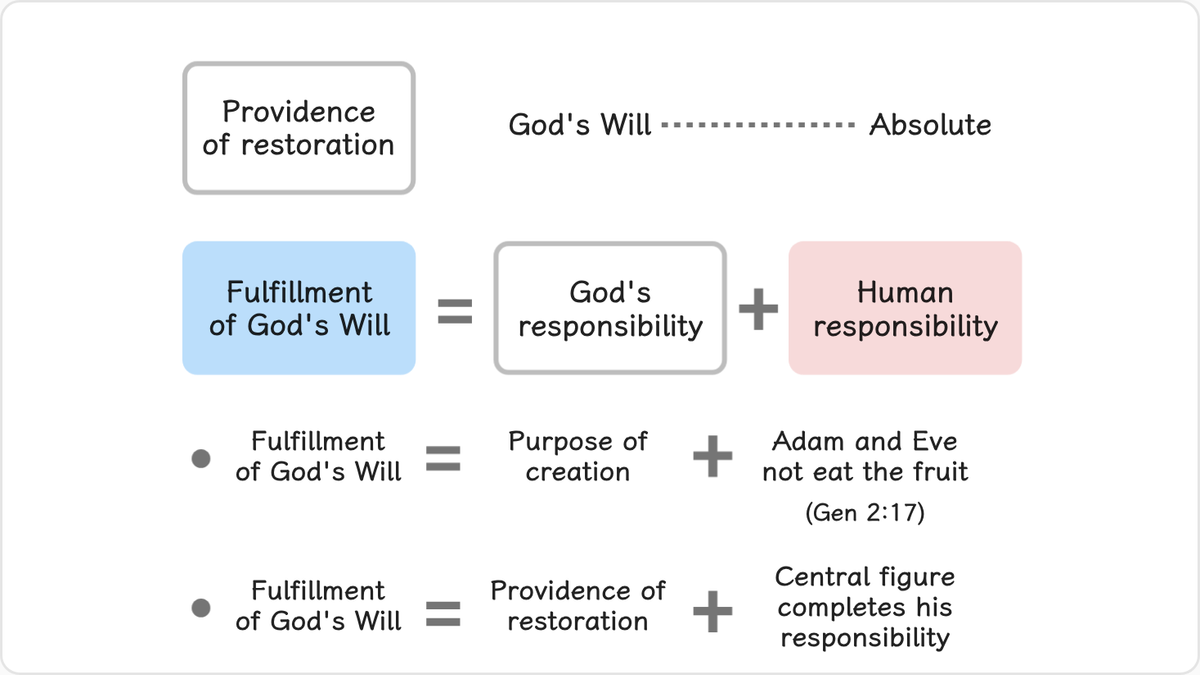
- Although God’s Will to realize His purpose of creation through the providence of restoration is absolute and beyond human influence,
- its fulfillment necessarily requires the accomplishment of the human portion of responsibility.
- Originally, God’s purpose of creation was to be fulfilled through Adam and Eve only when they completed their given responsibility and refrained from eating the fruit of the tree of the knowledge of good and evil.
- Similarly, in the providence of restoration, God’s Will is accomplished only when the central figure responsible for a mission completes his portion of responsibility.
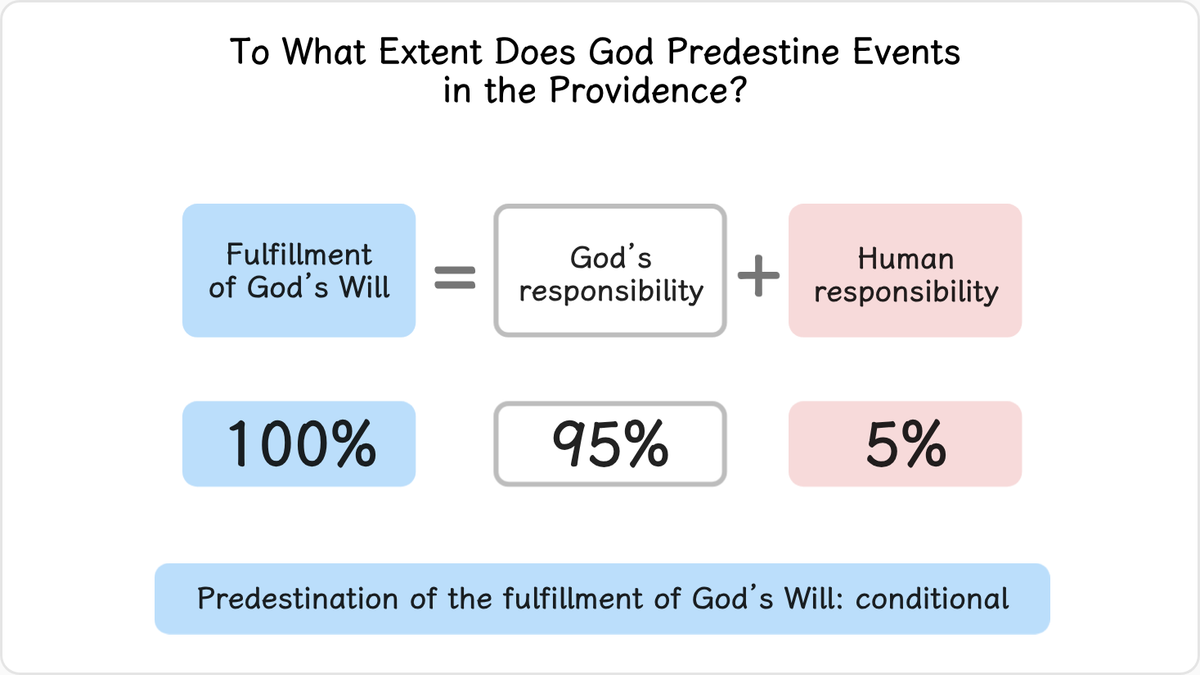
- To what extent does God predestine the unfolding of the events in the providence?
- Although God’s Will to realize the purpose of the providence of restoration is absolute,
- God predestines the process of its accomplishment conditionally,
- contingent upon the five percent responsibility of the central figure,
- which must be completed in addition to the ninety-five percent responsibility of God.
The Predestination of Human Beings
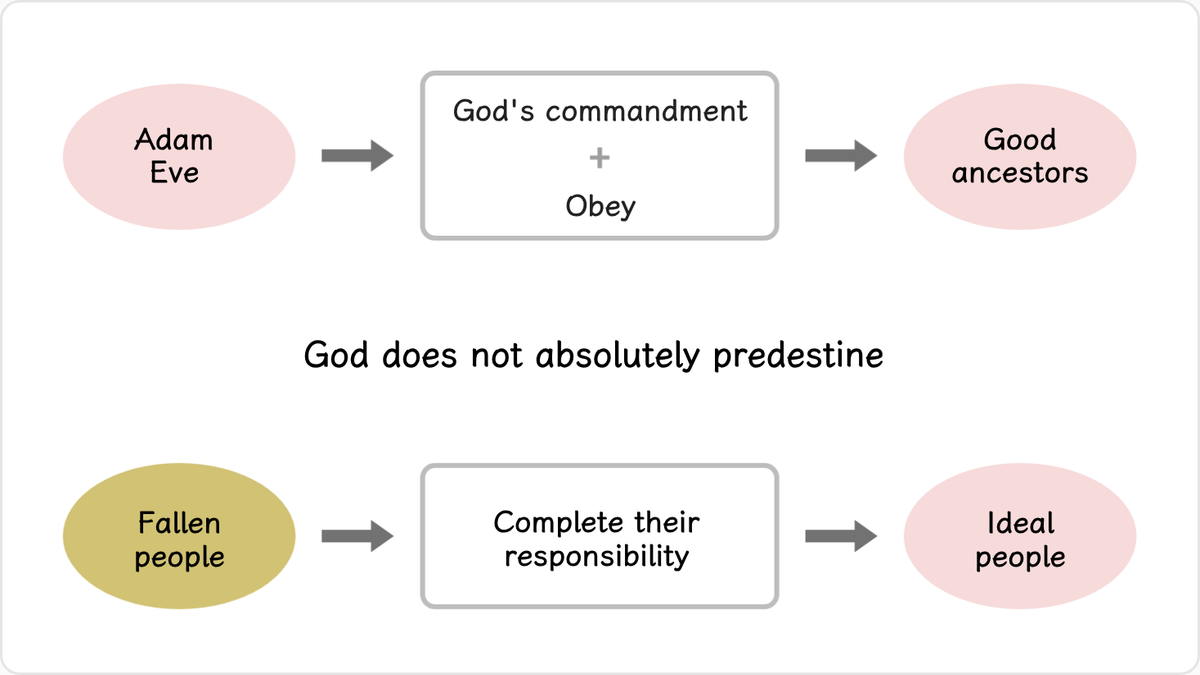
- Adam and Eve were to become the good ancestors of humanity,
- conditional upon fulfilling their responsibility to obey God’s commandment not to eat of the fruit.
- Accordingly, God did not absolutely predestine that Adam and Eve would become our good ancestors.
- The same holds for all fallen people:
- they can become the ideal people God has foreordained them to be
- only when they complete their responsibility.
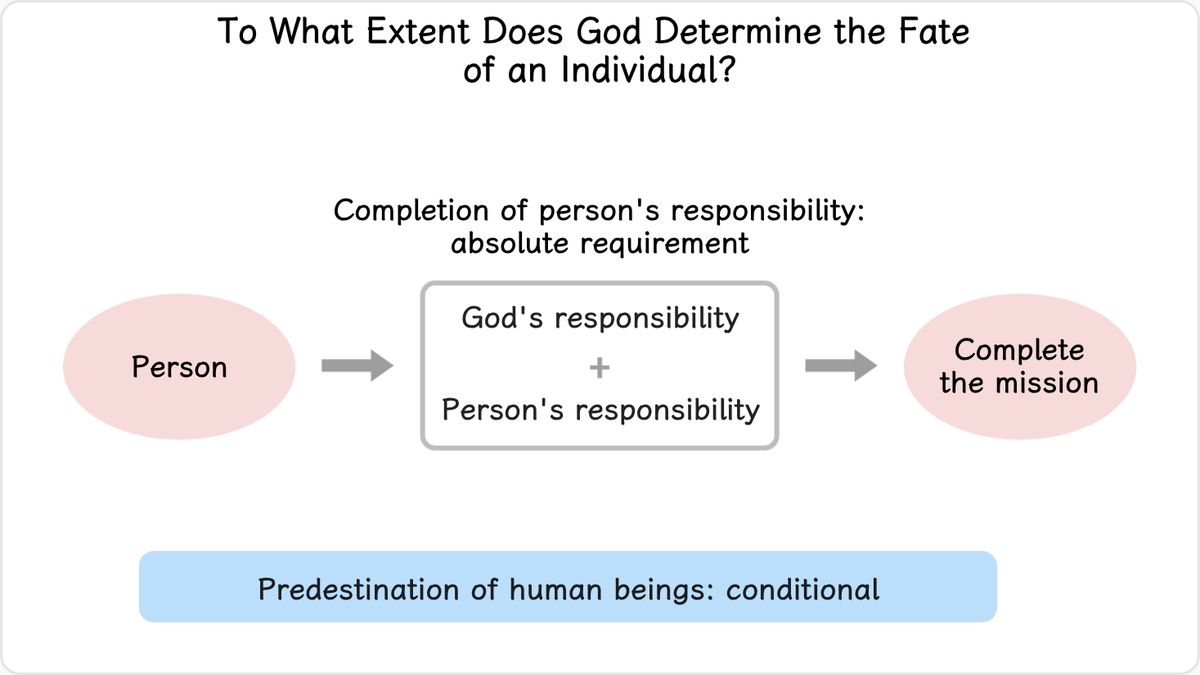
- To what extent does God determine the fate of an individual?
- The fulfillment of God’s Will through an individual absolutely requires that he complete his responsibility.
- Hence, even though God predestines someone for a particular mission,
- God’s ninety-five percent responsibility and the person’s five percent responsibility must be accomplished together
- before the person can complete his given mission and fulfill God’s Will.
- If the person does not complete his responsibility, he cannot become the person God has purposed him to be.
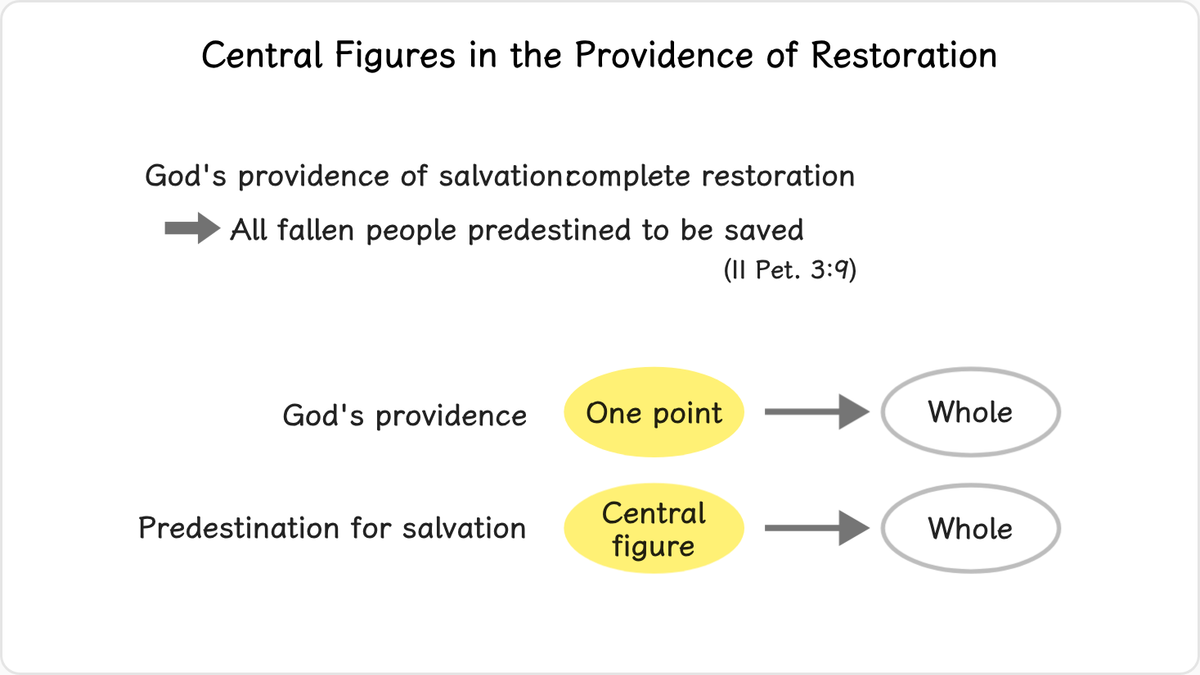
- Let us next examine God’s predestination of central figures in the providence of restoration.
- The purpose of God’s providence of restoration is to restore completely the fallen world to the original world which God intended.
- Therefore, although the times of their salvation may differ, all fallen people are predestined to be saved (II Pet. 3:9).
- Yet, as was the case with God’s creation,
- His providence of salvation – a work of recreation – cannot be completed in an instant.
- It begins from one point and gradually expands to cover the whole.
- Therefore, in the providence of salvation,
- God first predestines one person to be the central figure and then calls him to a mission.
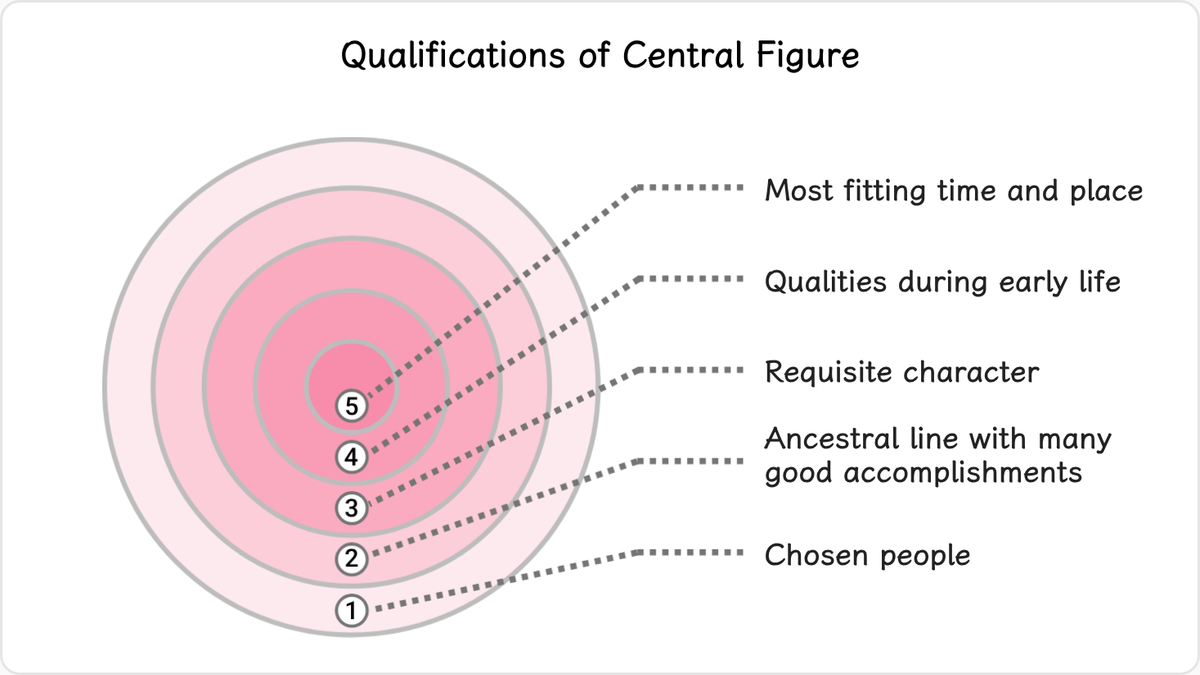
- What qualifications should the person possess to merit such a calling?
- First, the central figure must be born into the chosen people.
- Next, even among the chosen people, he must come from an ancestral line with many good accomplishments.
- Among the descendants of this outstanding lineage, he must be endowed with the requisite character.
- Among those with the requisite character, he must develop the necessary qualities during his early life.
- Finally, among those who have acquired these qualities, God selects first the individual who lives in a time and place most fitting to His need.
Elucidation of Biblical Verses Which Support the Doctrine of Absolute Predestination
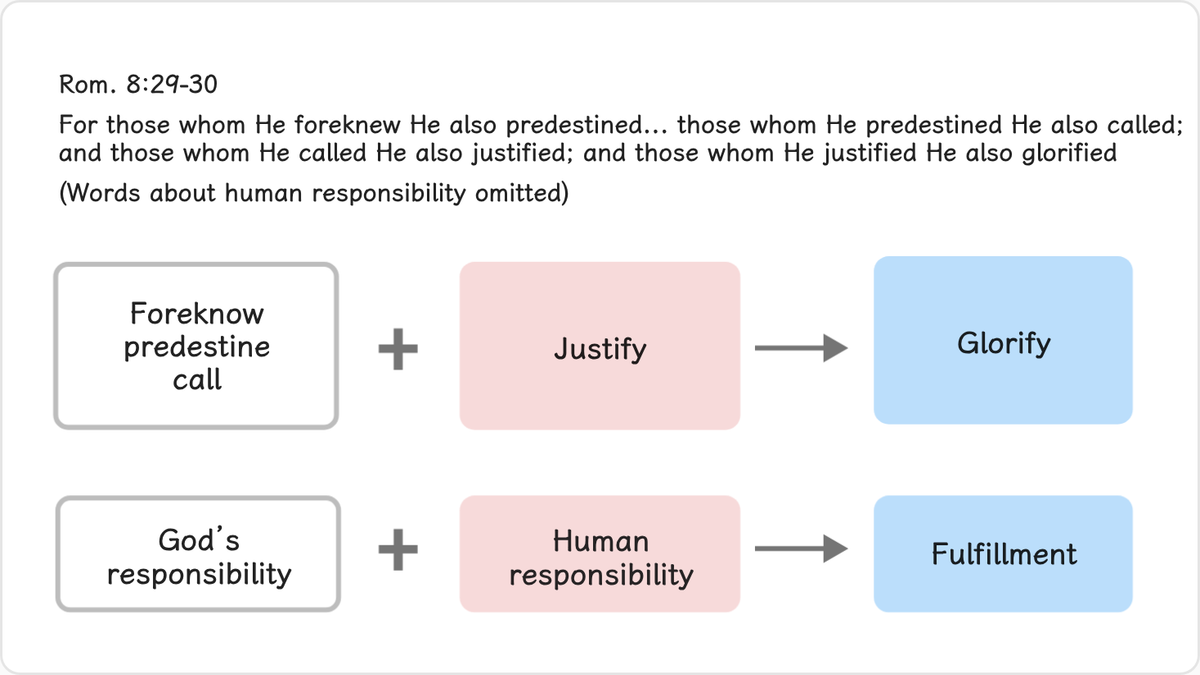
- Rom. 8:29-30 says: "For those whom He foreknew He also predestined . . . those whom He predestined He also called; and those whom He called He also justified; and those whom He justified He also glorified".
- God predestines those whom He foreknows; then He calls upon him to fulfill the purpose of the providence.
- Calling the person is God’s responsibility, but that alone does not entitle the person to be justified before God and given glory.
- Only when the person completes his responsibility after being called by God
- is he justified and then glorified.
- God’s predestination concerning an individual’s glorification is thus contingent upon the completion of his portion of responsibility.
- Because the biblical verse does not mention the human portion of responsibility, people may misinterpret it to mean that all affairs are determined solely by God’s absolute predestination.
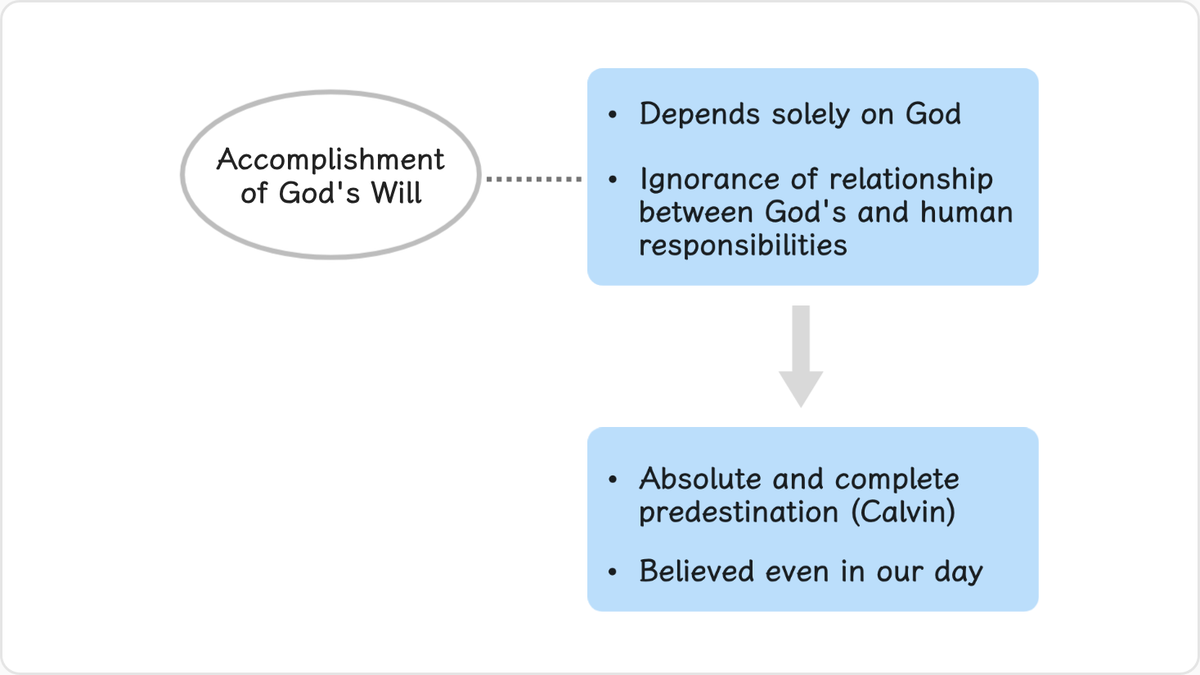
- People such as John Calvin have propounded the doctrine of absolute and complete predestination,
- which is widely believed even in our present day.
- They have held to such a doctrine because they wrongly believed that the accomplishment of God’s Will depends solely on the power and work of God.
- They were ignorant of the true relationship between God’s portion of responsibility and the human portion of responsibility in the fulfillment of the purpose of the providence of restoration.