The Parallels between the Two Ages in the Providence of Restoration
The Parallels between the Two Ages in the Providence of Restoration
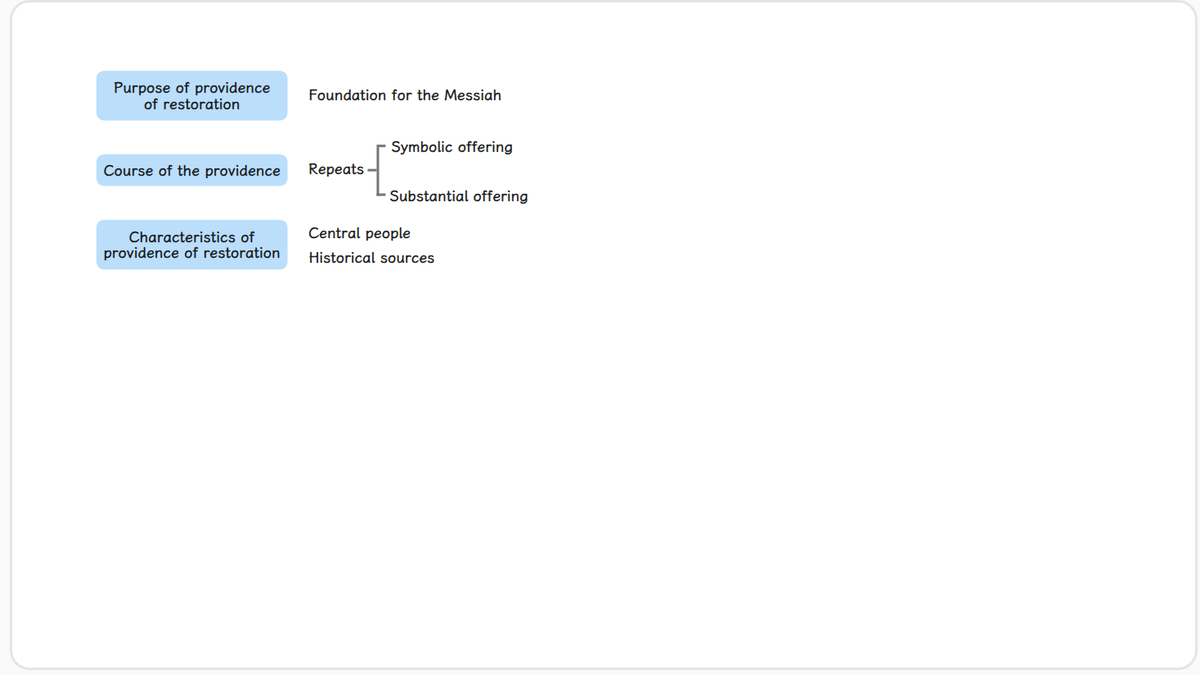
- Since the ultimate purpose of the providence of restoration is to lay the foundation for the Messiah, if it is prolonged, the dispensations to restore this foundation must be repeated.
- This has meant, in effect, the repetition of dispensations to restore through indemnity the symbolic offering and the substantial offering.
- Let us examine the comparable characteristics of each providential period from this standpoint.
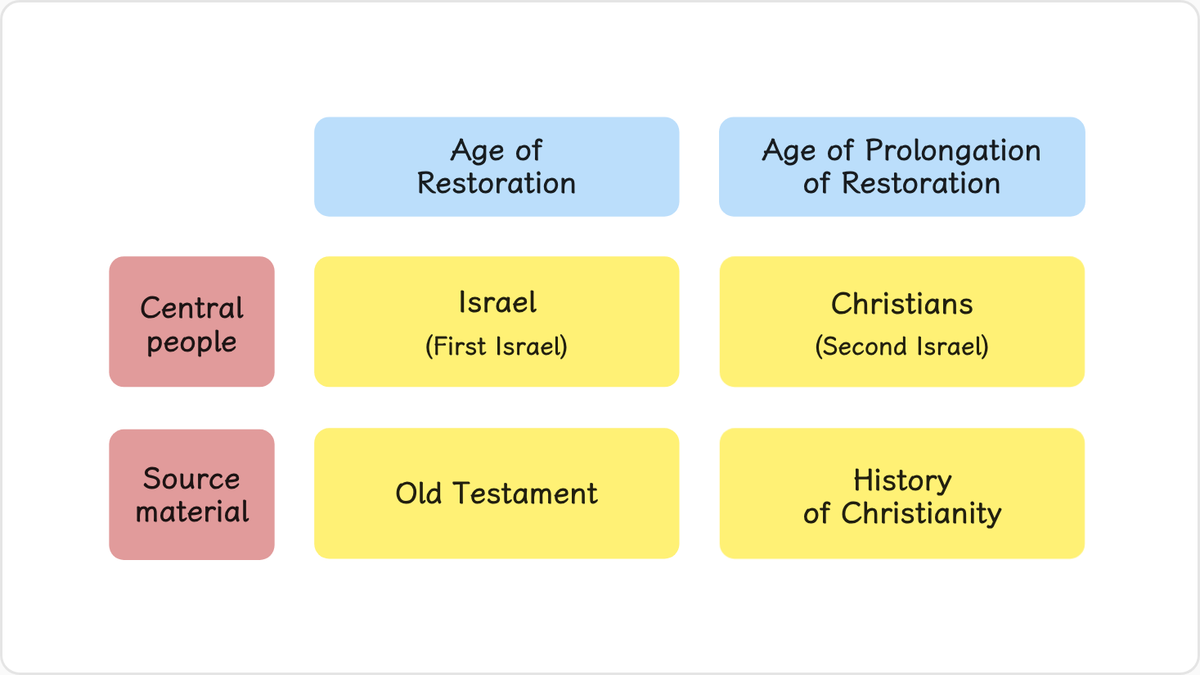
- The nation centrally responsible for God’s providence in the Age of the Providence of Restoration was Israel.
- The Old Testament, which records the history of Israel, provides the source material with which to study the history of the providence in that age.
- The people who became centrally responsible for the providence in the Age of the Prolongation of the Providence of Restoration were the Christians.
- Accordingly, the history of Christianity provides the source material for understanding providential history in this age.
- In this sense, the descendants of Abraham in the Old Testament Age may be referred to as the First Israel, and the Christians in the New Testament Age may be called the Second Israel.
The Period of Slavery in Egypt and the Period of Persecution in the Roman Empire
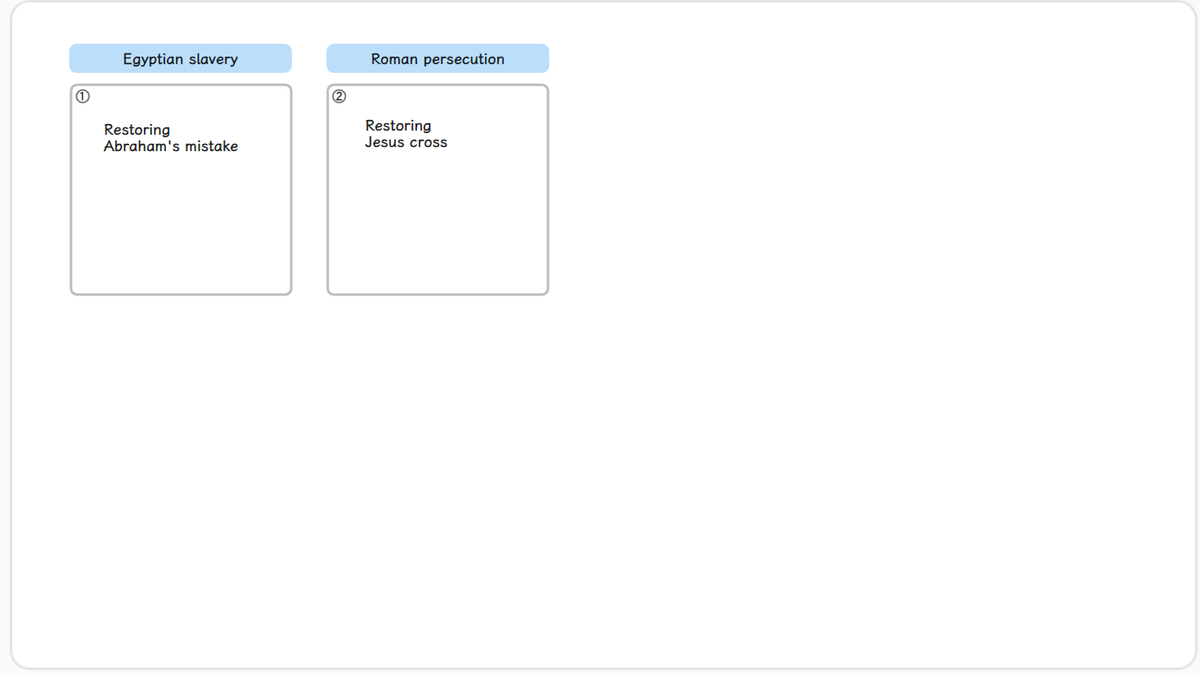
- The period of slavery in Egypt was for the restoration of the 400-year period from Noah to Abraham, which had been defiled due to Abraham’s mistake in his offering.
- The corresponding period of persecution in the Roman Empire was to restore this previous period through parallel indemnity conditions.
- By enduring this suffering, the Christians were restoring through indemnity the 400-year period of preparation for the advent of the Messiah,
- which had been defiled due to the Jewish people’s mistake in not honoring Jesus as a living sacrifice but leading him to the cross.
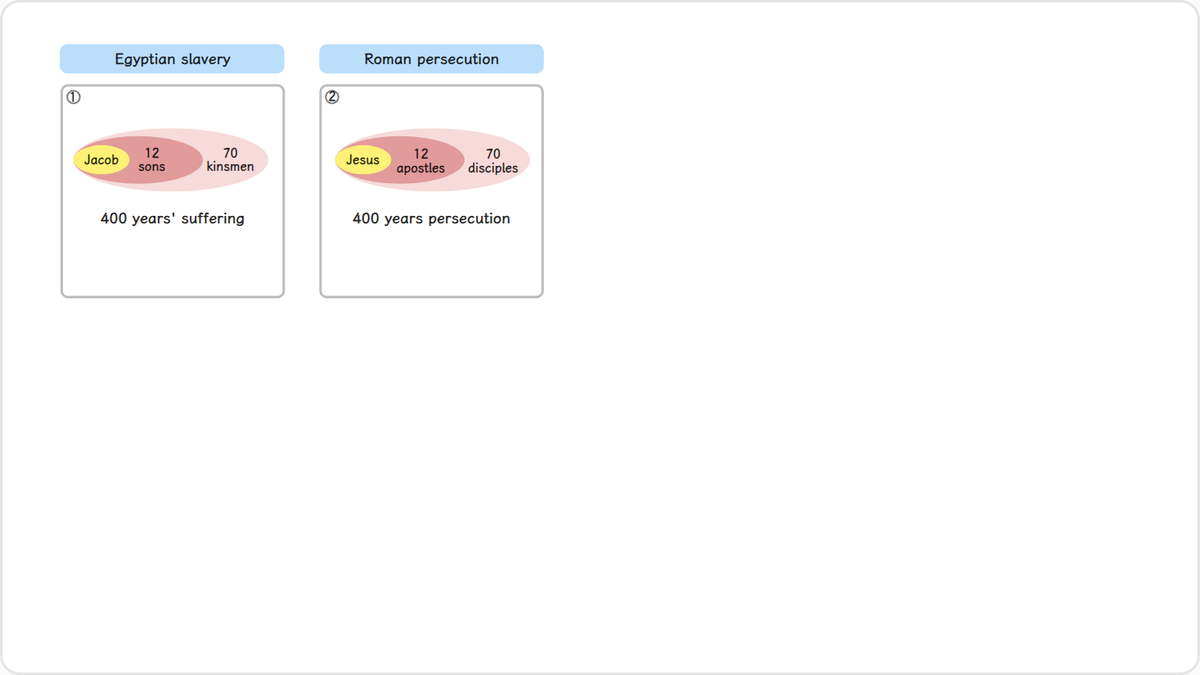
- During the period of Egyptian slavery, after Jacob entered Egypt with his 12 sons and 70 kinsmen, their descendants suffered terrible abuse at the hands of the Egyptians for 400 years.
- During the period of Roman persecution, Jesus' twelve apostles and seventy disciples were the first of many generations of Christians who suffered severe persecution in the Roman Empire over a period of 400 years.
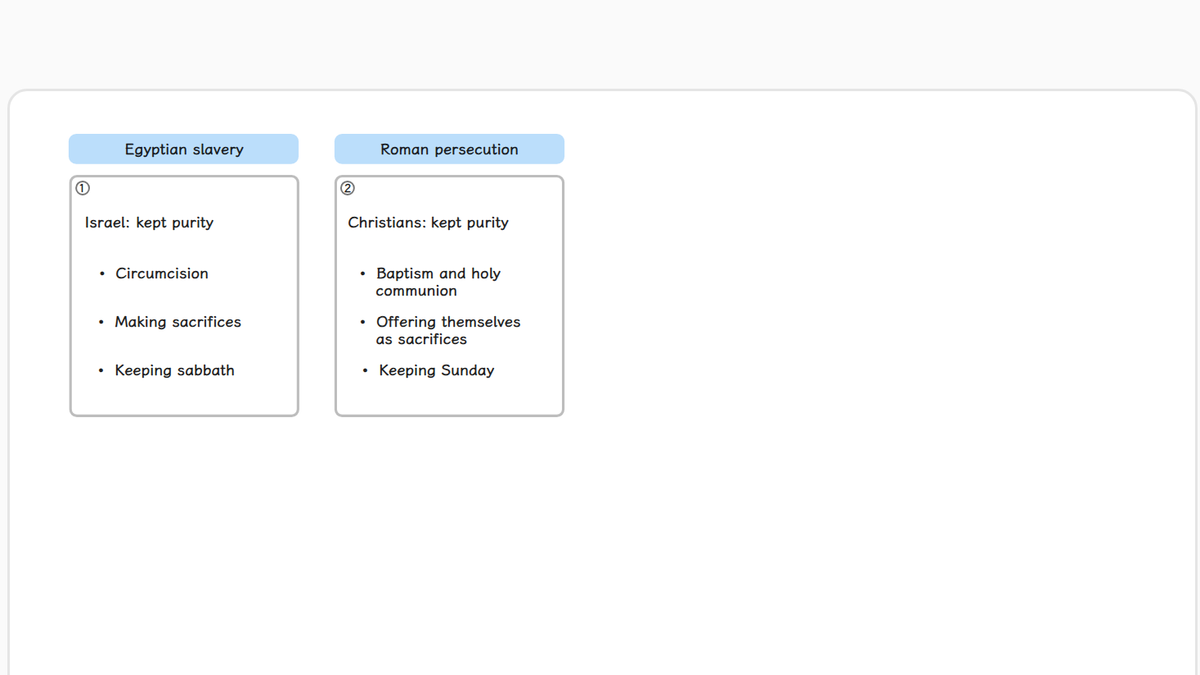
- In the period of slavery in Egypt, the chosen people of the First Israel kept themselves pure by circumcision, by making sacrifices, and, as they left Egypt, by keeping the Sabbath.
- During the period of persecution in the Roman Empire, the Christians as the Second Israel lived a life of purity by performing the sacraments of baptism and holy communion, offering themselves as sacrifices, and keeping the Sabbath.
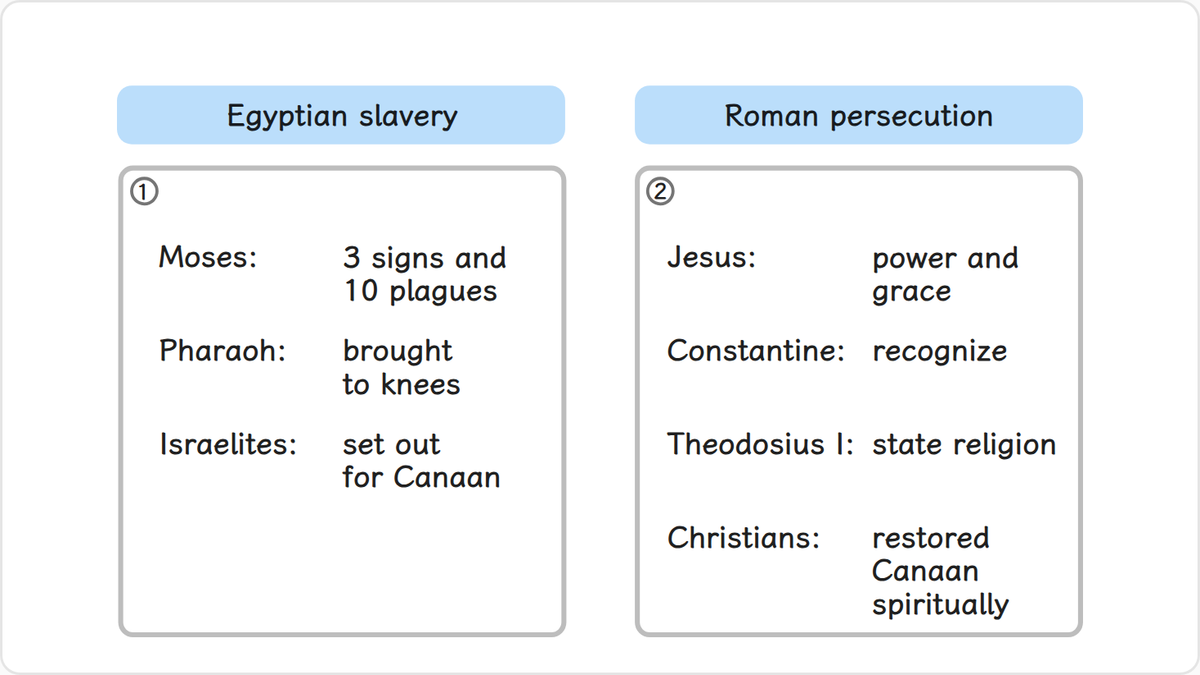
- Moses then led the Israelites out of Egypt and set out for the land of Canaan.
- He brought the Pharaoh to his knees by the power of the three signs and ten plagues.
- Likewise, toward the end of the period of persecution in the Roman Empire, Jesus increased the numbers of believers by moving their hearts with his power and grace.
- Jesus led Emperor Constantine to recognize Christianity,
- and Theodosius I to establish Christianity as the state religion.
- Christians thus restored Canaan spiritually inside the Roman Empire, the satanic world.
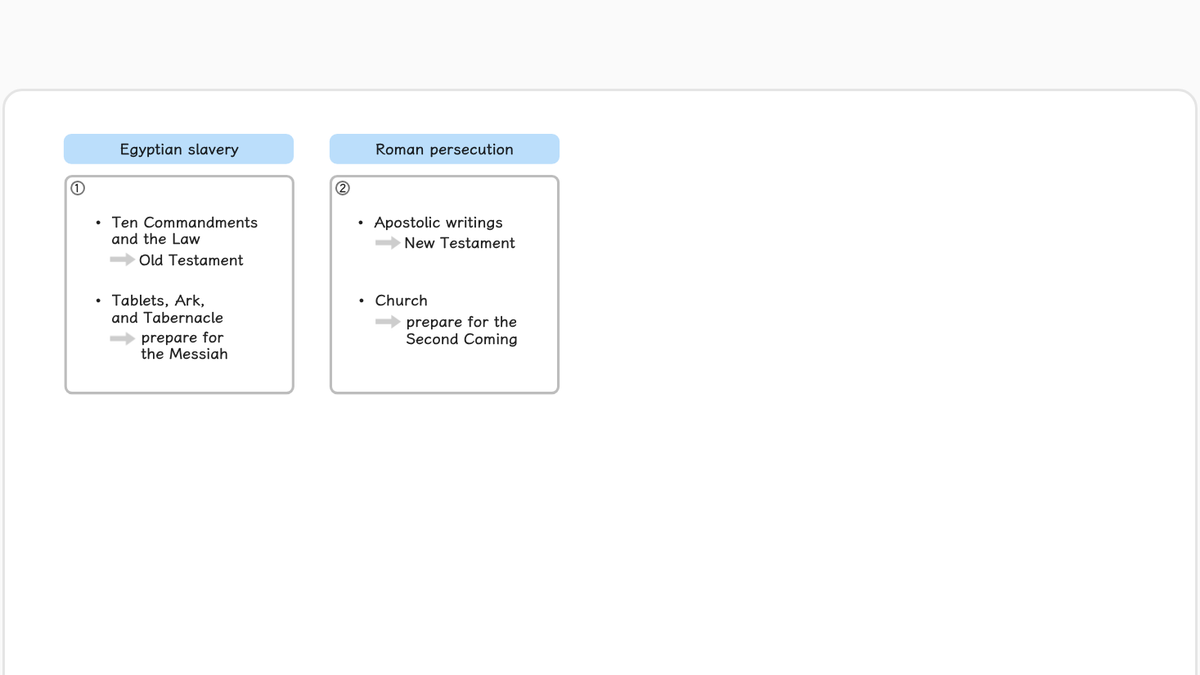
- Moses received the Ten Commandments and God’s Word revealed in the Law, which formed the core of the Old Testament Scriptures.
- By setting up and honoring the tablets of stone, the Ark of the Covenant and the Tabernacle, he paved the way for the Israelites to prepare for the coming of the Messiah.
- Christians gathered the writings which had been left behind by the apostles and evangelists and established the canon of the New Testament.
- They built up churches and expanded their foundation to prepare for the Second Coming of Christ.
The Period of the Judges and the Period of Regional Church Leadership
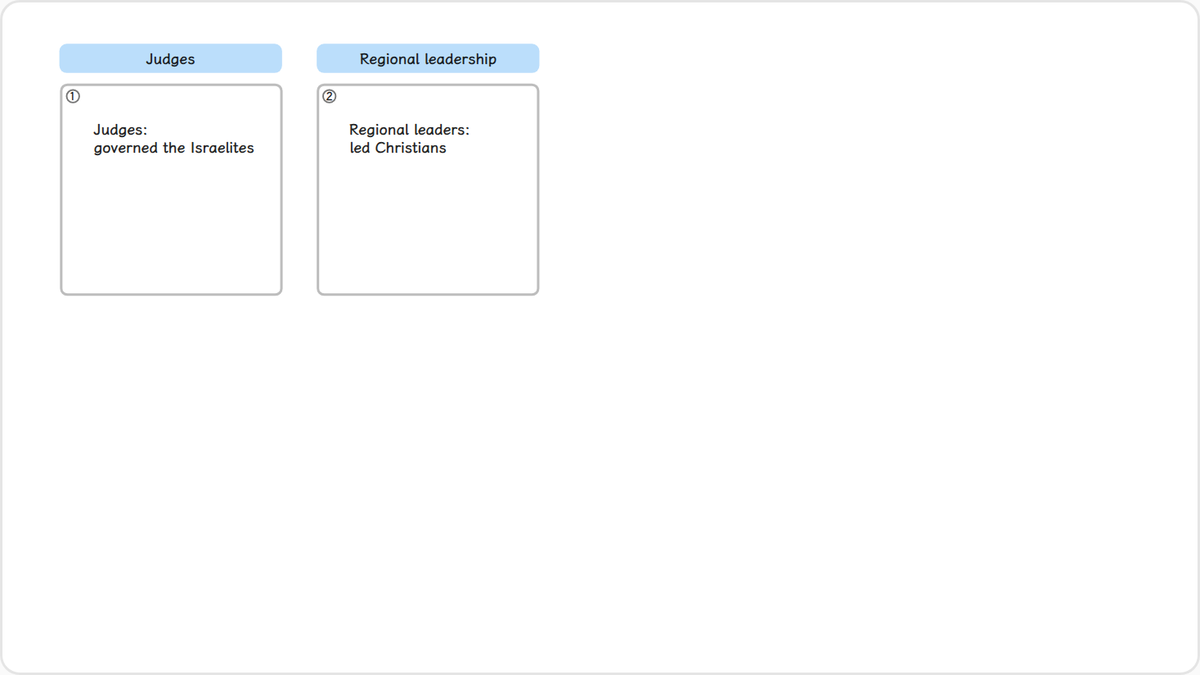
- After the Israelites entered the land of Canaan, 15 judges including Samson, Eli and Samuel governed the Israelite tribes for 400 years. This is called the period of the judges.
- In the New Testament Age, the period of regional church leadership was set up to restore the period of the judges through parallel indemnity conditions.
- In this period, regional church leaders – patriarchs, bishops and abbots – led Christian society and had duties similar to those of the judges.
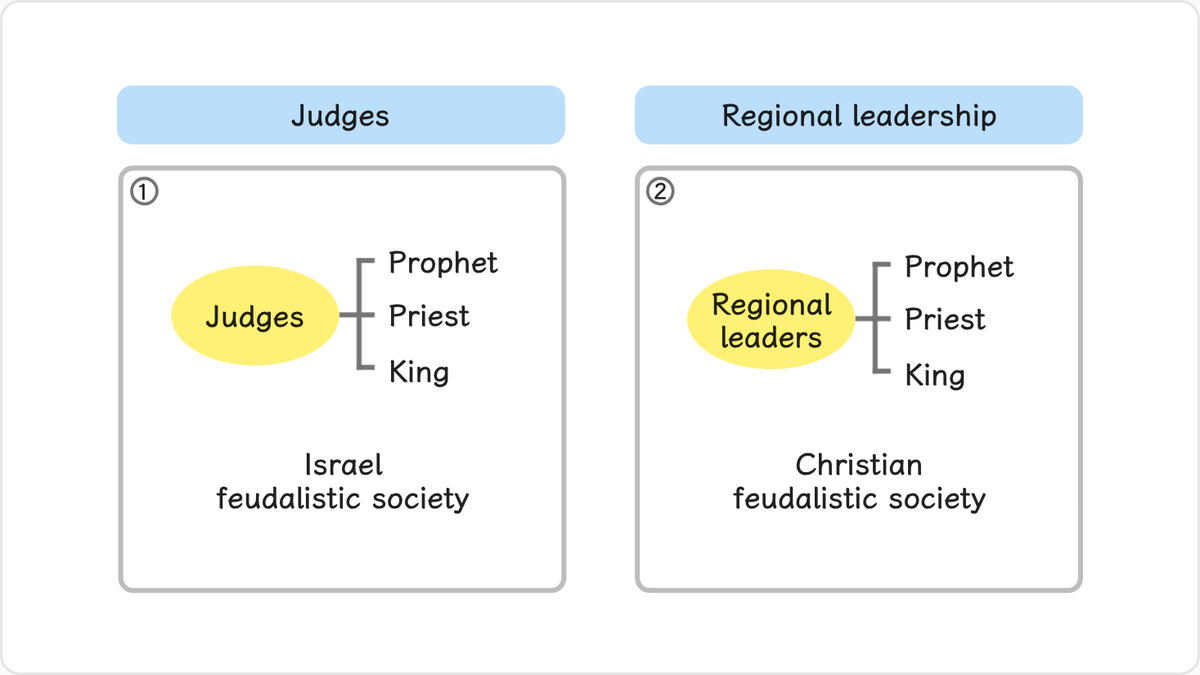
- The judges filled the various responsibilities of prophet, priest and king, which became separate offices in the later periods.
- Israel in this period was a feudalistic society.
- Like the judges of the Old Testament Age, the regional church leaders had duties similar to those of prophet, priest and king.
- Christian society in this period was a feudalistic society under these local authorities.
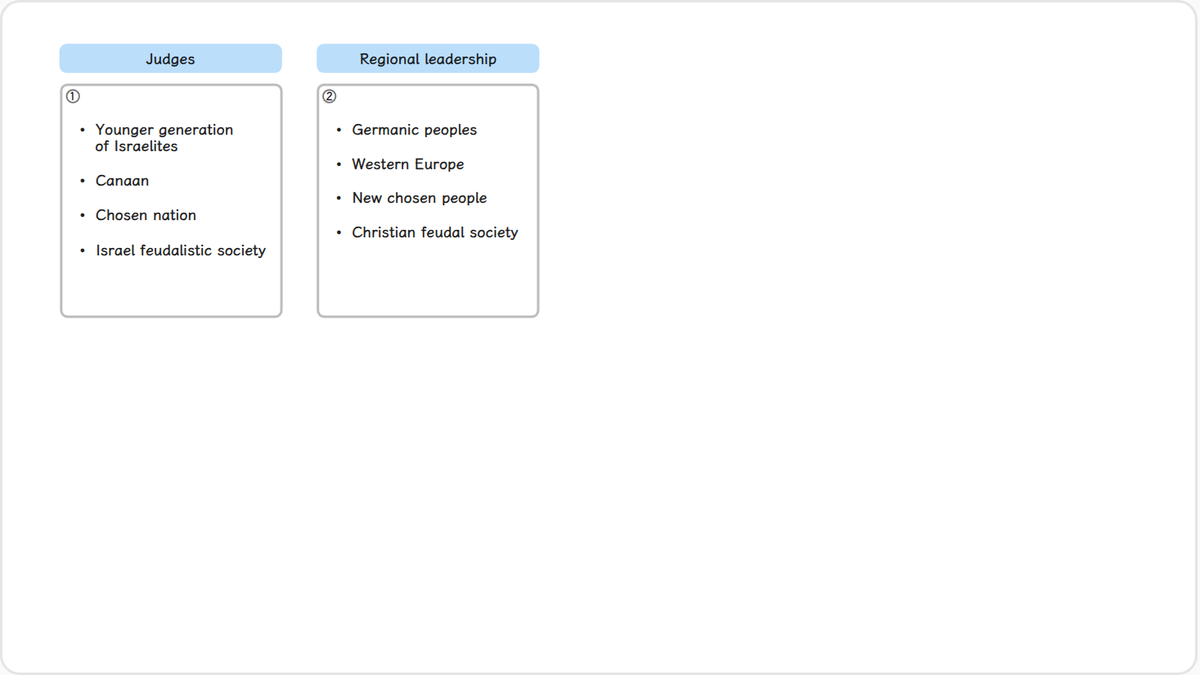
- The period of the judges began after the Israelites were liberated from slavery in Egypt and the younger generation united solidly under the leadership of Joshua and Caleb to enter the land of Canaan.
- They parceled out the territory among their clans and tribes.
- Settling in villages united around the judges, the people consolidated into a chosen nation and established a simple feudalistic society.
- The period of regional church leadership in the Christian era began after the liberation of Christianity from the persecution of the Roman Empire, the satanic world.
- Christians spread the Gospel to the Germanic peoples, many of whom had migrated to Western Europe in the fourth century to escape the invading Huns.
- In their new land of Western Europe, God raised up the Germanic tribes as a new chosen people,
- and established an early form of feudal society, which later matured into the feudalism of the Middle Ages.
The Period of the United Kingdom and the Period of the Christian Empire
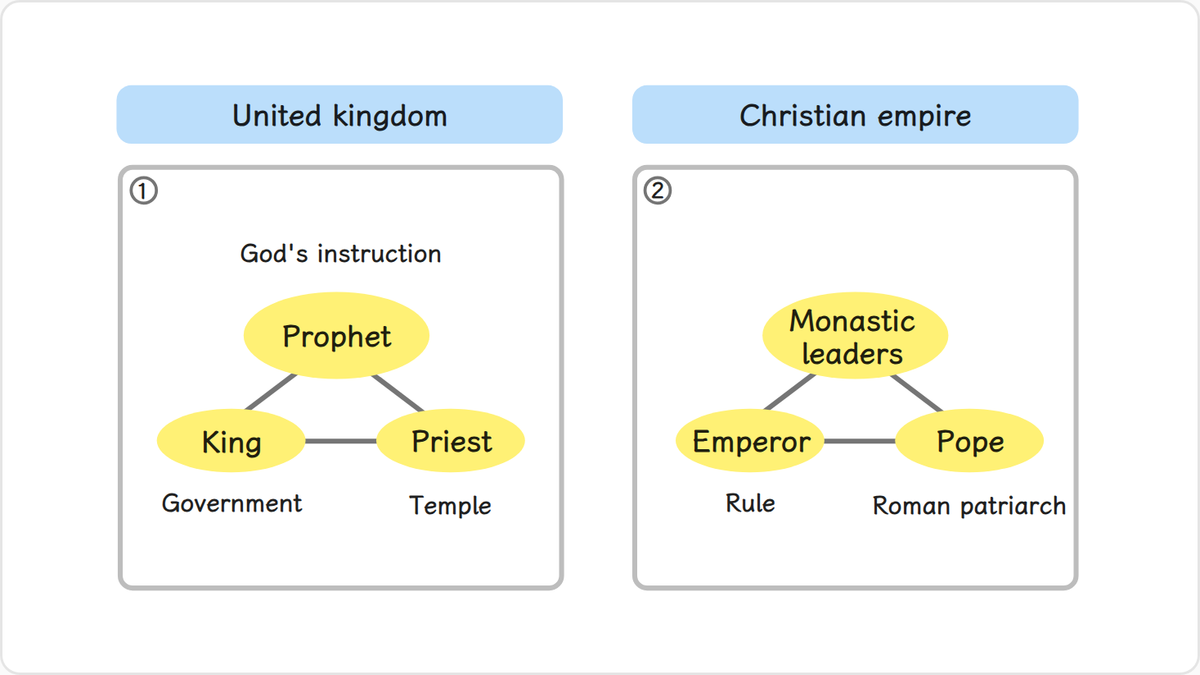
- In the period of the united kingdom, the functions of the judge were apportioned to the offices of prophet, priest and king.
- The prophets received instructions directly from God, the priests kept charge over the Tabernacle and later the Temple, and the king governed the nation.
- Each carried on their distinct missions in guiding Israel to accomplish the goal of the providence of restoration.
- The purpose of the period of the Christian empire was to restore the period of the united kingdom through parallel indemnity conditions.
- Thus, when the period of regional church leadership came to a close,
- the missions of these leaders were apportioned to the offices of monastic leaders corresponding to the prophets, the pope corresponding to the high priest, and the emperor, who ruled the people.
- They were responsible to guide the Second Israel to accomplish the goal of the providence of restoration.
- In the previous period, the Christian Church had been divided into the five patriarchates of Jerusalem, Antioch, Alexandria, Constantinople and Rome, with Rome dominant in the West.
- The pope, as the Roman patriarch was called, supervised all the bishops and abbots in Western Europe.
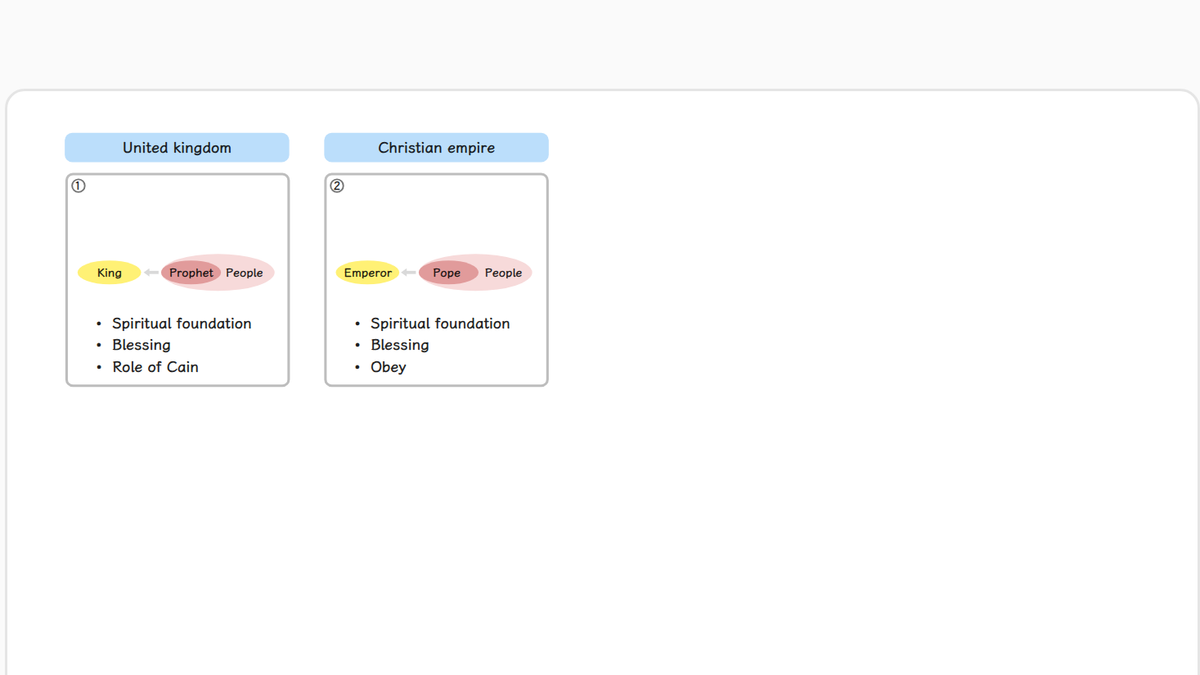
- In the period of the united kingdom of Israel, the king was the central figure for restoring the foundation of faith.
- The prophet and high priest, after laying the spiritual foundation for the king and anointing and blessing him as king, were to take the role of Cain before him.
- In the Christian empire, the central figure of the foundation of faith was the emperor.
- The pope, comparable to the high priest of Israel, who received God’s commands through the prophets, was to lay the spiritual foundation for the emperor.
- After crowning and blessing the emperor, the pope was to obey him as a subject.
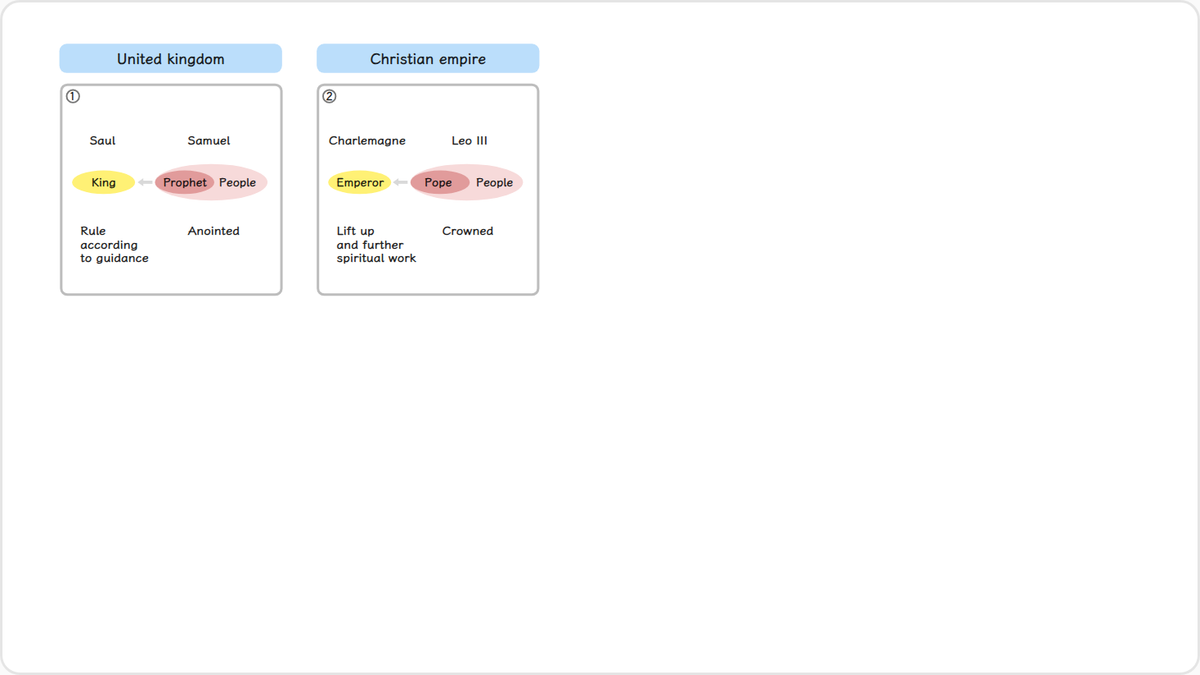
- In the period of the united kingdom, the king was to rule his kingdom according to the guidance of the prophets, and the prophets were to obey the king as his subjects.
- About 800 years after Abraham’s descendants entered Egypt, by God’s command the prophet Samuel anointed Saul as the first king of Israel.
- In the Christian empire, the emperor, in turn, was to lift up and further the spiritual work of the papacy.
- Likewise, Pope Leo III crowned Charlemagne and blessed him as the first emperor of Christendom (Second Israel) in 800 A.D.
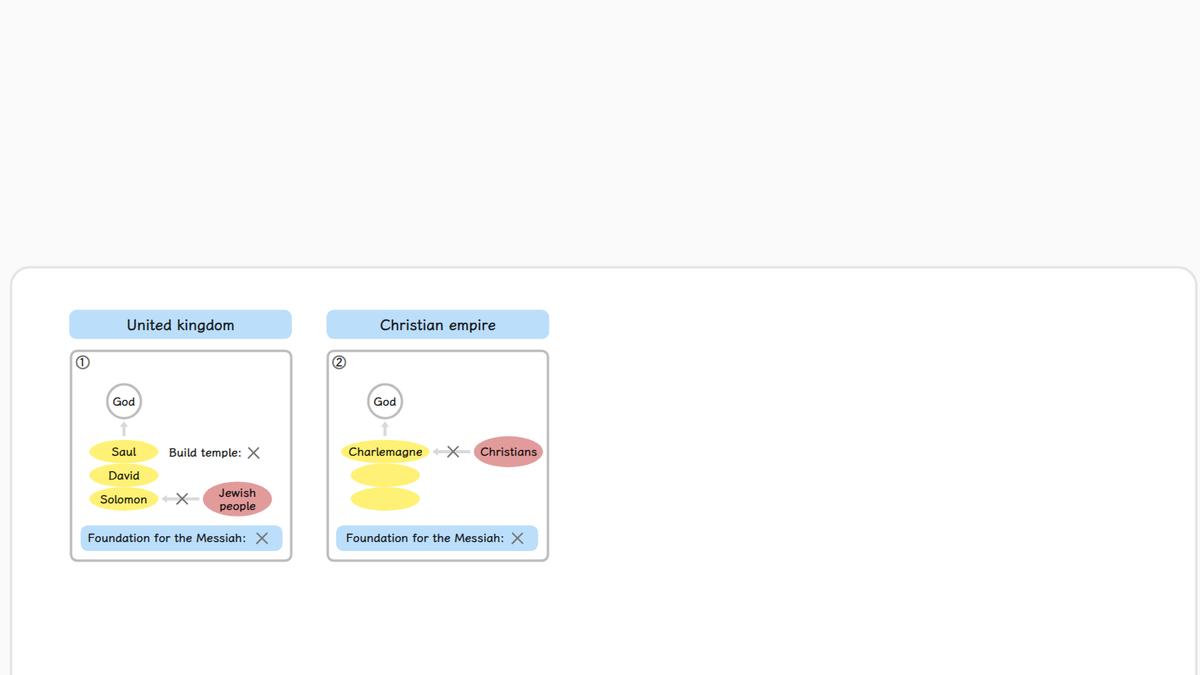
- Because King Saul disobeyed the commands of God given through the prophet Samuel (I Sam. 15:1-23), he was in no position to build the Temple.
- 40 years of King David’s reign and 40 years of King Solomon’s reign would pass before the foundation of faith was laid and the Temple built.
- Nevertheless, King Solomon left the position of Abel for the substantial offering when he fell into lust.
- Hence, there was no way for Israel to establish the foundation of substance or the foundation for the Messiah.
The Period of the Divided Kingdoms of North and South and the Period of the Divided Kingdoms of East and West
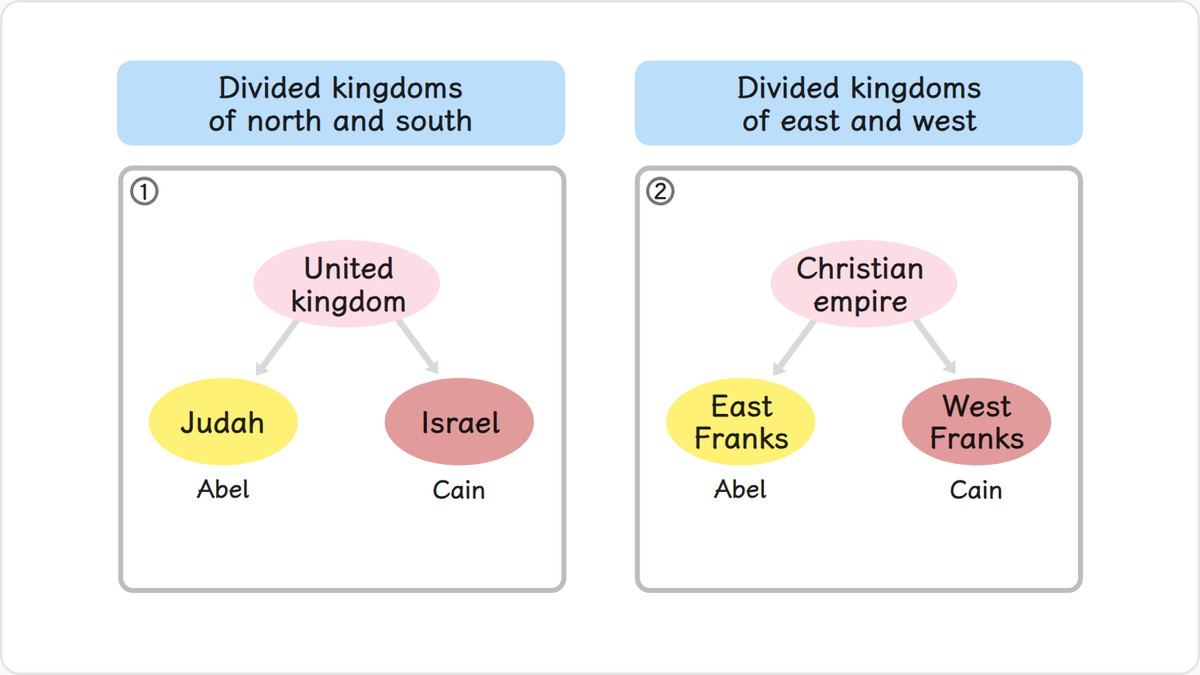
- Because King Solomon was led by his wives and concubines to worship idols, the united kingdom of Israel was divided upon his death, having lasted only three generations.
- The kingdom of Israel in the north, which was founded by ten of the twelve tribes, was in the position of Cain,
- while the kingdom of Judah in the south, which was founded by the two remaining tribes, was in the position of Abel.
- This was how the period of the divided kingdoms of north and south began.
- The Christian empire also began to divide in the third generation. Charlemagne’s grandsons partitioned it into three kingdoms: the East Franks, the West Franks and Italy.
- The descendants of Charlemagne were in bitter and constant conflict with each other.
- The remnants of the Christian empire soon coalesced into two kingdoms, with Italy reverting to the rule of the East Franks.
- The kingdom of the East Franks came to be called the Holy Roman Empire and it stood in the position of Abel in relation to France, as the kingdom of the West Franks came to be called.
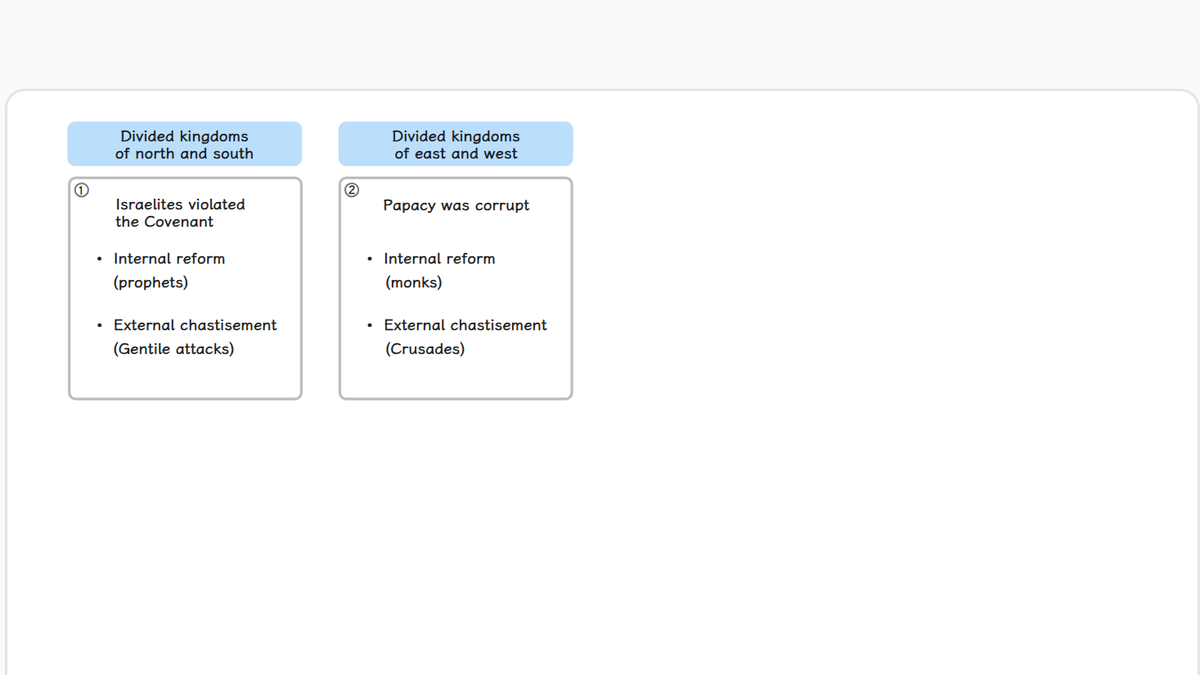
- In the period of the divided kingdoms of north and south, whenever the Israelites violated their covenant with God, straying from the ideal of the Temple,
- God sent many prophets to move them to repentance and internal reform.
- However, because they did not repent, God chastised them externally by sending gentile nations such as Syria, Assyria and Babylon to attack them.
- During the parallel period of the divided kingdoms of east and west, the papacy was corrupt.
- God sent prominent monks to promote internal reform in the Church.
- Since the papacy and the Church did not repent, God chastised them externally by letting their people fight the Muslims. This was the providential reason behind the Crusades.
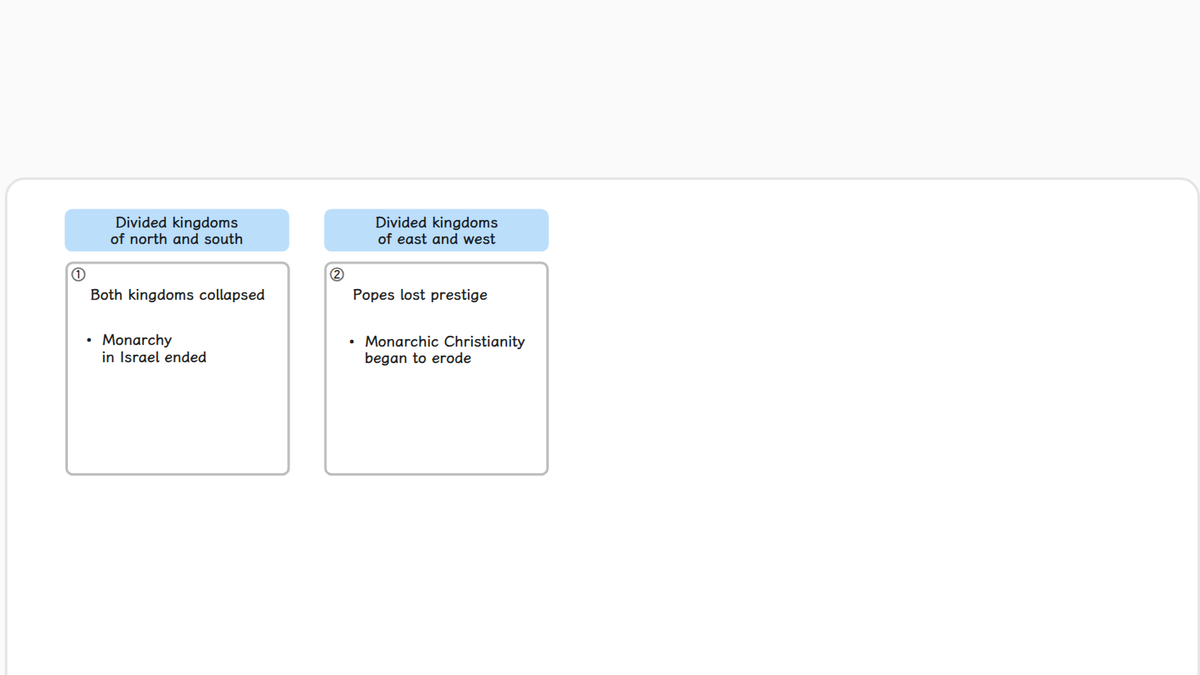
- The period of the divided kingdoms of north and south came to an end when gentile nations took the people of Israel and Judah into exile.
- They put an end to the monarchy in Israel.
- Likewise, at the close of the period of the divided kingdoms of east and west, the papacy had completely lost its prestige and credibility after the repeated defeats of the Crusades.
- Christianity thus lost its center of spiritual sovereignty.
- Moreover, the lords and knights were decimated by the Crusades, and since the papacy and the feudal lords had spent enormous funds to pursue these unsuccessful wars, they were left impoverished.
- Monarchic Christianity began to erode.
The Period of Israel’s Exile and Return and the Period of the Papal Exile and Return
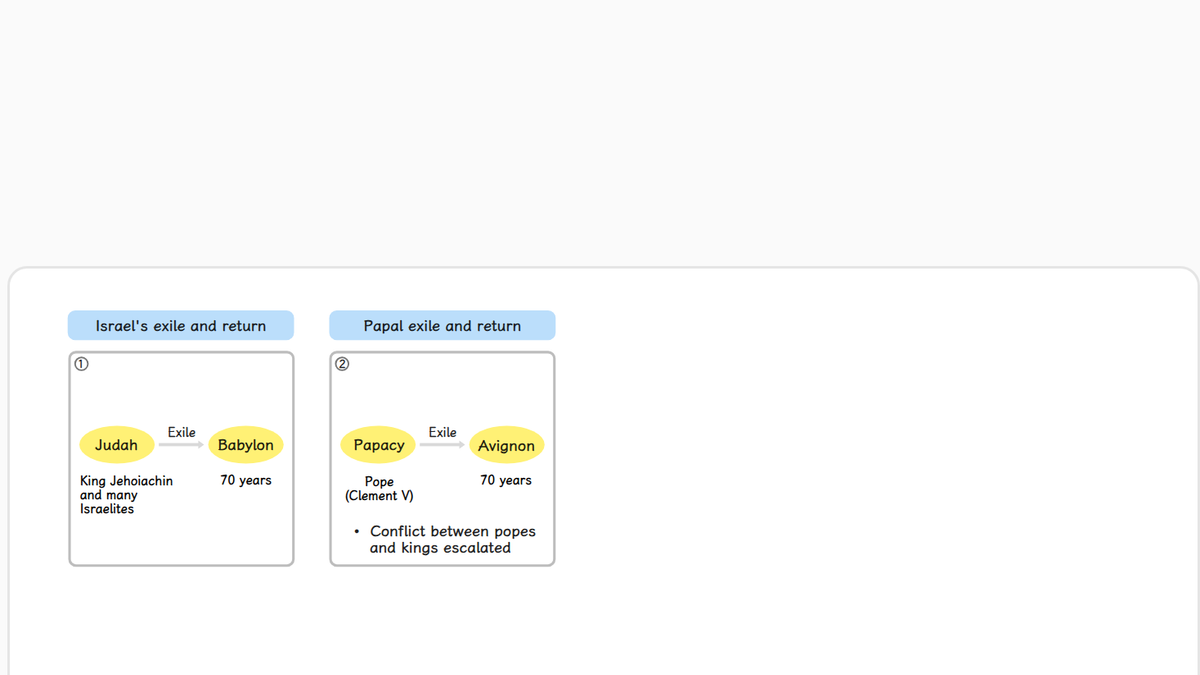
- Because the Israelites fell into faithlessness, God had them suffer hardships as exiles in Babylon.
- Nearly seventy years elapsed from the time King Nebuchadnezzar of Babylon took into captivity King Jehoiachin and his royal family, as well as prophets including Daniel and Ezekiel, priests, officials, craftsmen and many other Israelites, until Babylon fell.
- In the period of papal exile and return, the end of the Crusades saw the gradual collapse of the feudal system in Europe and the emergence of modern nation-states.
- As the power of secular monarchies grew, the conflict between the popes and the kings escalated.
- In one such conflict, King Philip IV, “the Fair,” of France imprisoned Pope Boniface VIII for a time.
- In 1309, Philip forced Pope Clement V to move the papacy from Rome to Avignon in southern France.
- For seventy years, successive popes lived there subject to the kings of France, until the papal residence returned to Rome.
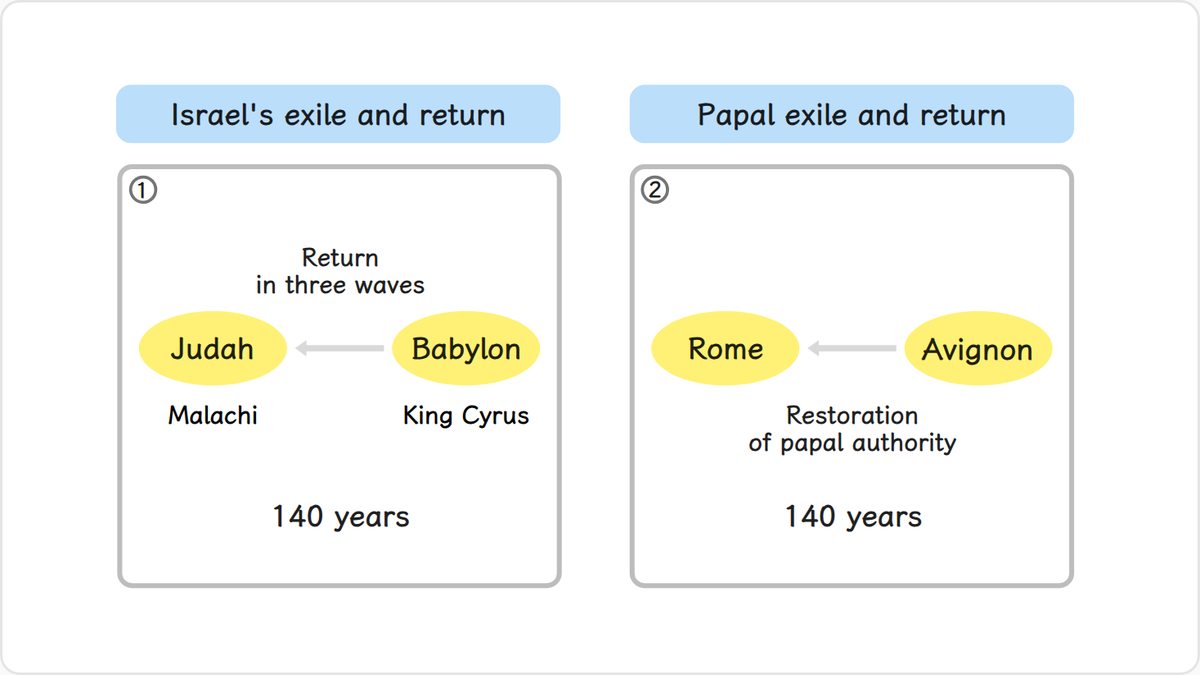
- After Persia conquered Babylon and the Persian King Cyrus liberated the Israelites, it took another 140 years for the exiles to return to their homeland in three waves,
- until they fully reformed themselves as a nation united around God’s Will as proclaimed in the messianic prophecies of Malachi. Henceforth, they began to prepare for the coming of the Messiah.
- After the pope returned to Rome, a period of approximately 140 years ran, through the Great Schism, the conciliar movement and the restoration of papal authority in the Roman Church,
- to the eve of the Protestant Reformation spearheaded by Martin Luther in 1517.
The Period of Preparation for the Advent of the Messiah and the Period of Preparation for the Second Advent of the Messiah
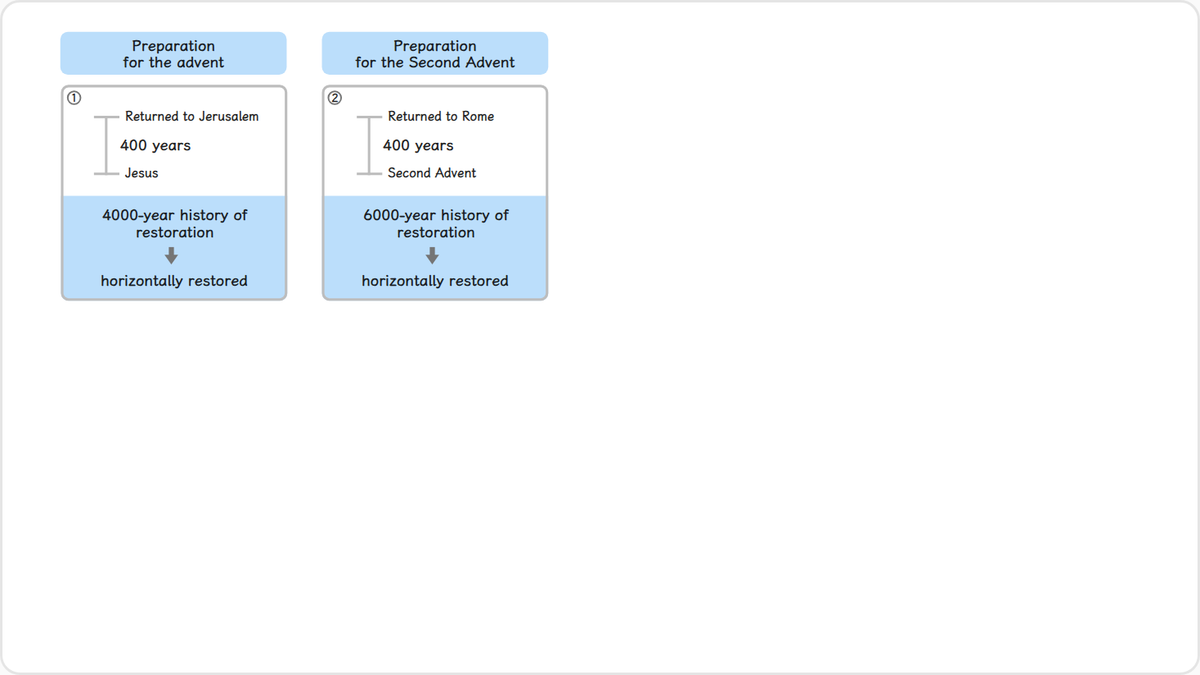
- After the Israelites returned to Jerusalem, another 400 years elapsed before Jesus came.
- This was the period of preparation for the advent of the Messiah and it was intended to be the final period of providential history in which the vertical indemnity conditions of 4,000 years would be horizontally restored through indemnity.
- After the papacy returned to Rome, Christianity is to meet the Christ at his Second Advent only after passing through 400 years of the period of preparation for the Second Advent of the Messiah.
- This period is intended to be the final period of providential history, when all the vertical indemnity conditions which have accumulated during the 6,000-year history of the providence of restoration since Adam’s day are horizontally restored.
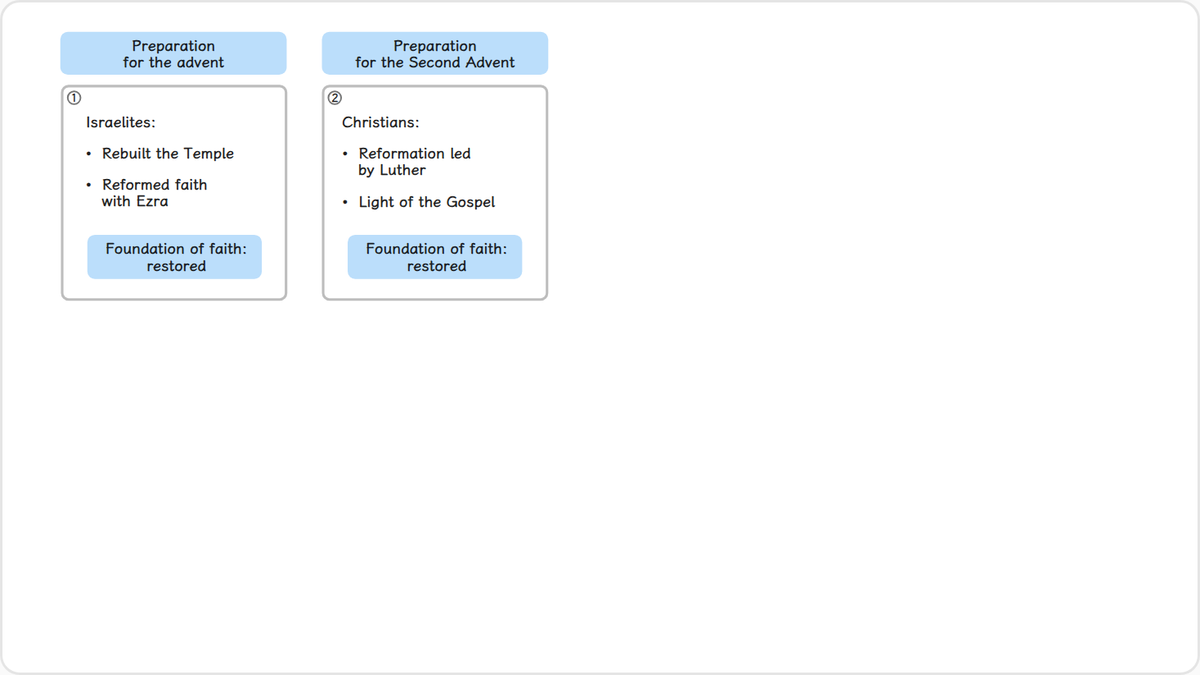
- Upon returning from the Babylonian exile,
- the Israelites established the foundation of faith by repenting of their past sin of idolatry, rebuilding the Temple,
- and reforming their faith based on the Mosaic Law under the guidance of Ezra the scribe.
- Likewise, medieval Christians established the foundation of faith by seeking to reform the Roman church.
- These efforts culminated in the Protestant Reformation led by Martin Luther.
- This movement pierced the gloom of medieval Europe with the light of the Gospel and pioneered new paths of faith.
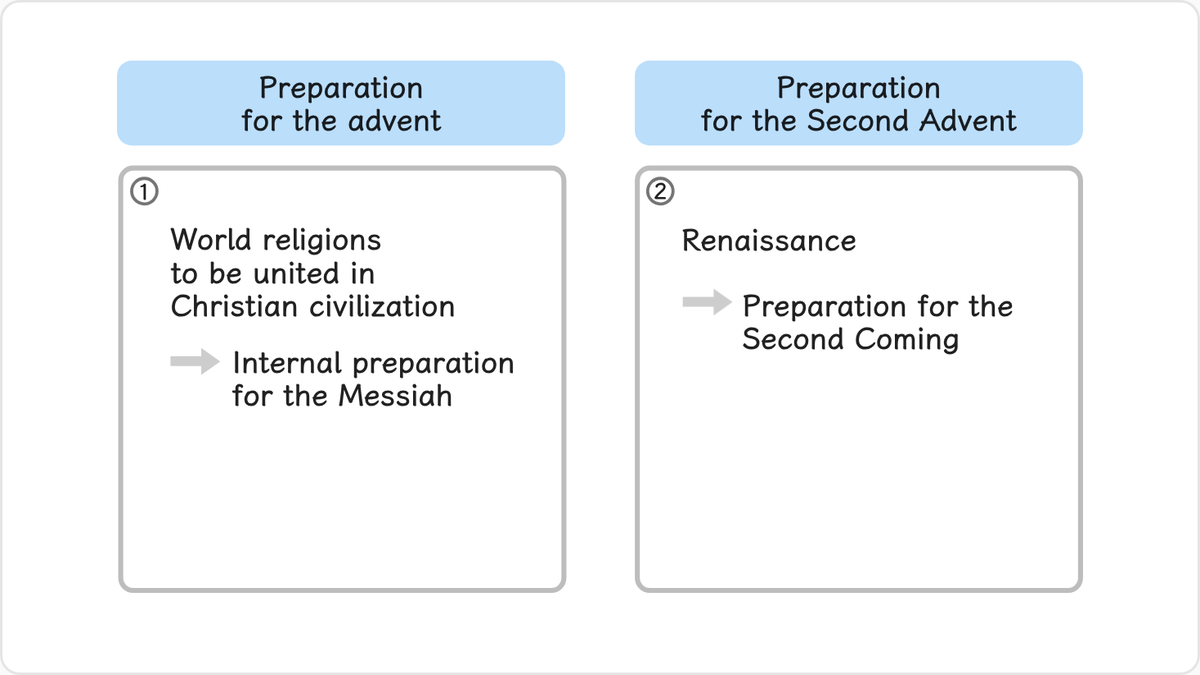
- In the period of the preparation for the advent of the Messiah, among the world's peoples, God founded religions suited to their regions and cultures by which they could make the necessary internal preparations to receive the Messiah.
- Jesus was to come upon this worldwide foundation of preparation and bring together all religions into one worldwide Christian civilization.
- In the period of preparation for the Second Advent of the Messiah, beginning with the Renaissance,
- progress in virtually every field of human endeavor, including politics, economy, culture and science, has increased at a rapid rate, creating a global environment conducive to the work of Christ at his Second Coming.
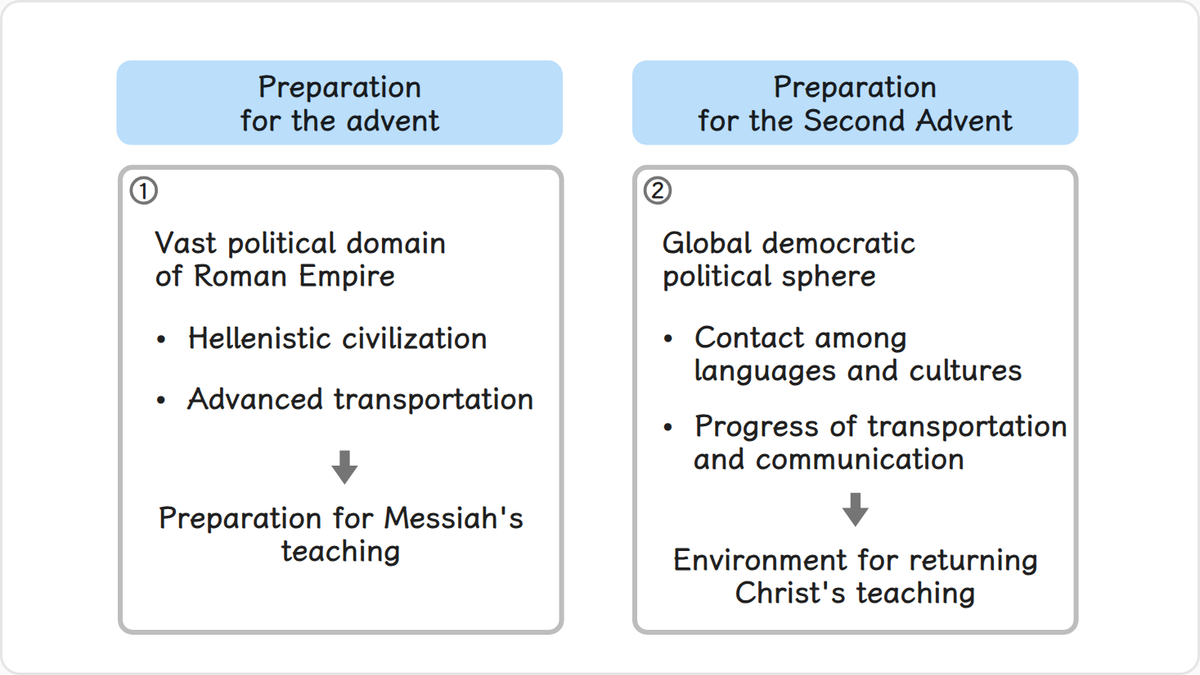
- In Jesus’ day, the Roman Empire ruled the vast domains, integrated by an advanced and extensive transportation system.
- This was the center of a vast Hellenistic civilization.
- Thus, all the necessary preparations had been made for a swift transmission of the Messiah's teachings to the world.
- Similarly, in the present era of the Second Advent, the democratic political sphere has expanded throughout the world.
- The rapid progress of transportation and communication, and the extensive contact among languages and cultures has brought the world much closer together.
- These factors have fully prepared an environment in which the teachings of the returning Christ can freely and swiftly be conveyed to the hearts of all humankind.
The Providence of Restoration and the Progress of History
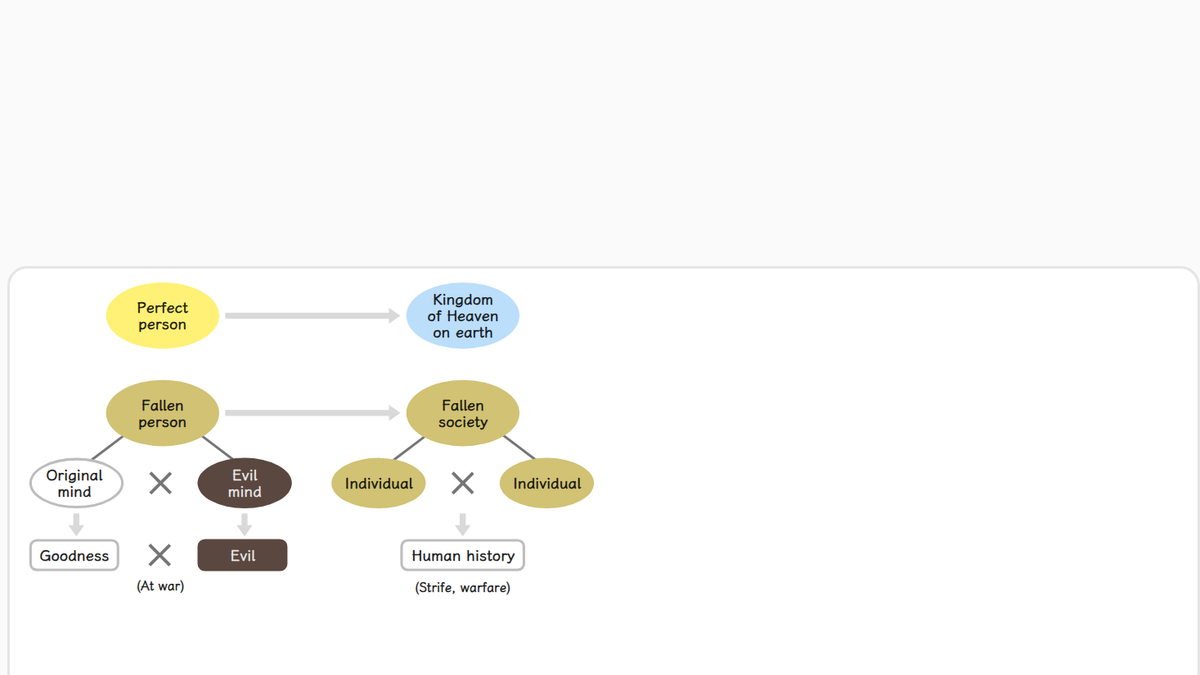
- Fallen society may be regarded as formed in the likeness of a fallen person.
- We can better understand the history of societies built by sinful humanity by examining the inner life of a fallen person.
- A fallen person possesses both an original mind, which pursues goodness, and an evil mind, which pursues evil, and the two minds are constantly at war with each other, inclining him toward shifting and conflicting behavior.
- Since human society is composed of individuals who are constantly at war within themselves, interactions among them cannot help but be full of discord and conflict.
- Human history has consisted of people’s conflict-ridden social relationships constantly changing with the course of time. Hence, it has necessarily unfolded in strife and warfare.
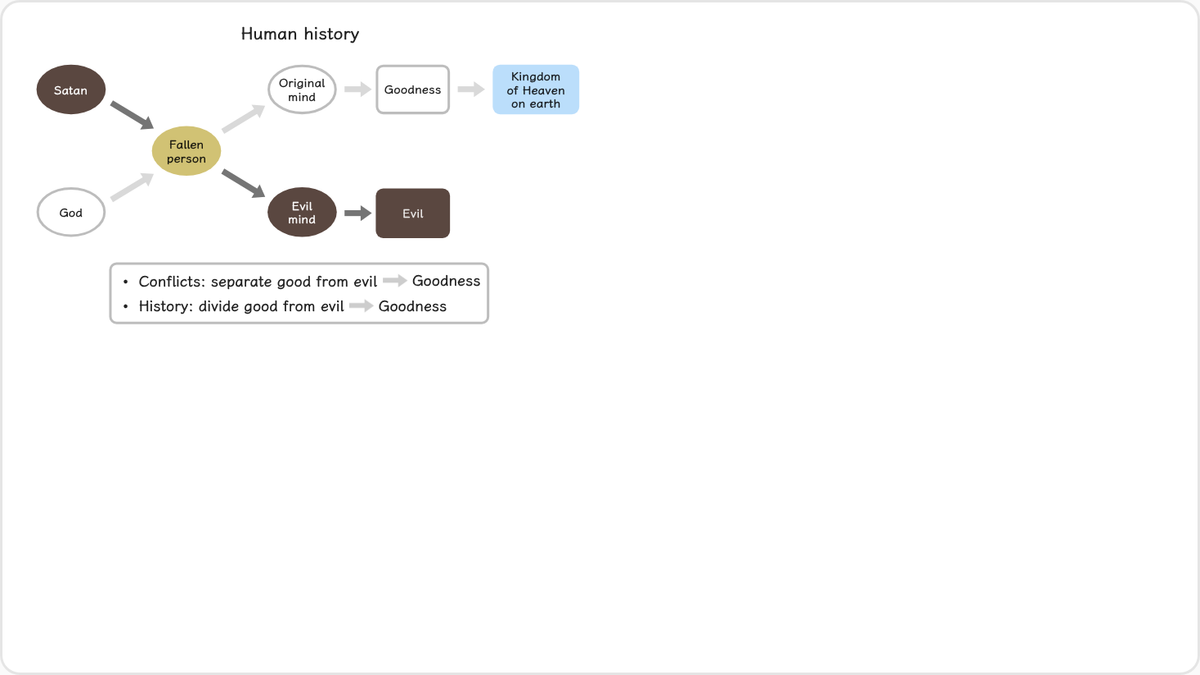
- Because of the activity of the original mind within himself, even a fallen person can respond to God’s providence of restoration and join in furthering the goal of goodness.
- Progress in history thus originates with individuals who, even amidst the vortex of good and evil, make determined efforts to reject evil and promote goodness.
- Therefore, the world toward which history is progressing is the Kingdom of Heaven, where the goal of goodness will be realized.
- We must understand that conflicts and wars are interim phenomena to separate good from evil in the pursuit of this ultimate goal of goodness.
- In this respect, we can recognize that the progress of history toward goodness is driven by a process of constantly dividing good from evil according to God’s providence of restoration.
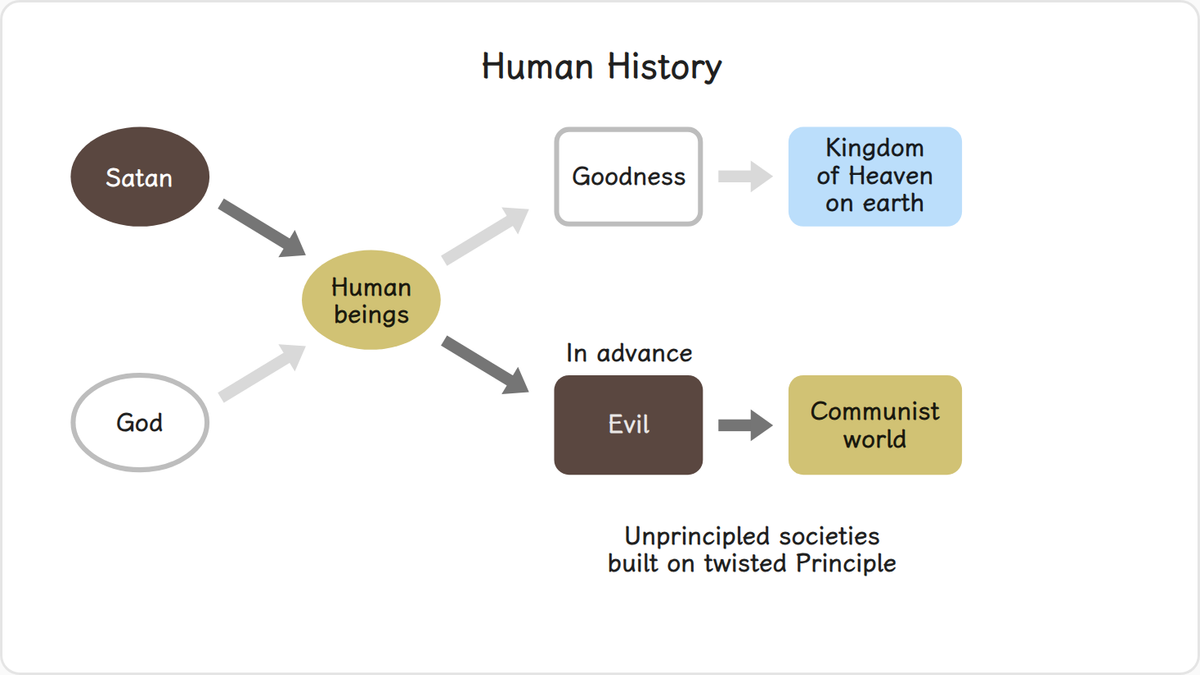
- Meanwhile, on the basis of his relationship of blood ties with the first human beings,
- Satan has worked through fallen people to realize, in advance of God, a perverted form of the ideal society which God intends to realize.
- As a result, in human history we witness the rise of unprincipled societies which are built upon twisted versions of the Principle.
- At the end of human history, before God can restore the Kingdom of Heaven on earth, Satan will have built an unprincipled world in a distorted image of the Kingdom: this is none other than the communist world.
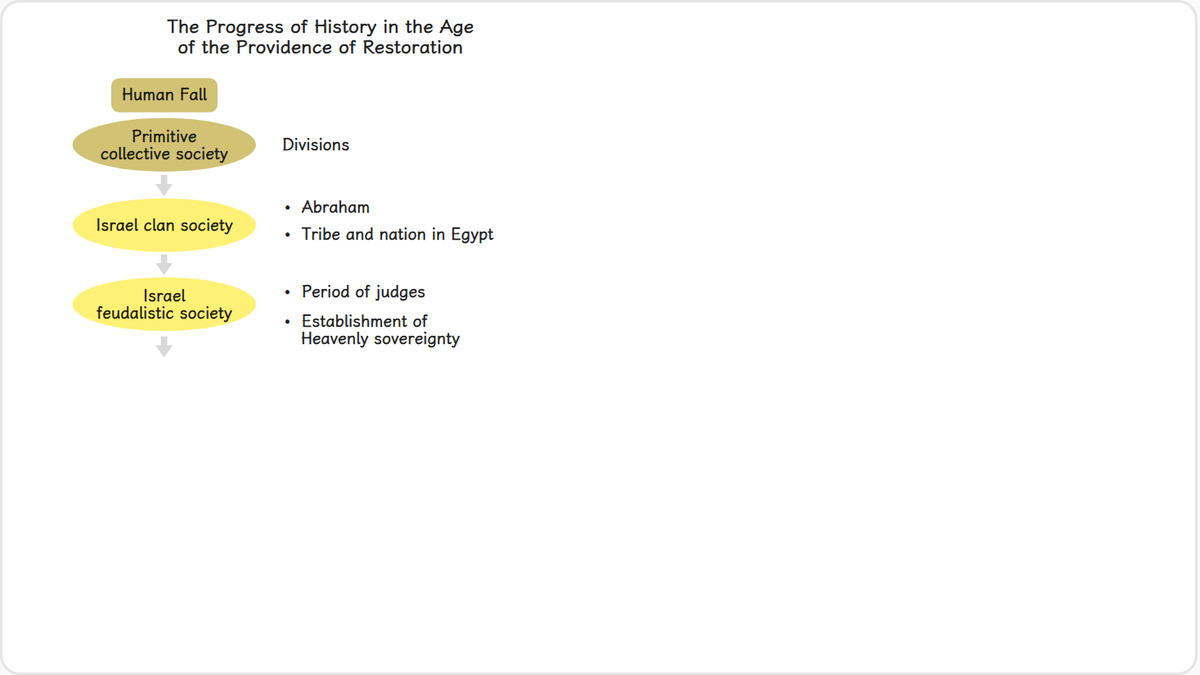
- The first society built by fallen people was a primitive collective society.
- Due to the activity of the original mind calling people to respond to God’s providence of restoration, divisions between relative good and evil surely arose in primitive societies.
- God called Abraham out of the sinful world to be the standard-bearer of goodness and blessed him with descendants who would uphold the Will of God.
- God raised up Abraham’s descendants into the first Israelite clan society.
- They entered Egypt as a clan society, but by the time they left Egypt for Canaan, they had grown into a tribal society.
- Israelite society in the period of the judges was a feudalistic society.
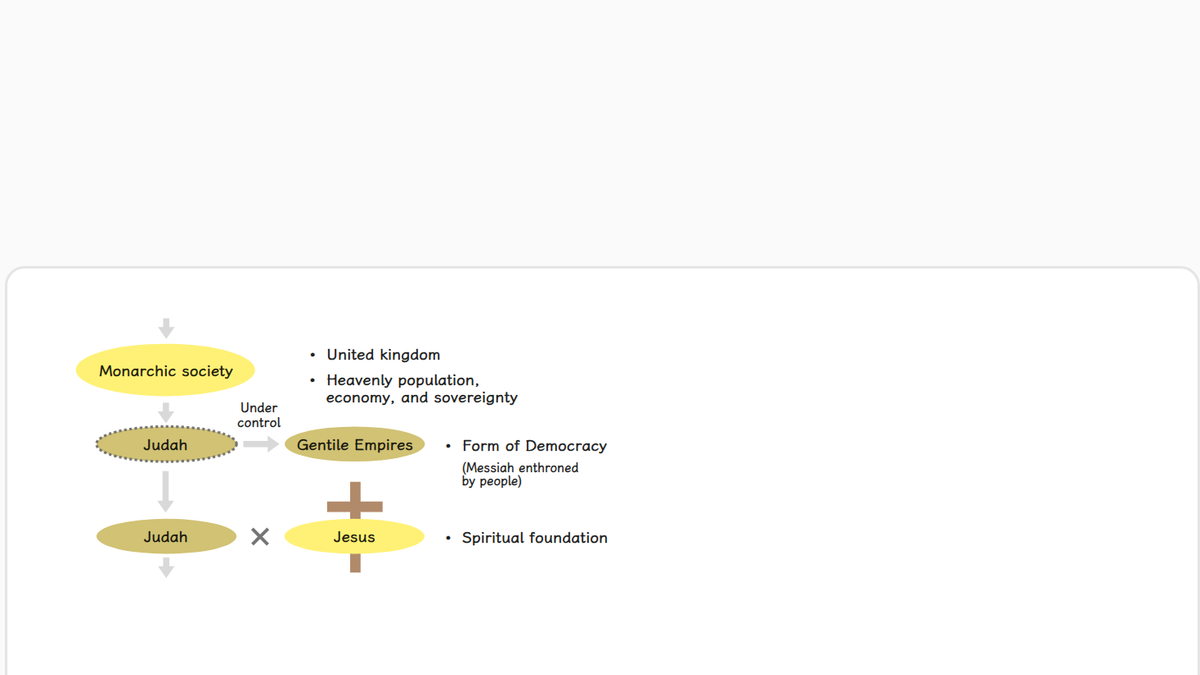
- The monarchic society amalgamated the smaller units of political and economic sovereignty secured by the earlier feudalistic society into a single territory with a large population, a strong economy and a well-defended sovereignty.
- This was done with the establishment of the united kingdom of Israel founded by King Saul.
- After the fall of Judah, God kept the throne of Israel vacant and put the Jewish people under the control of successive gentile empires including Greece.
- God fashioned Israel's society in the form of Greek democracy in order that when the Messiah came, he could be enthroned by the will of the people.
- However, the Jewish public crucified Jesus. Consequently, the purpose of the providence was attained only spiritually.
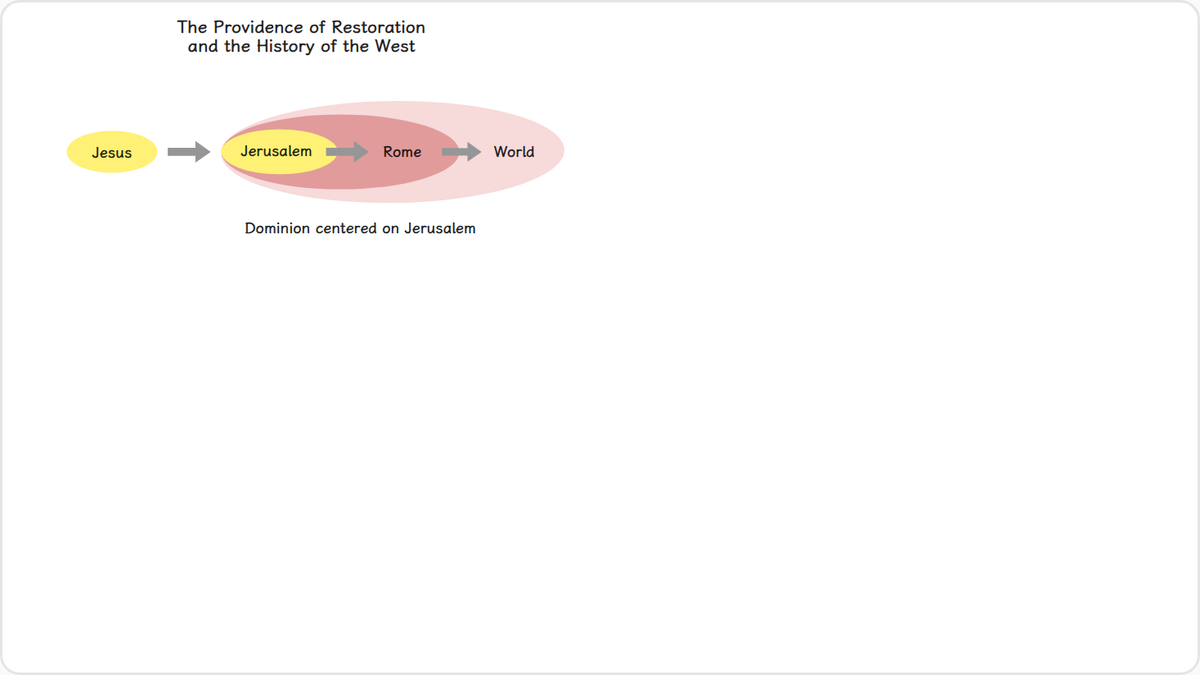
- Had the Jewish people believed in Jesus as the Messiah and united with him, the Roman Empire would have been won over by Jesus during his lifetime.
- Jesus would have been honored throughout the empire as the King of Kings. He would have established a worldwide dominion with Jerusalem as its capital.
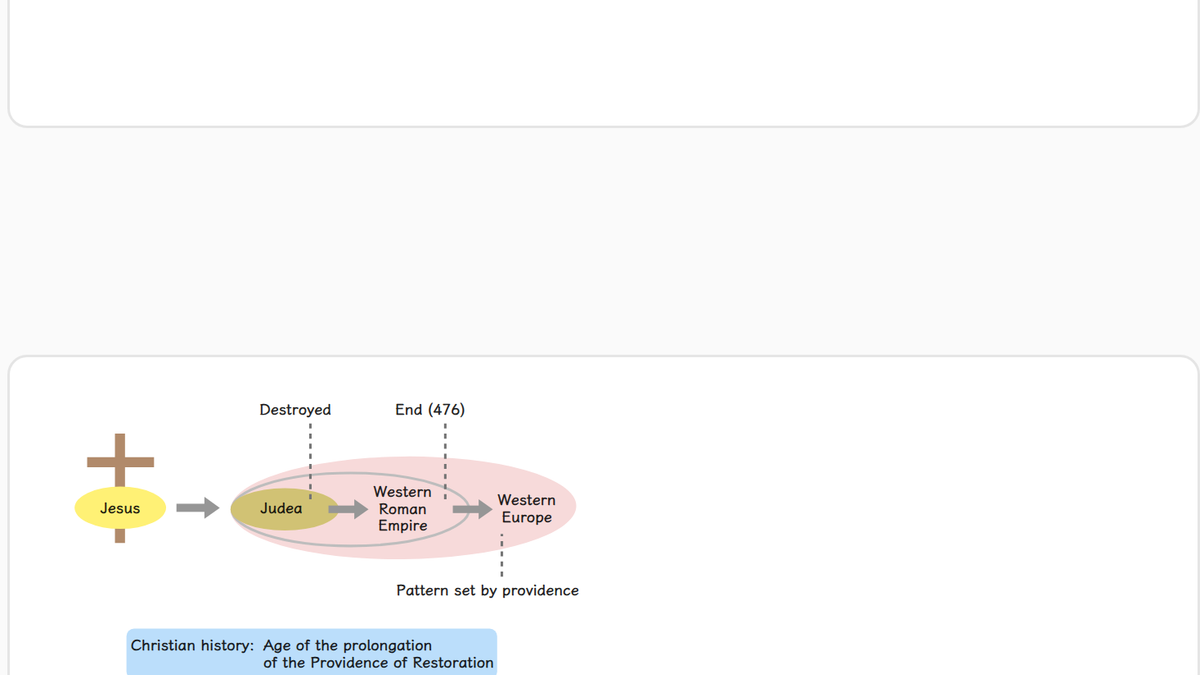
- Because the Jewish people disbelieved, Judea was destroyed and the Western Roman Empire came to an end in 476 A.D.
- The center of God’s providence of restoration shifted from Judea, the land of God’s bitter grief, to Western Europe, formerly the territory of the Western Roman Empire.
- Accordingly, the spiritual providence of restoration based on Christianity has been conducted primarily in Western Europe.
- Only in Western Europe has the history of this era progressed strictly according to the pattern set by the providence of restoration.
- Hence, the Christian history in Western Europe provides us with information about the events which shaped the Age of the Prolongation of the Providence of Restoration.
- Like science, economic activities deal with the practical world. Indeed, economic progress bears a close relationship to the development of science.
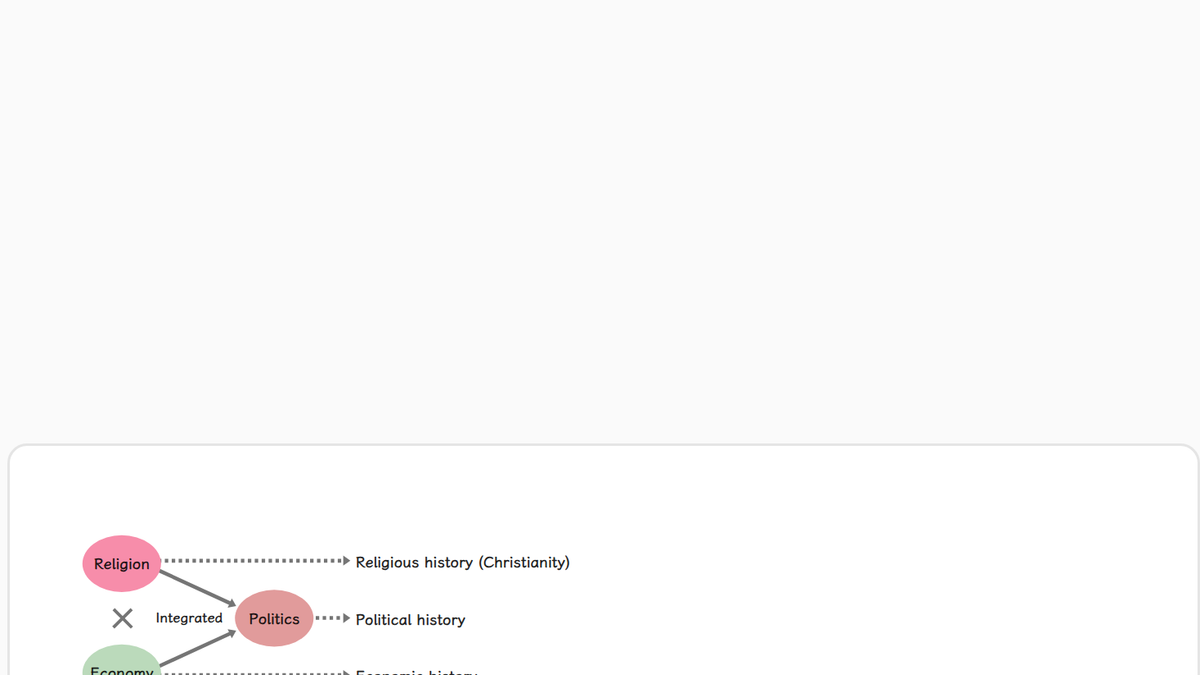
- Accordingly, religious history, based on the internal development of God’s providence, and economic history, based on the external development of His providence, have taken divergent directions and have progressed at different rates.
- Although religion and economy, like religion and science, seem to develop at variance with each other, they are related in the life of society.
- Religion and economy are integrated with our life in society through politics.
- Western political history has pioneered a path through which to harmonize religion and economy.
- Therefore, to accurately grasp the progress of history as it moves toward the goal of the providence of restoration, we must also investigate separately the history of politics.
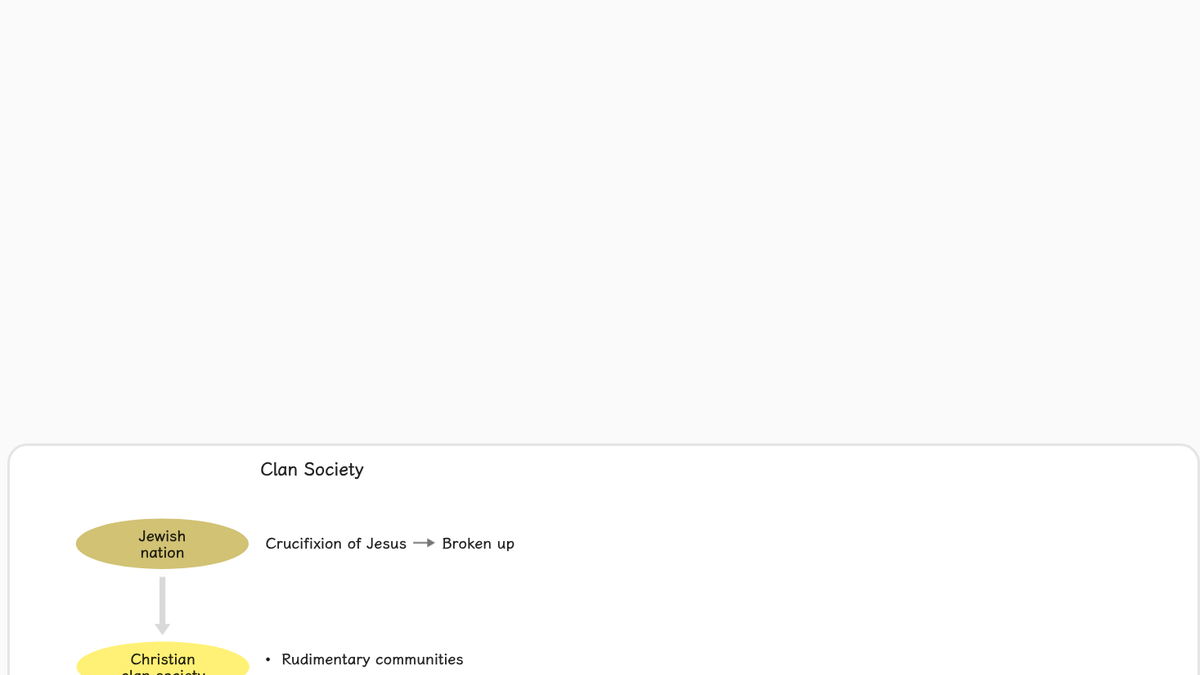
- With the crucifixion of Jesus, the Jewish nation had fallen to Satan’s side.
- Consequently, God broke up that society, calling devout believers out of it to establish a Christian clan society.
- Christian clan society was composed of rudimentary communities with little or no structured political or economic system. In this period, religion, politics and economics did not progress independently.
- Despite severe persecution, Christian clan society gradually prospered in the Roman Empire around the Mediterranean Sea and developed into a Christian tribal society.
- Christian society expanded greatly as Christianity was brought to the Germanic peoples who migrated into this territory in the latter half of the fourth century.
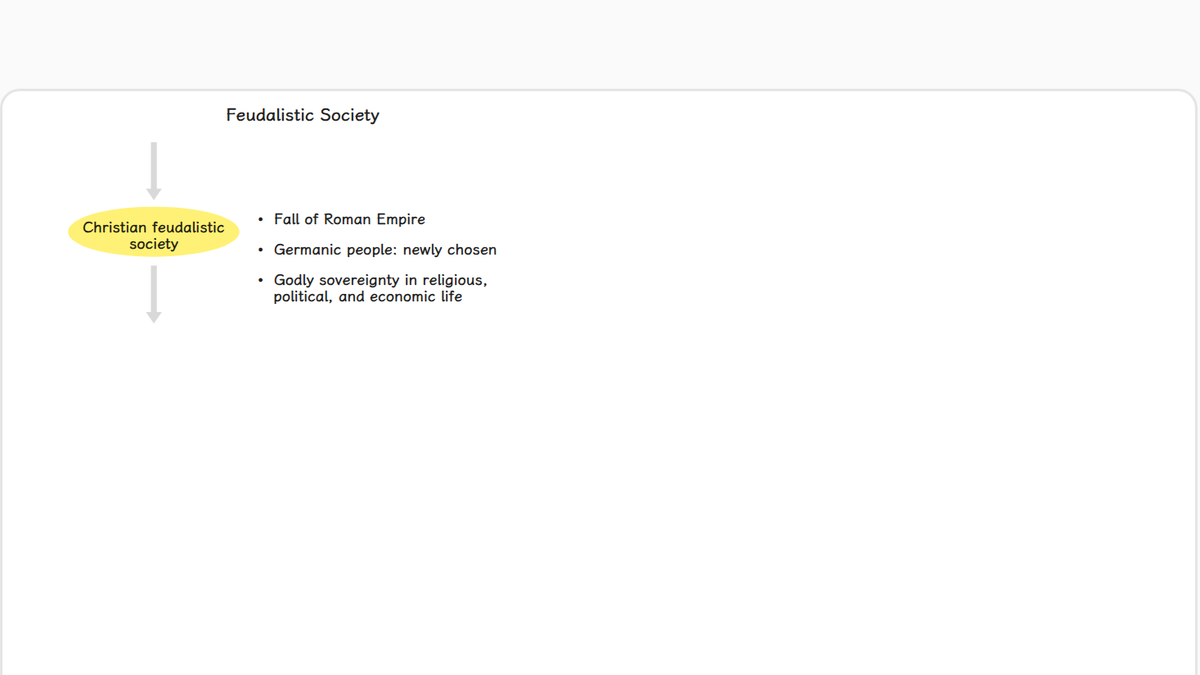
- A feudalistic society was born in Europe when, around the fall of the Roman Empire, imperial authority waned and the empire sank into chaos.
- God raised a feudalistic society among the newly-Christianized Germanic peoples whom He had chosen to lead the providence.
- By strengthening small units under godly sovereignty in the spheres of religious, political and economic life, God laid the groundwork to establish a godly kingdom.
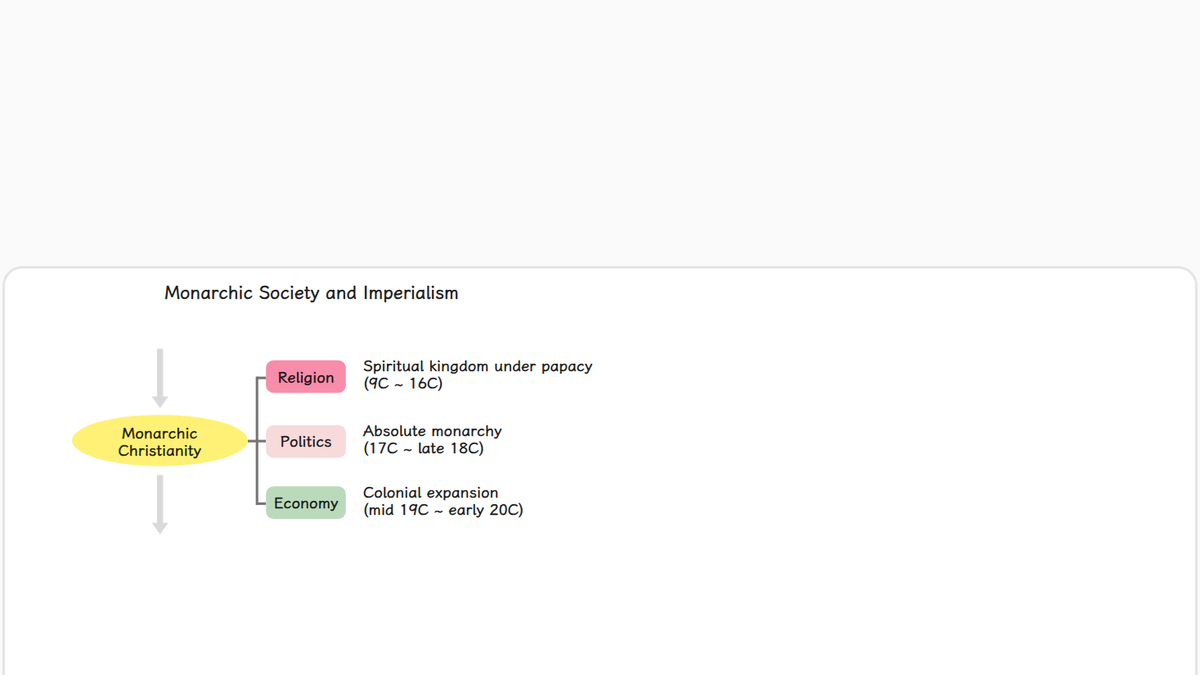
- In the sphere of religion, monarchic Christianity was a spiritual kingdom which transcended national borders.
- It was established under the rule of the papacy and upon the spiritual foundation for the Messiah.
- With the decline of feudalism at that time, the previously decentralized powers of the feudal lords came to be concentrated in the hands of kings of large nation-states.
- In the political sphere, absolute monarchies flourished until the French Revolution in 1789.
- In the progress of economic history, feudalism was followed by capitalism, which was accompanied by the age of colonial expansion. Monopolizing finances and capital was the goal of powerful capitalists.
- Capitalism arose concurrently with the rise of absolute monarchy in the 17th century and flourished during and after the Industrial Revolution.

- God began a process that would eventually tear down monarchic societies and raise up democracies in their place in order to commence a new providence for rebuilding a sovereign nation fit to receive the Messiah.
- The progress of history in the religious sphere moved to the stage of democratic Christianity after monarchic Christianity was shattered by the Protestant Reformation of 1517.
- Through the Reformation, democratic forces within Christianity dismantled the spiritual kingdom over which the papacy had commanded sole authority.
- In the political sphere the democratic movements which rose against the absolute monarchies of the seventeenth and eighteenth centuries gave rise to revolutions in England, America and France, giving birth to today’s democratic societies.
- With the progress of economic history, socialist ideals arose which undermined imperialism and fostered a democratic form of economy.
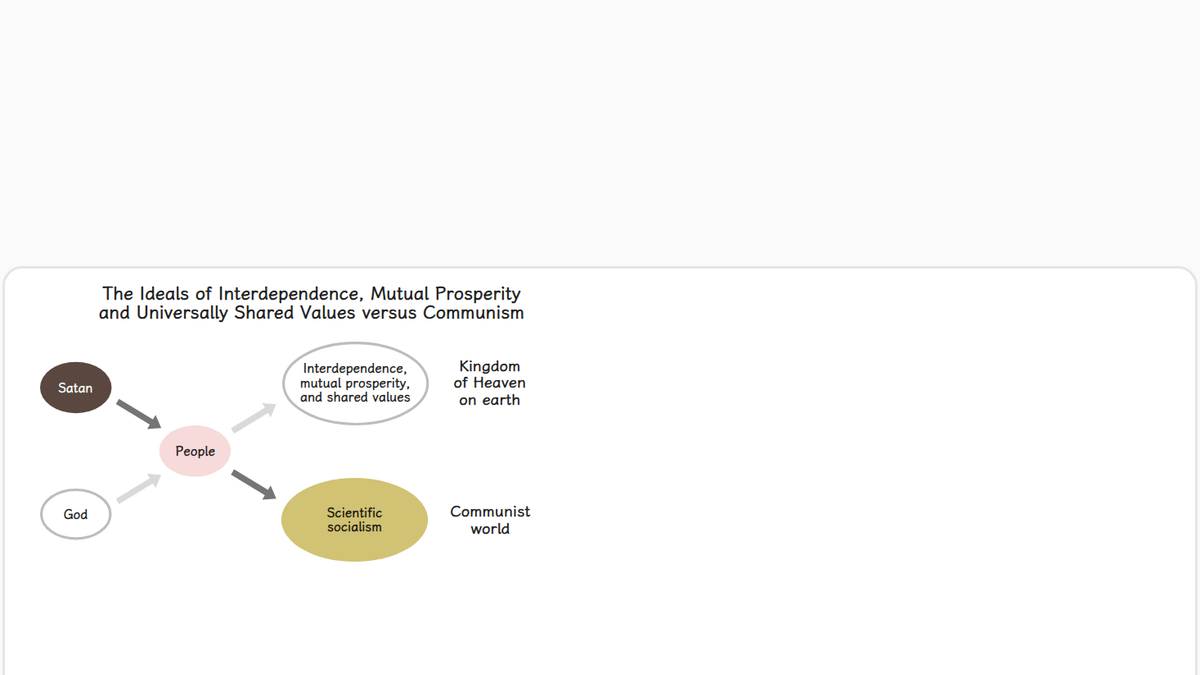
- In seeking for a socialistic society on Heaven’s side, people’s original mind has drawn them to the ideals of interdependence, mutual prosperity and universally shared values.
- The world in which these ideals will finally be realized is none other than the Kingdom of Heaven on earth, under the leadership of the returning Christ.
- Since Satan mimics God’s providence in advance, the satanic side has advocated “scientific socialism” based on the theories of dialectical and historical materialism and has built the communist world.
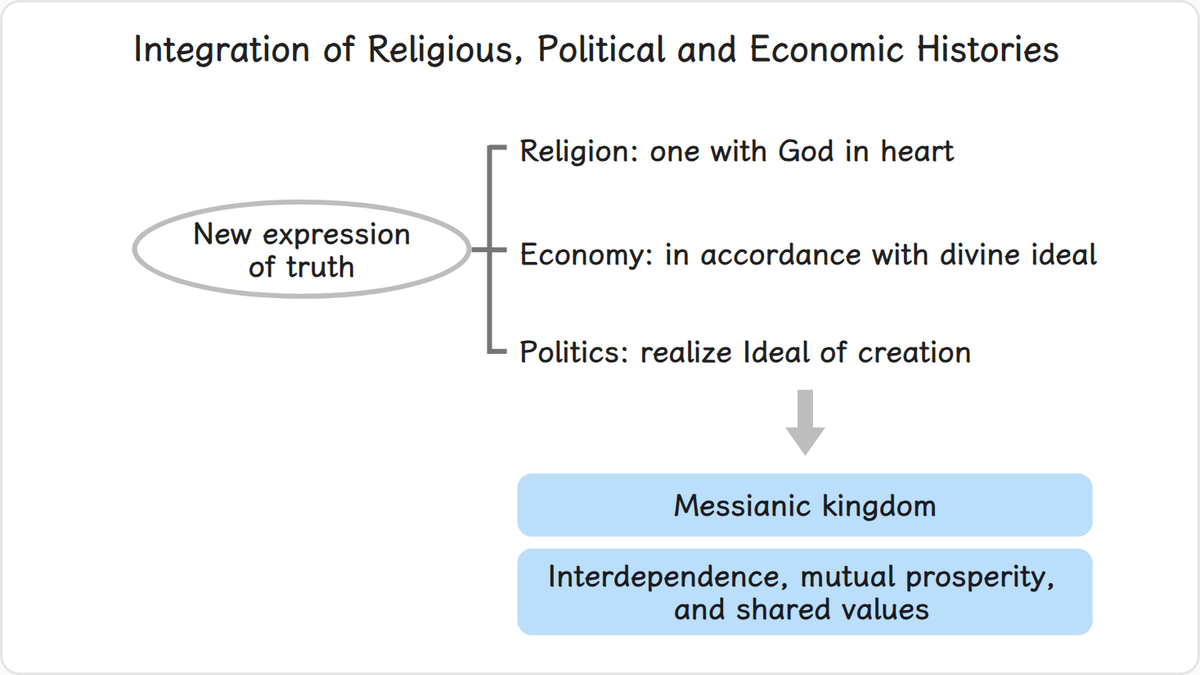
- How can religion, politics and economy, which have progressed separate paths, come together at one point at the consummation of providential history to lay the foundation for the Second Advent of Christ?
- For the paths of religion, politics and economy to converge and realize God’s ideal, a new expression of truth must emerge which can completely integrate religion and science.
- The religion founded upon this truth will lead all of humanity to become one with God in heart.
- Such people will build an economy in accordance with the divine ideal. These will be the foundations for a new political order which can realize the ideal of creation.
- This will be the messianic kingdom built on the principles of interdependence, mutual prosperity and universally shared values.