The Providence to Lay the Foundation for Restoration
The Providence to Lay the Foundation for Restoration
The Providence of Restoration in Adam’s Family
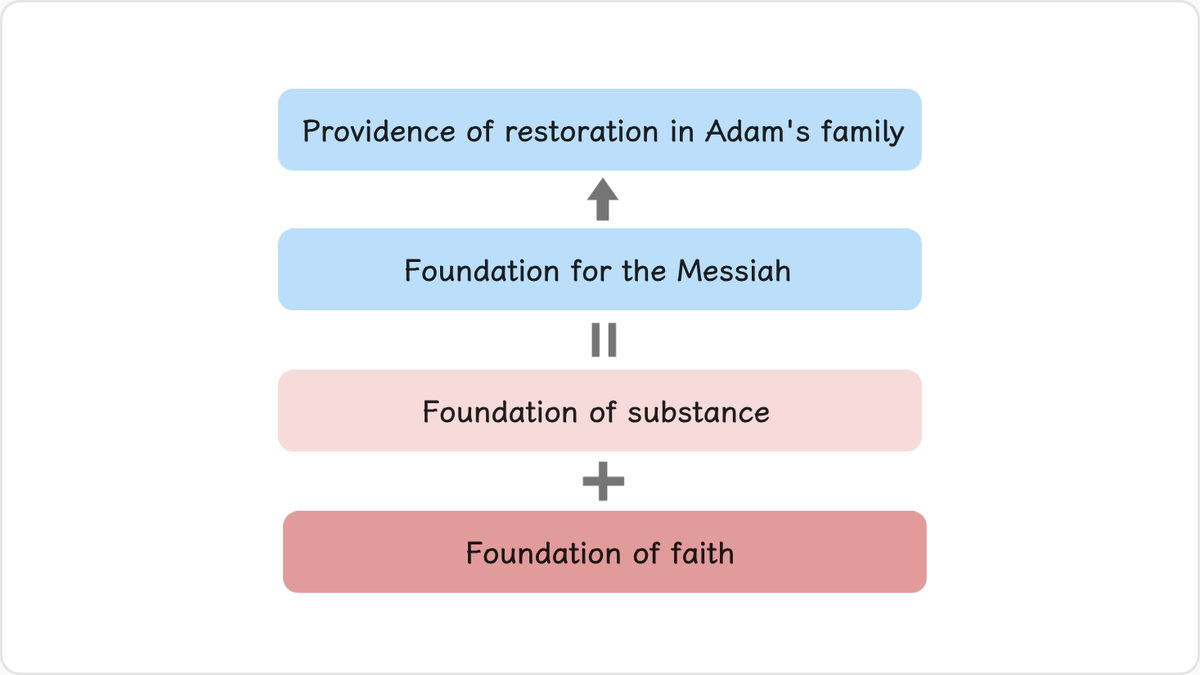
- God immediately began His providence to restore fallen people by having Adam’s family lay the foundation for the Messiah.
- For the providence of restoration to be accomplished in Adam’s family, the members of his family had to make certain conditions of indemnity to restore the foundation of faith and the foundation of substance.
- On these two foundations, the foundation for the Messiah was to be established, and the Messiah could have come to Adam’s family.
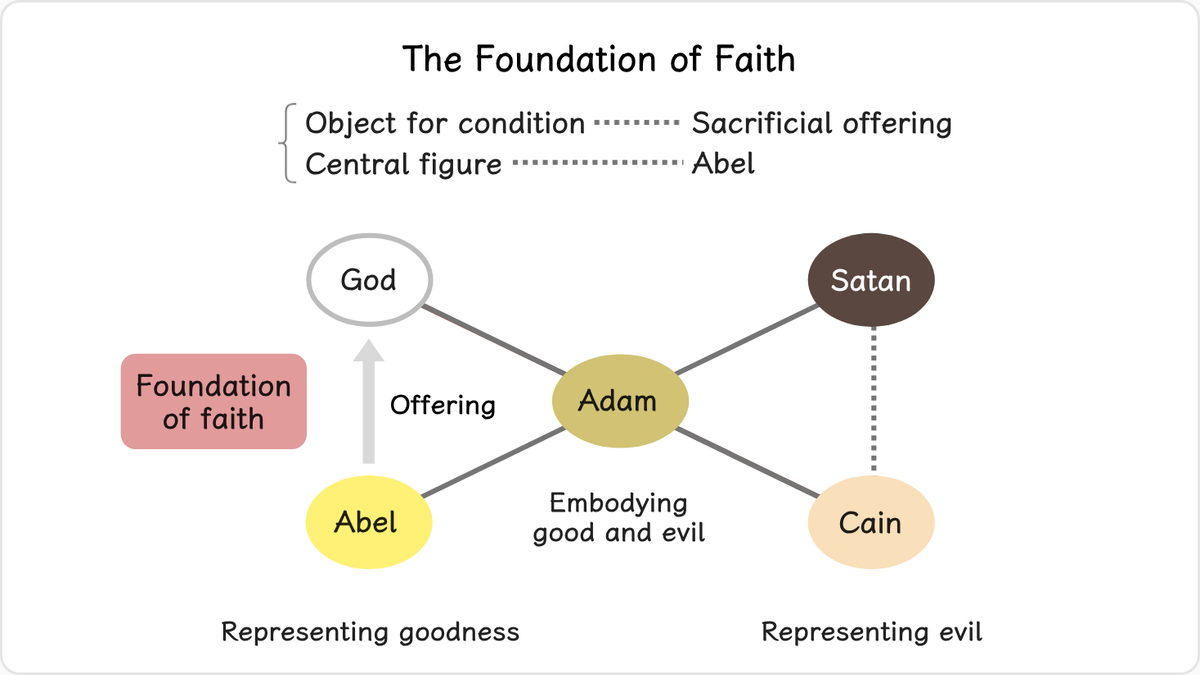
- To restore through indemnity the foundation of faith, fallen people must set up an object for the condition, substituting for God’s Word. For Adam’s family, this object was a sacrificial offering.
- To restore the foundation of faith, there must also be a central figure.
- One would expect that the central figure in Adam’s family be Adam himself.
- Yet nowhere in the biblical record do we find Adam offering a sacrifice. Instead, his sons Cain and Abel offered them. What was the reason for this?
- God symbolically divided Adam, who embodied both good and evil, by giving him two sons, representing good and evil.
- God set them in positions where each dealt with only one master, God or Satan, and had them offer sacrifices separately.
- Cain was chosen to represent evil. Therefore, he was in a position to relate with Satan.
- Abel was chosen to represent goodness. Therefore, he was in a position to relate with God.
- Abel stood in a proper relationship with God and made the offering in a manner acceptable to Him (Heb. 11:4).
- In this way, Abel successfully laid the foundation of faith in Adam’s family.
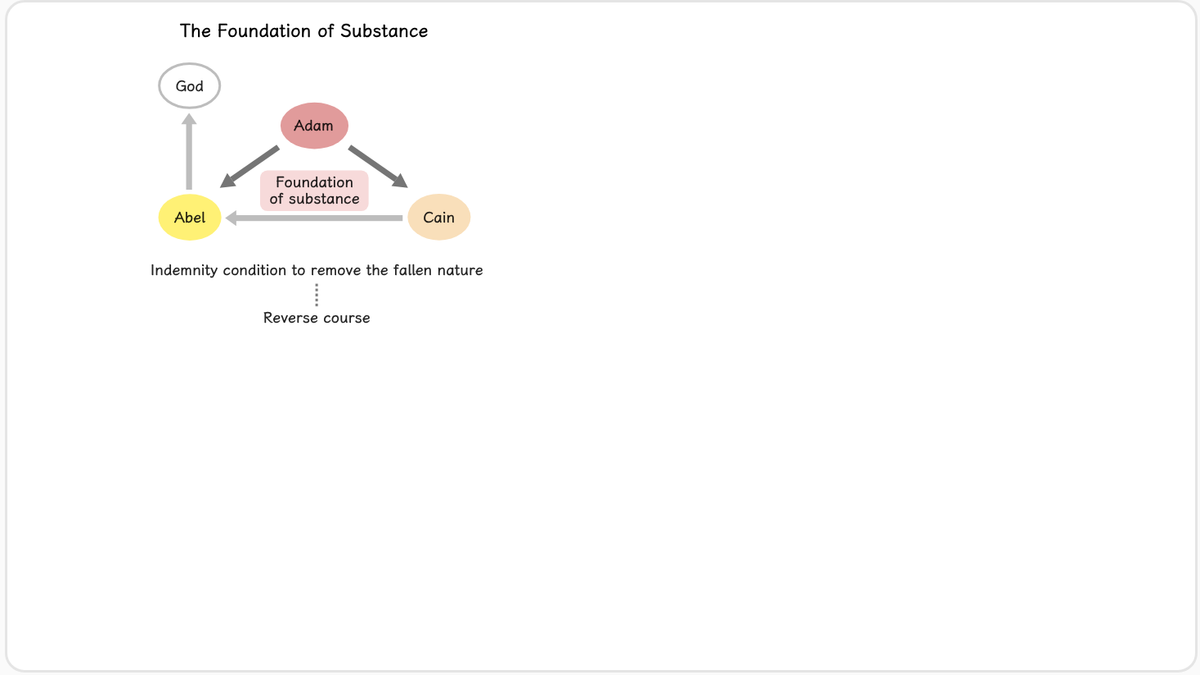
- Had Cain fulfilled the indemnity condition to remove the fallen nature, God would have gladly accepted his sacrifice.
- The foundation of substance would then have been laid in Adam’s family.
- To remove the fallen nature, a person must make an indemnity condition by taking a course which reverses the process through which human beings initially acquired the fallen nature.

- The Archangel fell because he did not love Adam; rather, he envied Adam, who was receiving more love from God than he.
- This was the cause of the first primary characteristic of the fallen nature: failing to take God’s standpoint.
- The Archangel fell because he did not respect Adam as God’s mediator and did not receive God’s love through him; rather, he attempted to seize Adam’s position.
- This was the cause of the second primary characteristic of the fallen nature: leaving one’s proper position.
- The Archangel fell when he claimed dominion over Eve and Adam, who were his rightful lords.
- This was the cause of the third primary characteristic of the fallen nature: reversing dominion.
- The Archangel conveyed to Eve his evil will. Eve in turn conveyed this evil will to Adam and led him to fall.
- This was the cause of the fourth primary characteristic of the fallen nature: multiplying evil.
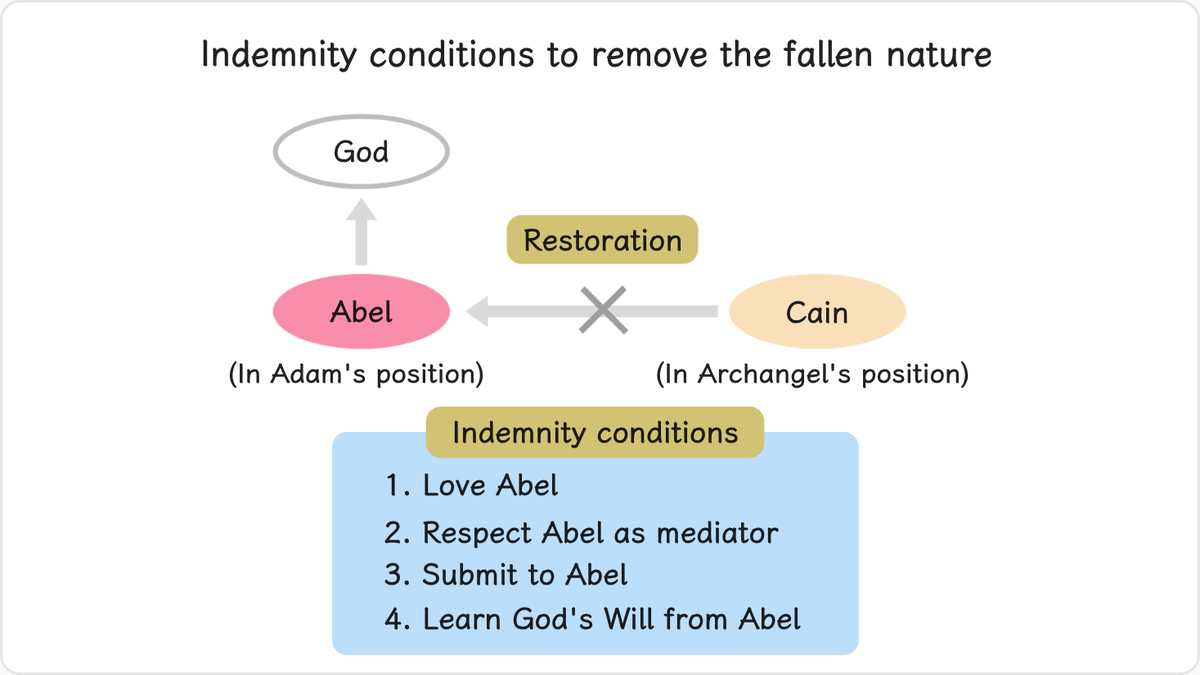
- To remove these characteristics of the fallen nature:
- First, Cain, who stood in the Archangel’s position, should have taken God’s standpoint by loving Abel, who stood in Adam’s position.
- Second, Cain should have received God’s love through Abel, who stood in Adam’s position, respecting him as God’s mediator.
- Third, Cain should have obediently submitted to Abel, accepting Abel’s dominion.
- Fourth, Cain should have been receptive to the intentions of Abel, who stood closer to God, and learned God’s Will from him.
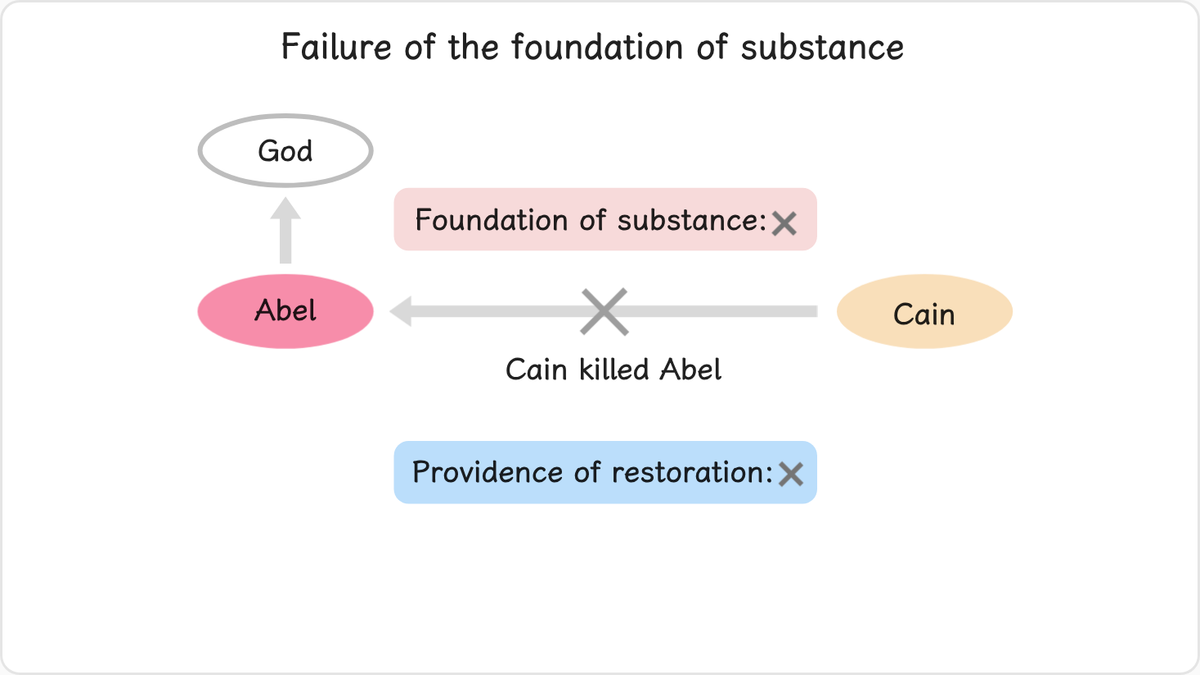
- If Cain had yielded to Abel and thus fulfilled the indemnity condition to remove the fallen nature in Adam’s family, they would have established the foundation of substance and restored the family foundation for the Messiah.
- Instead, Cain killed Abel. In murdering Abel, Cain repeated the sin of the Archangel. That is, he re-enacted the very process which had given rise to the primary characteristics of the fallen nature.
- Adam’s family thus failed to lay the foundation of substance.
- Consequently, God’s providence of restoration through Adam’s family could not be fulfilled.
- The foundation of faith is restored by making an acceptable symbolic offering, and the foundation of substance is established by making an acceptable substantial offering.
- The purpose for making the symbolic offering of all things is, first, to fulfill an indemnity condition for the restoration of the natural world to its original relationship with God,
- and second, to fulfill an indemnity condition for the symbolic restoration of human beings.
- The substantial offering means fulfilling the indemnity condition to remove the fallen nature. This is essential for the actual restoration of human beings.
- When a person in Cain’s position honors the person in Abel’s position and sets him above himself as an offering, they fulfill the indemnity condition to be restored as good children.
- At the same time, it is also reckoned as the indemnity condition for the restoration of their parents.
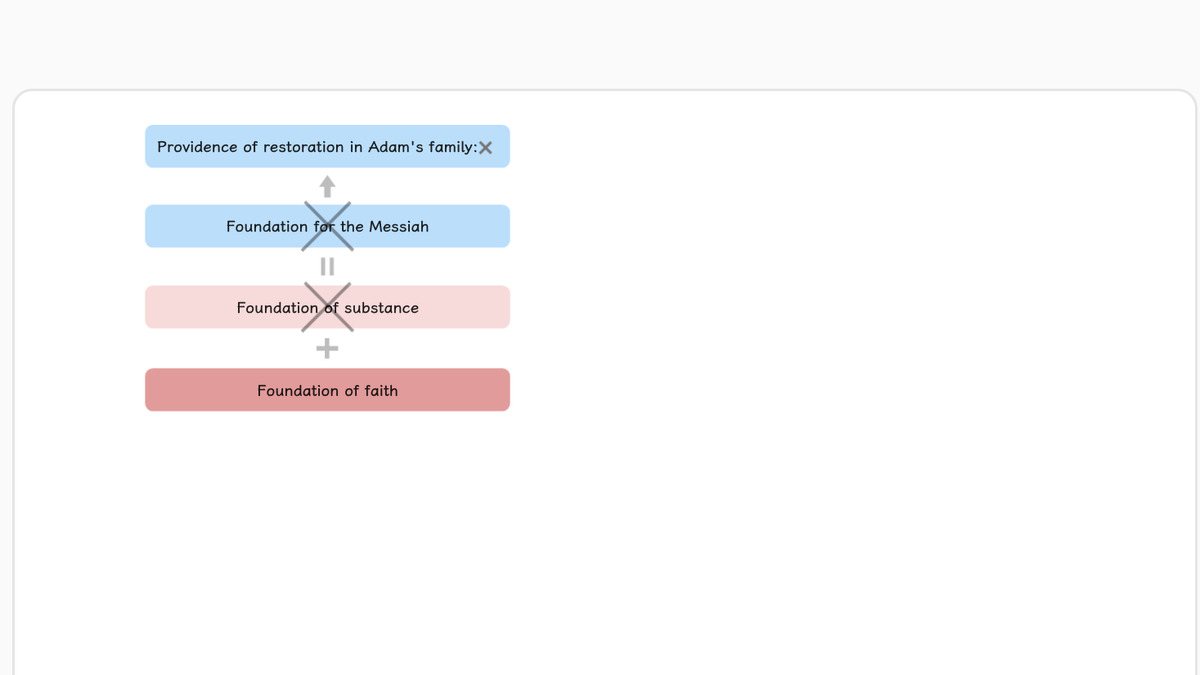
- When Abel made his sacrifice in a manner acceptable to God, he fulfilled the indemnity condition to restore Adam’s foundation of faith and firmly secured his position as the central figure of the substantial offering.
- However, when Cain murdered Abel, they failed to make the substantial offering.
- Hence, neither the foundation of substance nor the foundation for the Messiah could be established.
- God’s providence of restoration in Adam’s family came to naught.

- First, the failure of God’s providence of restoration in Adam’s family teaches us something about God’s conditional predestination of the accomplishment of His Will,
- and His absolute respect for the human portion of responsibility.
- From the time of creation, God predestined that His Will be accomplished based on the combined fulfillment of God’s portion of responsibility and the human portion of responsibility.
- God could not instruct Cain and Abel on how to properly make their sacrifices because it was their portion of responsibility that Cain make his sacrifice with Abel’s help.
- Second, even after Cain killed Abel, God began a new chapter of His providence by raising Seth in Abel’s place.
- This shows us that God has absolutely predestined that His Will shall one day be fulfilled,
- even though His predestination concerning individual human beings is conditional.
- Third, through the offerings of Cain and Abel, God teaches us that fallen people must constantly seek for an Abel-type person.
- By honoring, obeying and following him, we can accomplish God’s Will even without understanding every aspect of it.
The Providence of Restoration in Noah’s Family
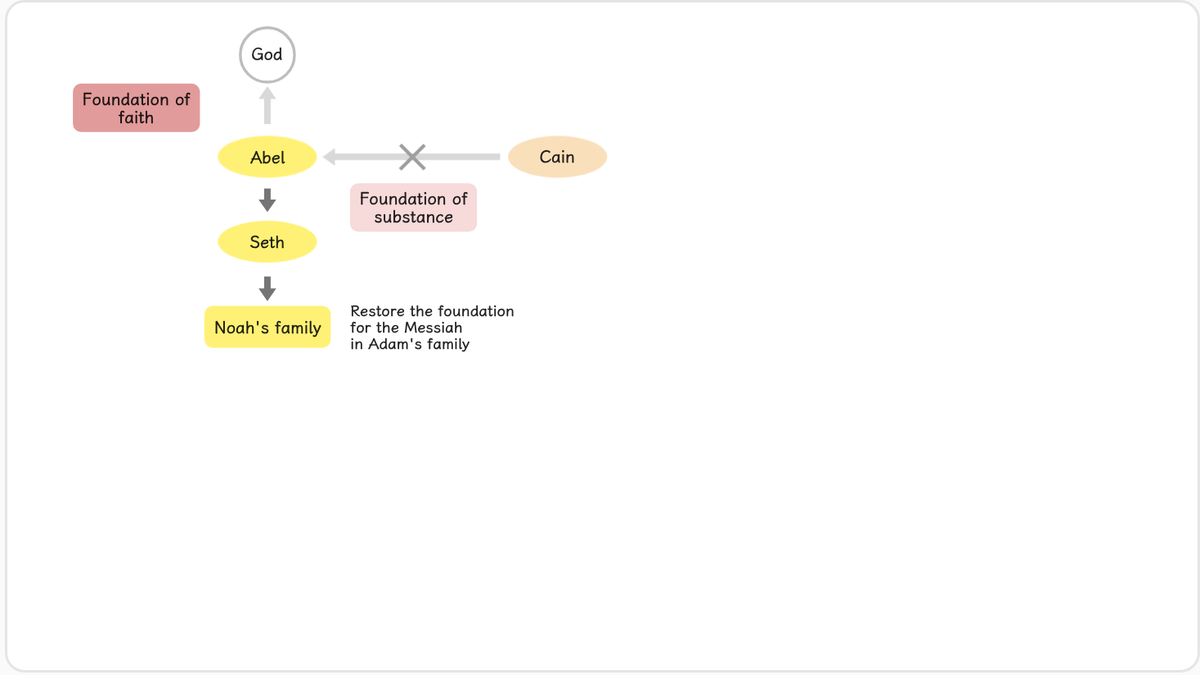
- Cain killed Abel, thereby preventing the providence of restoration in Adam’s family from being accomplished.
- Nevertheless, God had predestined absolutely the fulfillment of the purpose of creation, and His Will remained unchangeable.
- Hence, upon the foundation of the loyal heart which Abel demonstrated toward Heaven, God chose Seth in his place.
- From among Seth’s descendants, God chose Noah’s family to substitute for Adam’s family and commenced a new chapter in His providence.
- It is written that God judged the world by the flood: “And God said to Noah, ‘I have determined to make an end of all flesh; for the earth is filled with violence through them; behold, I will destroy them with the earth'”.
- This shows us that Noah’s time was the Last Days.
- Noah’s family was responsible to fulfill the indemnity condition to restore the foundation of faith,
- and then the indemnity condition to restore the foundation of substance.
- They were to restore through indemnity the foundation for the Messiah, which Adam’s family had failed to lay.

- In the providence of restoration through Noah’s family, Noah was the central figure to restore the foundation of faith.
- God called Noah 10 generations or 1600 biblical years after Adam.
- Noah was the second ancestor of humanity.
- Noah worked for 120 years on a mountain to build the ark in absolute obedience to God’s instructions.
- He was called by God upon the foundation of Abel’s loyal and faithful heart.
- Noah was a descendant of Seth, who had been chosen to replace Abel.
- Furthermore, Noah was a righteous man in the sight of God (Gen. 6:9).
- For these reasons, he was qualified to make the symbolic offering to God.
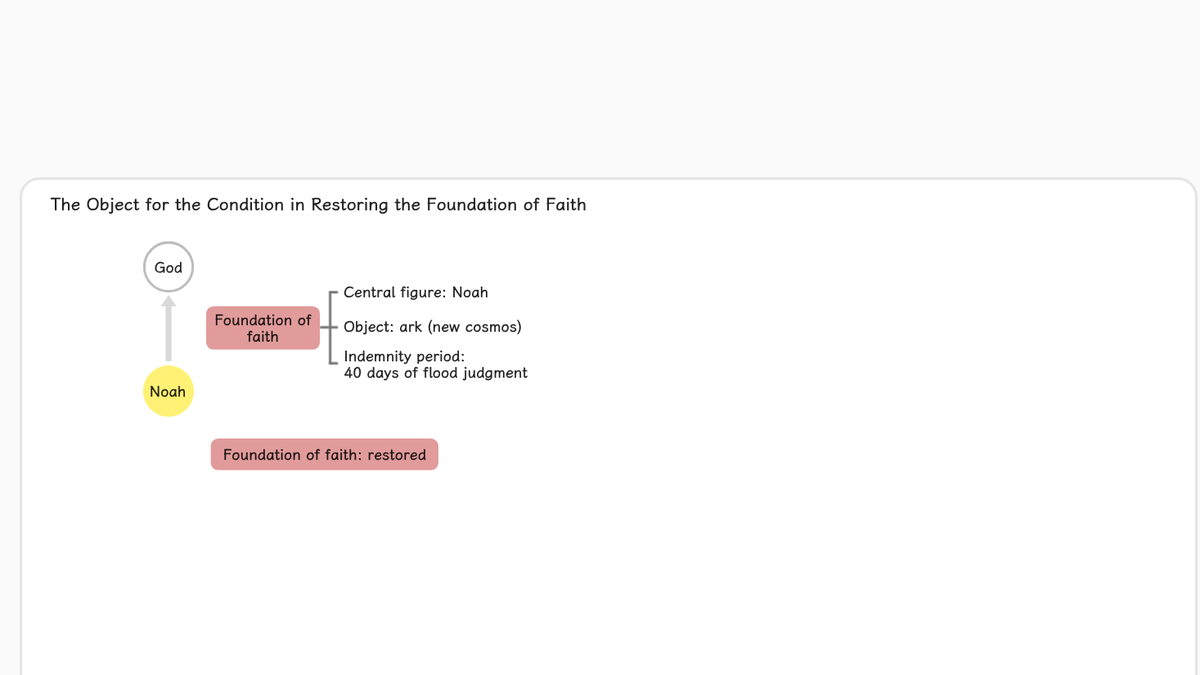
- The object for the condition by which Noah was to restore the foundation of faith was the ark.
- It was an indemnity condition for the restoration of the cosmos, which had been lost to Satan due to Adam’s fall, and signified the new cosmos.
- After the ark was completed, God judged the world with the flood for 40 days.
- Its purpose was to eliminate sinful humanity in order to raise up a family who would relate only with Him.
- Noah's family, with the judgement of 40 days, could restore through indemnity the foundation by fulfilling the dispensation of the ark which was an object for the condition restoring the foundation of faith exactly as God had intended.
- Noah successfully restored through indemnity the foundation of faith by fulfilling the dispensation of the ark and thereby making a symbolic offering acceptable to God.
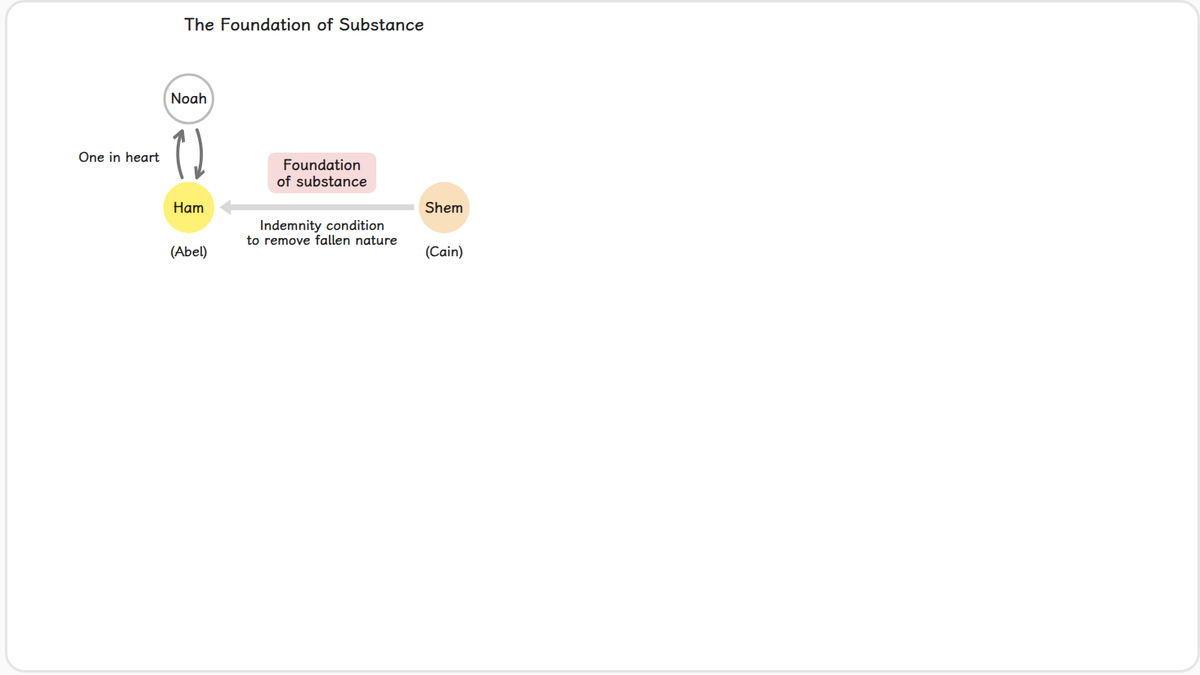
- Upon this foundation, Noah’s sons, Shem and Ham, were then to have stood in the position of Cain and Abel, respectively.
- Had they then succeeded in the substantial offering by fulfilling the indemnity condition to remove the fallen nature, they would have laid the foundation of substance.
- For Noah’s family to make an acceptable substantial offering, Ham, Noah’s second son, was to restore the position of Abel, Adam’s second son.
- In the case of Noah’s family, it was Noah, not Ham, who made the symbolic offering.
- Therefore, for Ham to stand in the position of Abel, as one who has succeeded in making the symbolic offering, he had to become inseparably one in heart with his father, Noah.

- Let us examine how God worked to help Ham become one in heart with Noah.
- The Bible reports that when Ham saw his father lying naked in his tent, he felt ashamed of Noah and stirred up the same feelings in his brothers, Shem and Japheth.
- Adam and Eve before the Fall were close in heart and innocently open with each other and with God; as it is written, they were not ashamed of their nakedness. Yet after they fell, they felt ashamed of their nakedness.
- When Ham felt ashamed of his father’s nakedness and acted to cover it up, he made a condition for Satan to enter; hence his feeling and act constituted a sin.
- Consequently, Ham could not restore through indemnity the position of Abel from which to make the substantial offering.
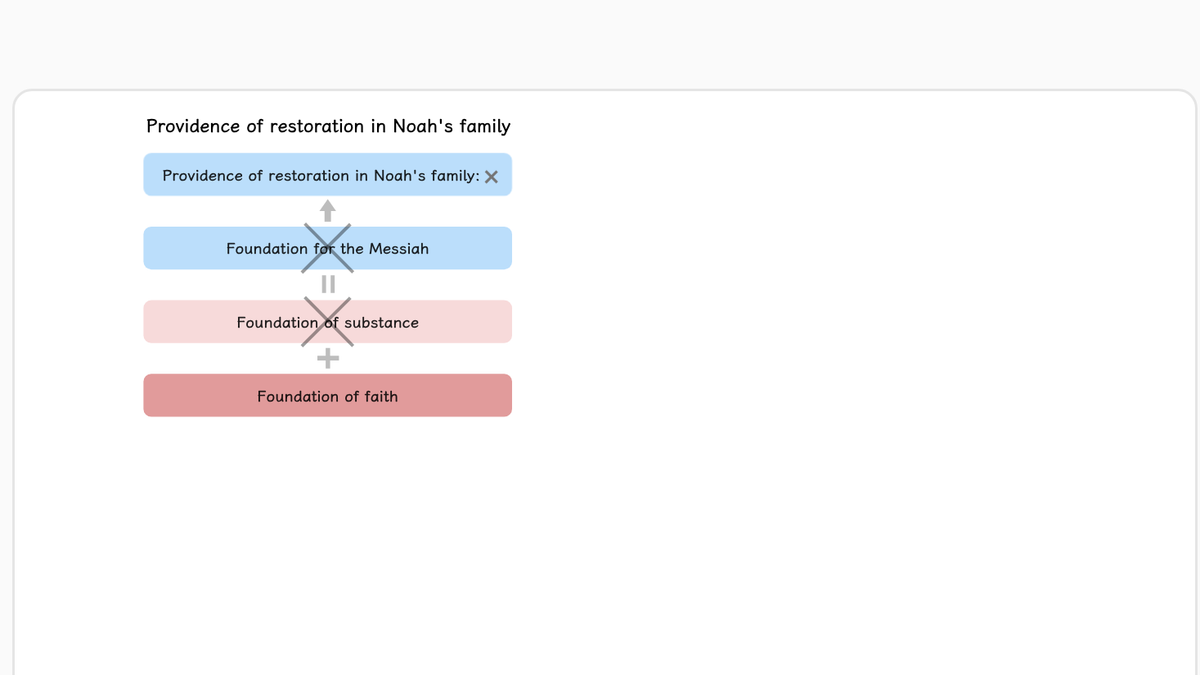
- Since Ham could not establish the foundation of substance,
- the providence of restoration in Noah’s family ended in failure.
The Providence of Restoration in Abraham’s Family
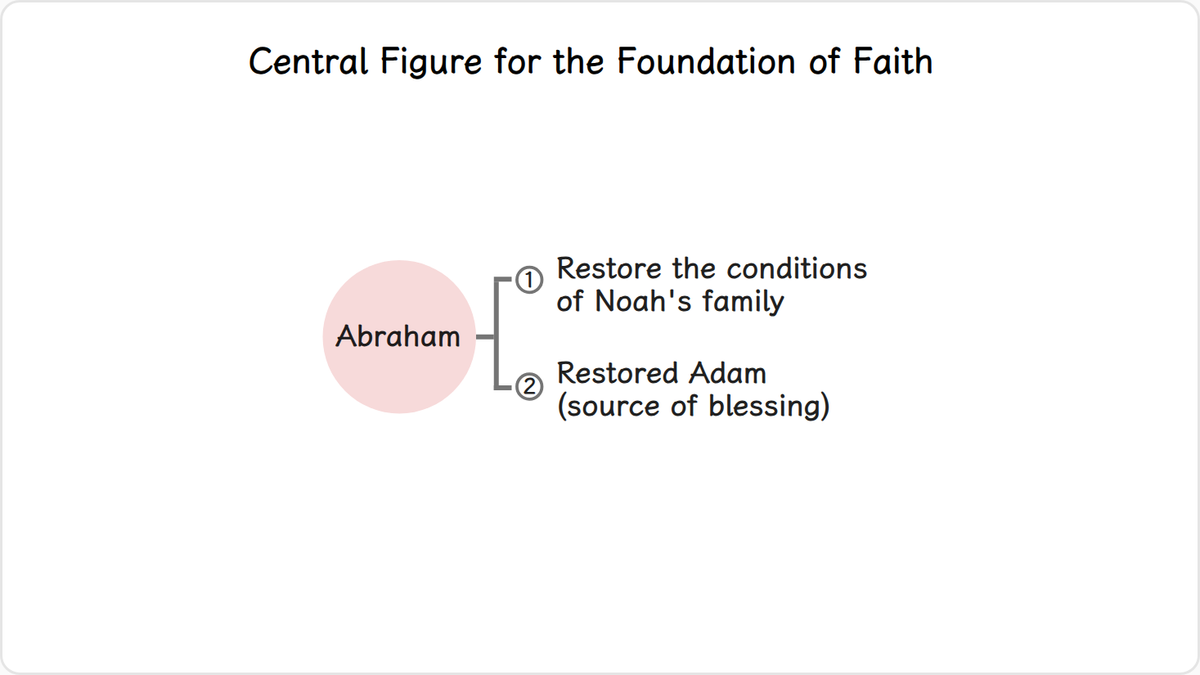
- In the providence of restoration in Abraham’s family, the central figure to restore the foundation of faith was Abraham.
- Abraham was to restore through indemnity all the conditions which had been given to Noah to fulfill, but which were lost to Satan due to Ham’s sin.
- Abraham was to inherit the mission of Noah and thus the mission of Adam. In this capacity, he represented restored Adam.
- As God had blessed Adam and Noah, God also blessed Abraham to make a great nation and be a source of blessing (Gen. 12:2).
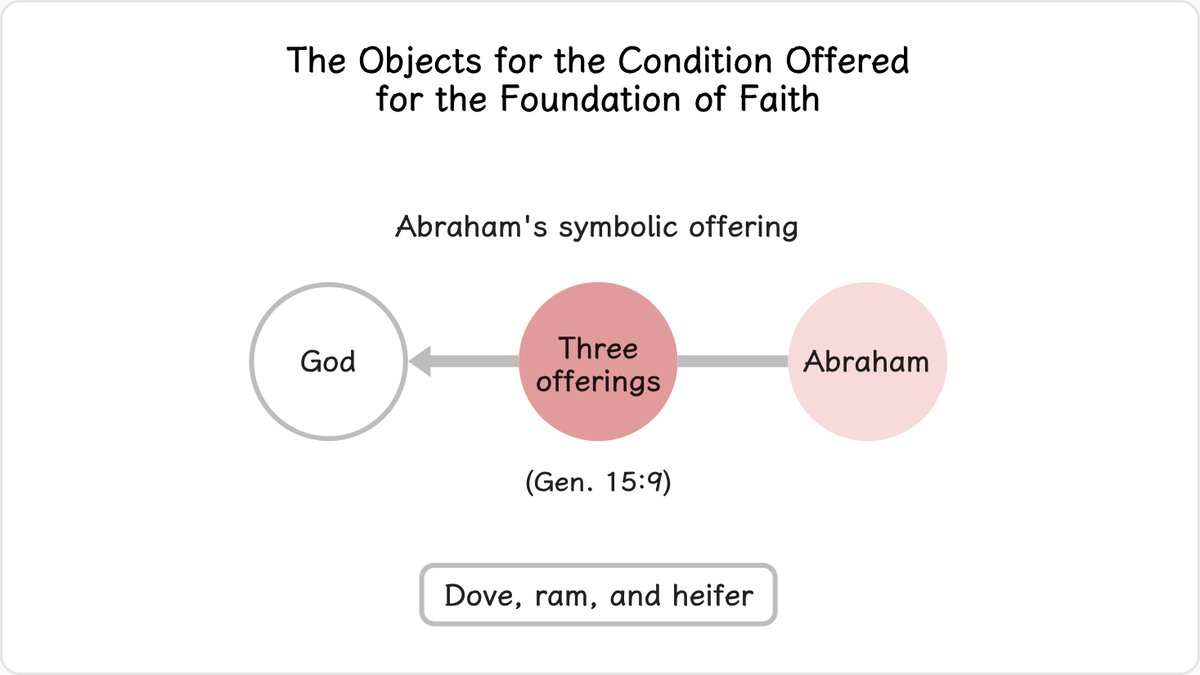
- God commanded Abraham to offer a dove and a pigeon, a ram and a goat, and a heifer (Gen. 15:9).
- These were the objects for the condition which he offered to restore the foundation of faith.
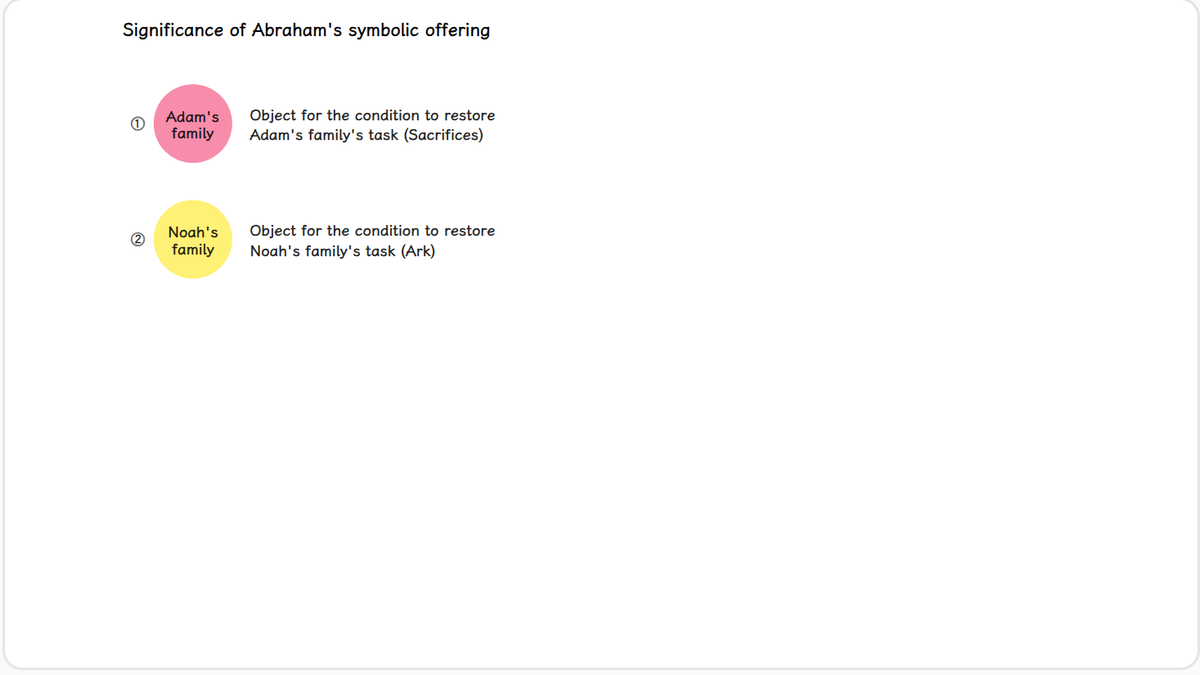
- For Abraham to become the father of faith, he had to restore through indemnity the position of Noah and Adam.
- Abraham was thus required to offer in an acceptable manner objects for the condition to restore all that Cain and Abel were supposed to accomplish through their sacrifices,
- and all that Noah’s family was trying to accomplish through the dispensation of the ark.

- Abraham offered three types of objects as the condition for his symbolic offering.
- First, a dove and a pigeon; second, a ram and a goat; and third, a heifer.
- These three sacrifices symbolized the cosmos,
- which was completed through the three stages of the growing period.
- The dove represented the formation stage.
- The ram represented the growth stage.
- The heifer represented the completion stage.
- Why did Abraham place the three sacrifices on one altar?
- Abraham, now in the position of Adam, was supposed to restore, all at once, the long providence which God had conducted through the three providential generations
- of Adam (formation), Noah (growth) and Abraham (completion).
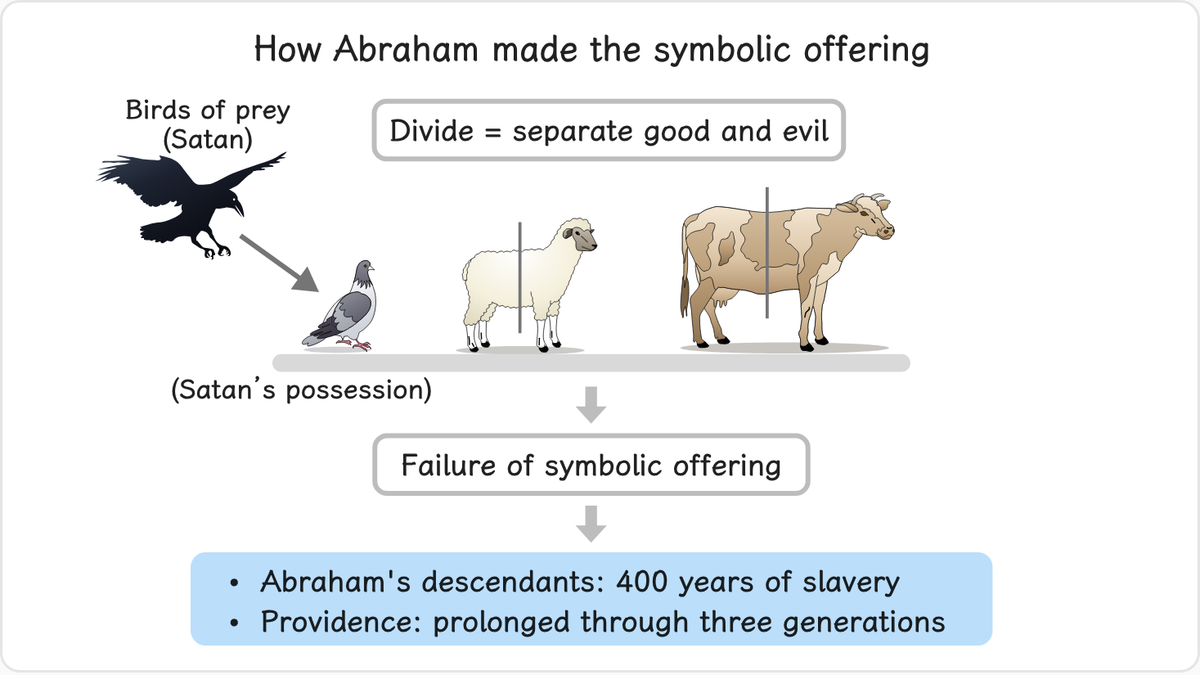
- Because Abraham did not cut the dove and pigeon in two as he should have, birds of prey came down and defiled the sacrifices.
- His mistake had the effect of acknowledging Satan’s claim of possession over them.
- Through this failure in the symbolic offering, all the conditions God intended to restore through it were lost.
- As a consequence, Abraham’s descendants had to suffer oppression and slavery for 400 years in the land of Egypt.
- Consequently, the providence centered on Abraham was prolonged through the three generations of Abraham, Isaac and Jacob.
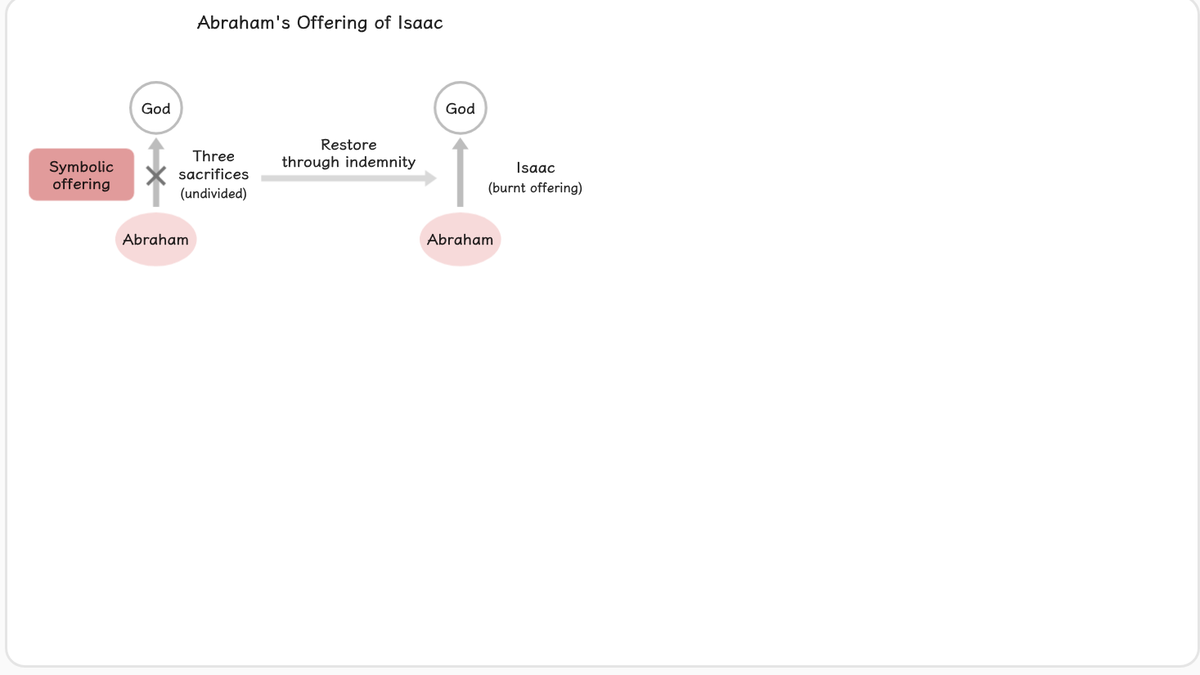
- After Abraham failed in the symbolic offering, God commanded him to sacrifice his only son Isaac as a burnt offering.
- In this way, God began a new dispensation for the purpose of restoring through indemnity Abraham’s failure.
- According to the principle of predestination, when someone fails to complete his responsibility, God does not use him a second time.
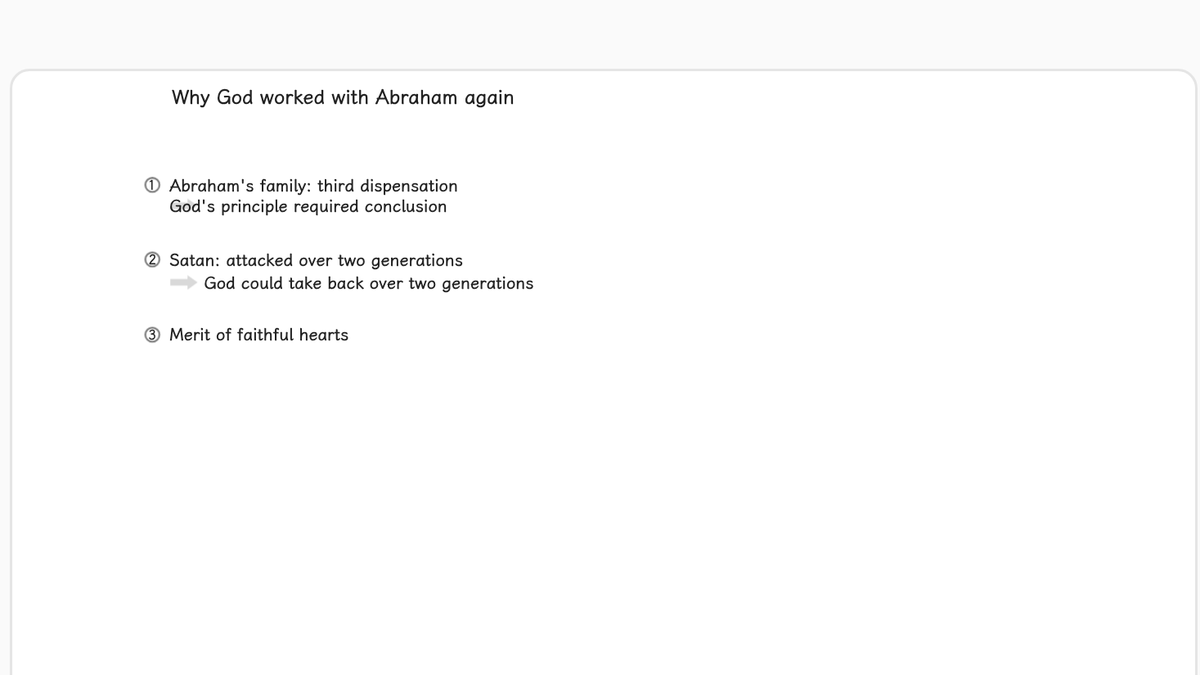
- Why, then, did God work with Abraham again when he had him offer Isaac?
- First, the number three represents completion.
- Since the providence to lay the foundation for the Messiah in Abraham’s family was the third dispensation, God’s Principle required that it conclude this time.
- Second, Satan had attacked both Adam and his son Cain, defiling the family over the course of two generations.
- Hence, according to the principle of restoration through indemnity, God could work to take back Abraham and his son Isaac over the course of two generations.
- Third, even though Abraham failed, God could raise him up and give him another chance to make an offering based on the accumulated merit of Abel’s and Noah’s faithful hearts.
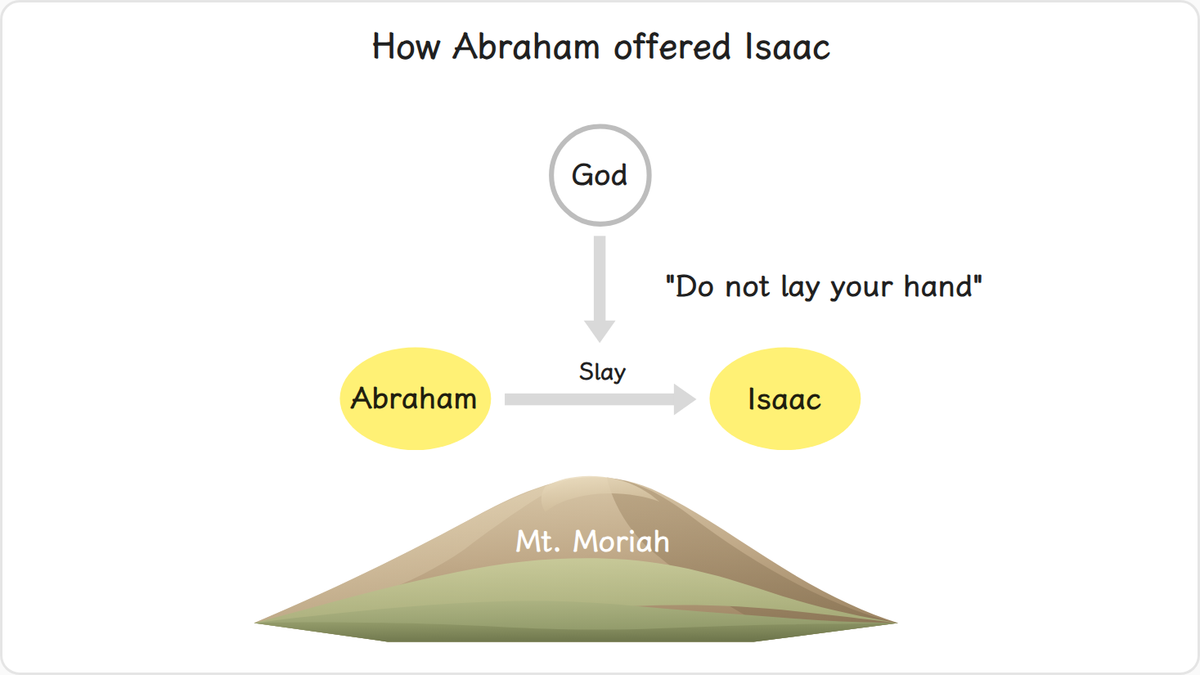
- How did Abraham offer Isaac?
- Abraham put forth his hand, and took the knife to slay his son. But the angel of the Lord called to him from heaven,
- and said, “Do not lay your hand on the lad or do anything to him; for now I know that you fear God...” (Gen. 22:9-12).

- Abraham’s zeal to do God’s Will and his resolute actions, carried out with absolute faith, obedience and loyalty,
- lifted him up to the position of already having killed Isaac. Therefore, he completely separated Satan from Isaac.
- Because Abraham succeeded in his offering of Isaac, the providence of restoration in Abraham’s family could be carried on by Isaac.
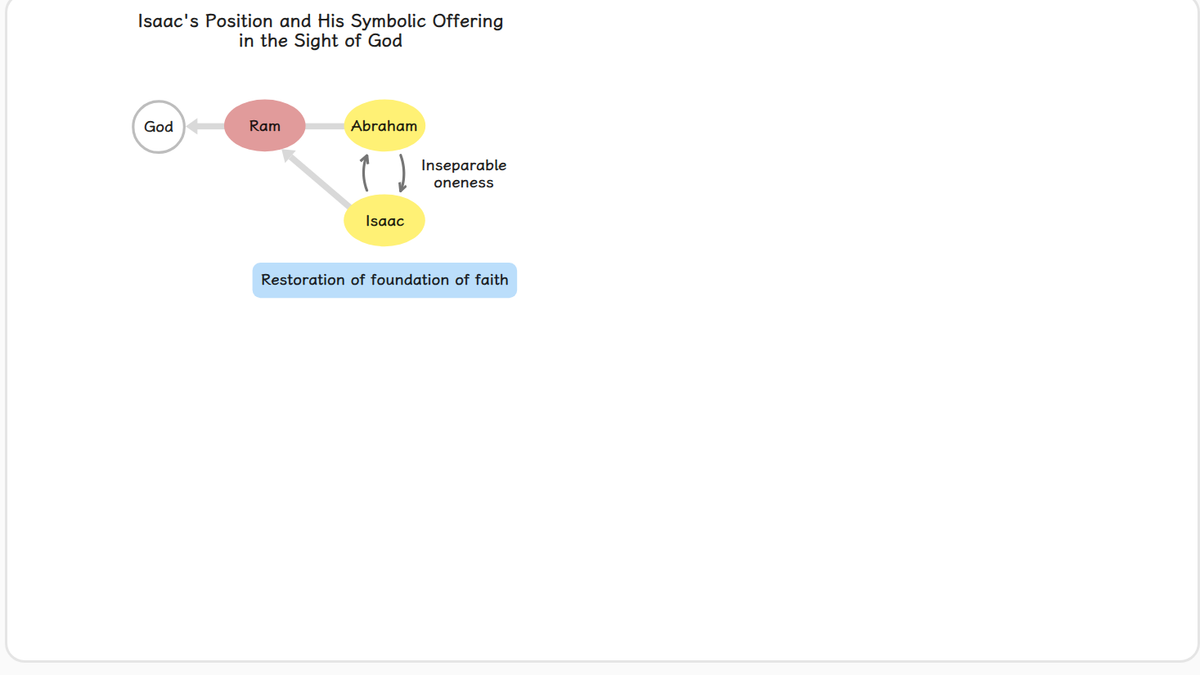
- Through the success of Isaac's offering, Abraham and Isaac attained inseparable oneness in their fidelity to God’s Will.
- After the divine mission had passed from Abraham to Isaac, Abraham offered the ram provided by God as the substitute for Isaac.
- In fact, this was the symbolic offering by which Isaac restored the foundation of faith.
- In this way, Isaac, having inherited Abraham’s mission, made the symbolic offering and restored through indemnity the foundation of faith.
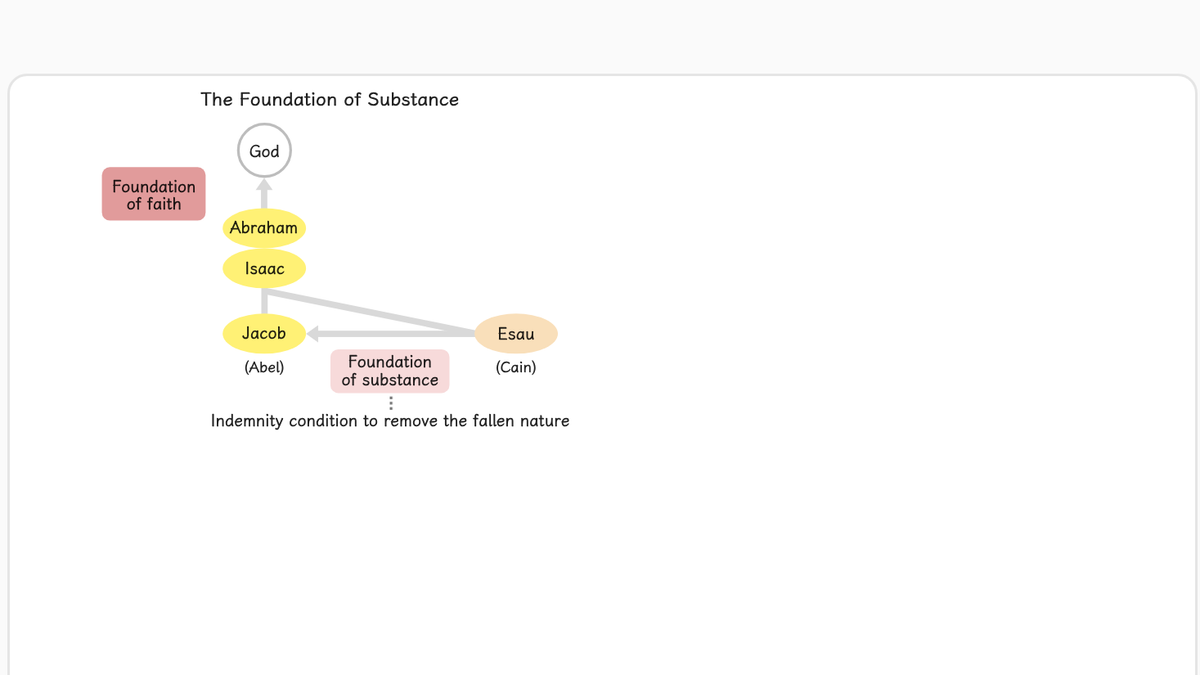
- To establish the foundation for the Messiah in Isaac’s family, the foundation of substance had to be laid next.
- For this purpose, Isaac’s sons, Esau and Jacob, had to be placed in the divided positions of Cain and Abel respectively.
- By making the substantial offering, they were responsible to fulfill the indemnity condition to remove the fallen nature and lay the foundation of substance.

- Before Esau and Jacob could make the substantial offering, Jacob first had to fulfill the indemnity condition to restore the position of Abel.
- First, Jacob fulfilled the condition of victory in the fight to restore on the individual level the birthright of the eldest son.
- Jacob, as the second son, cleverly obtained it from Esau in exchange for some bread and a pottage of lentils.
- Second, Jacob went to Haran, which represented the satanic world.
- After suffering through 21 years of drudgery, he triumphed over Laban in the fight to restore the birthright by gaining family and wealth as his due inheritance.
- Third, on his way back to Canaan, the land of the promised blessing, Jacob triumphed in wrestling with an angel at the ford of Jabbok,
- thereby restoring dominion over the angel in a substantial struggle.
- Through these three victories, Jacob restored through indemnity the position of Abel.
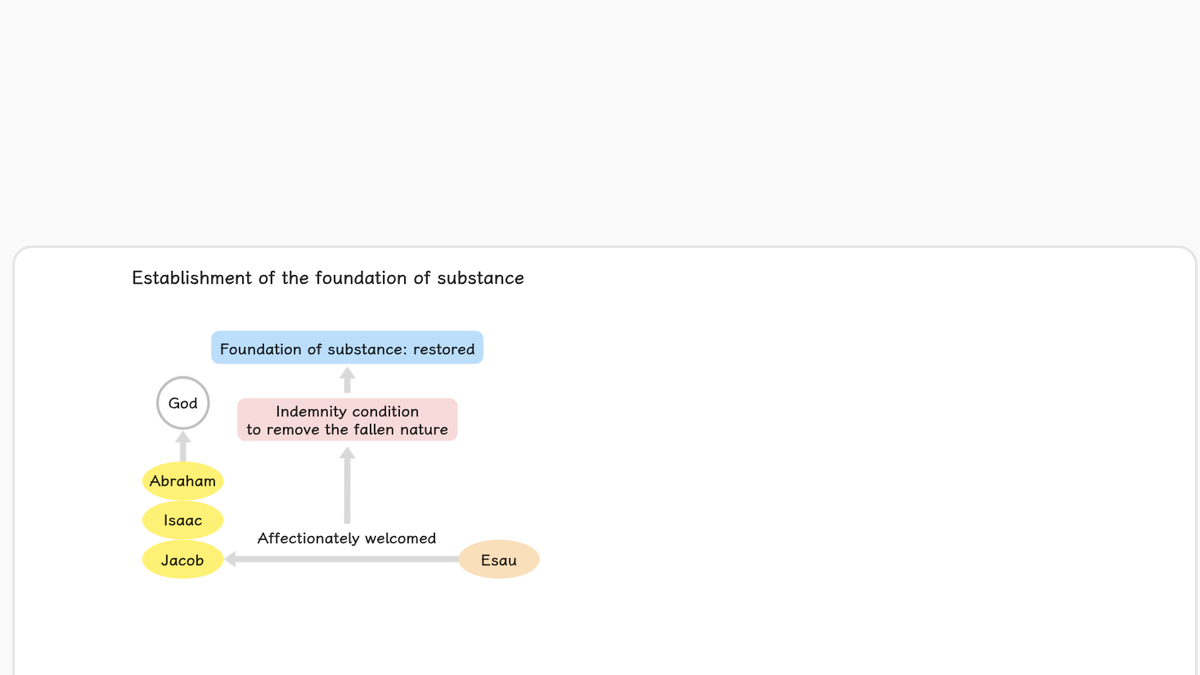
- Esau and Jacob thus secured the positions in which Cain and Abel had stood at the moment when God accepted Abel’s offering.
- For them to fulfill the indemnity condition to remove the fallen nature,
- Esau needed to love Jacob, respect him as his mediator to God, obediently submit to Jacob’s directions, and finally, multiply goodness by inheriting goodness from the bearer of God’s blessing.
- When Esau opened his arms and affectionately welcomed Jacob, they fulfilled the indemnity condition to remove the fallen nature.
- Their victory restored through indemnity, horizontally in one family, the long vertical course of history in which God had been working to restore the foundation of substance.

- At last, the foundation for the Messiah was established. One would expect that the Messiah would have come on the earth at that time.
- However, by Abraham’s time, fallen people had already built up satanic nations which could easily overpower Abraham’s family.
- Hence, the Messiah could not have safely come on that foundation. A foundation of a sovereign state was needed to cope with the nations of the satanic world.
- The foundation for the Messiah established in Isaac’s family became the basis upon which to begin the course of indemnity to establish the national foundation for the Messiah.

- Jacob, as the central figure who laid the foundation for the Messiah in Isaac’s family, was responsible to shoulder Abraham’s sin.
- He was also responsible to embark upon an indemnity course to realize on the national level the Will which had been entrusted to Isaac.
- Therefore, as was the case with Abraham and Isaac, God regarded Abraham, Isaac and Jacob as the same person with respect to His Will, even though they were three different individuals.
- It is written, “I am the God of your father, the God of Abraham, the God of Isaac, and the God of Jacob” (Exod. 3:6).
- This verse indicates that although they were three generations, God regarded as one generation these ancestors who collectively accomplished His Will.

- Jacob triumphed as an individual in his struggle with Esau to win the birthright.
- He entered Haran and, as a family, triumphed in a 21-year struggle with his uncle Laban to win the birthright.
- Jacob was victorious in the fight with the angel. He was the first fallen man to fulfill the indemnity condition to restore dominion over the angel.
- Thereupon, he received the name “Israel” (Gen. 32:28), signifying that he set the pattern and laid the groundwork upon which the chosen people would be established.
- After returning to Canaan with these victories, Jacob won Esau’s heart, and together they fulfilled the indemnity condition to remove the fallen nature.
- Jacob thus victoriously completed the model course to bring Satan to submission.